
Three Key Takeaways
1. The ability to detect organizational drift before it becomes visible
The blog introduces a deeper way of reading execution—not through activity or alignment alone, but through how decisions accumulate, attention flows, and subtle divergence begins to shape outcomes beneath the surface.
2. A more modern lens for understanding execution in distributed organizations
It reframes execution not as a control problem, but as an interpretive system shaped by local judgment, workforce perception, and continuously shifting priorities
3. A deeper understanding of why performance variability is becoming harder to explain
The blog helps leaders recognize that outcomes today are increasingly influenced by cognitive, behavioral, and systemic conditions that traditional management metrics do not fully capture.
Introduction
In many organizations, a quiet shift is underway: even when strategic priorities are clear, execution does not always unfold with the same consistency. This is not a question of capability or intent. It reflects a change in how work gets done. As roles become more judgment-driven and decisions move closer to the point of execution, outcomes are increasingly shaped by how priorities are interpreted across the organization. For CEOs, this introduces a subtle but important challenge—alignment is no longer secured by direction alone; it must be sustained through how that direction is understood and acted upon at every level as part of broader organizational alignment strategies and CEO leadership alignment efforts.
This blog brings together multiple emerging perspectives—on execution, workforce psychology, attention, and organizational behavior—into a single integrated lens. In doing so, it reveals how these forces, often discussed separately, are collectively reshaping how modern organizations function and perform, influencing both executive decision-making and long-term organizational performance strategy.
When Execution Becomes Interpretive: Understanding the New Dynamics of Organizational Alignment Strategies
At its core, this shift is straightforward:
Execution is no longer driven primarily by top-down instruction. It is shaped by decisions made continuously across the organization, reflecting a more distributed execution model and evolving approaches to enterprise decision making.
There was a time when execution followed a more linear path:
Leaders decide → teams follow → outcomes align (more or less)
Today, that path looks different:
Leaders set direction → teams interpret → individuals prioritize → outcomes emerge
The shift from following to interpreting is what defines how execution operates in many organizations today, reshaping both the strategy to execution process and broader business execution strategy outcomes.
What Has Changed in the Strategy to Execution Process
This shift is not the result of a single change; it is unfolding within a broader context. Organizations today are operating in more dynamic and interconnected environments, shaped by geopolitical uncertainty, evolving workforce expectations, and a continued shift toward more inclusive and enabling leadership styles. As leadership moves away from purely directive models toward empowering teams, and as expectations around autonomy and ownership increase across generations, the locus of decision-making naturally becomes more distributed. These forces do not replace how work has changed; they amplify it.
1. Work has become more judgment-driven
Most roles today require ongoing prioritization, real-time trade-offs, and problem-solving in dynamic conditions.
Execution is no longer about completing predefined tasks, but more about deciding, often repeatedly, what deserves attention.
In practice, individuals are constantly asking:
What should I focus on right now?
2. Decision-making has moved closer to the point of execution
To improve speed and responsiveness, organizations have pushed decision-making deeper into the business, closer to teams and individuals.
This has reduced bottlenecks and increased agility, while also reshaping approaches to enterprise decision making.
It has also introduced a new reality:
More decisions made locally = greater variation in how priorities are acted upon.
3. The volume of inputs has expanded significantly
Employees now operate in environments shaped by continuous inputs: digital tools, cross-functional demands, real-time communication, and increasingly, data-driven and AI-supported recommendations.
Even when priorities are clear, attention is fragmented.
Which means individuals are constantly filtering:
What matters most in this moment?
4. Authority no longer guarantees alignment
Direction can be clear, and agreement may be visible, but execution can still diverge.
In practice:
- People may align in principle, but differ in follow-through
- Teams may comply, but interpret priorities in context
- Decisions may be accepted, but not uniformly enacted
Execution, therefore, is not simply directed. It is shaped collectively, often in ways that are not immediately visible, creating new challenges for leadership alignment and executive alignment.
What This Means in Practice
Distributed execution does not imply disorder. It reflects a more complex operating reality:
- Two teams can receive the same direction and act on it differently
- The same individual may prioritize differently under varying pressures
- Work that appears aligned at a strategic level can diverge at the point of action
And most importantly:
No single decision creates this variation in modern business execution strategy.
It is the accumulation of small, context-driven interpretations that ultimately shapes outcomes, influencing both organizational alignment strategies and long-term organizational performance strategy.
What Is Changing Beneath the Surface of Execution
Much of what shapes execution today does not present itself as a clear or immediate problem. It emerges gradually, through patterns that are easy to overlook because work continues and progress appears intact. Looking more closely, however, reveals a set of shifts that are less obvious, but increasingly consequential for how organizations function, influencing both organizational performance strategy and broader approaches to business execution strategy.
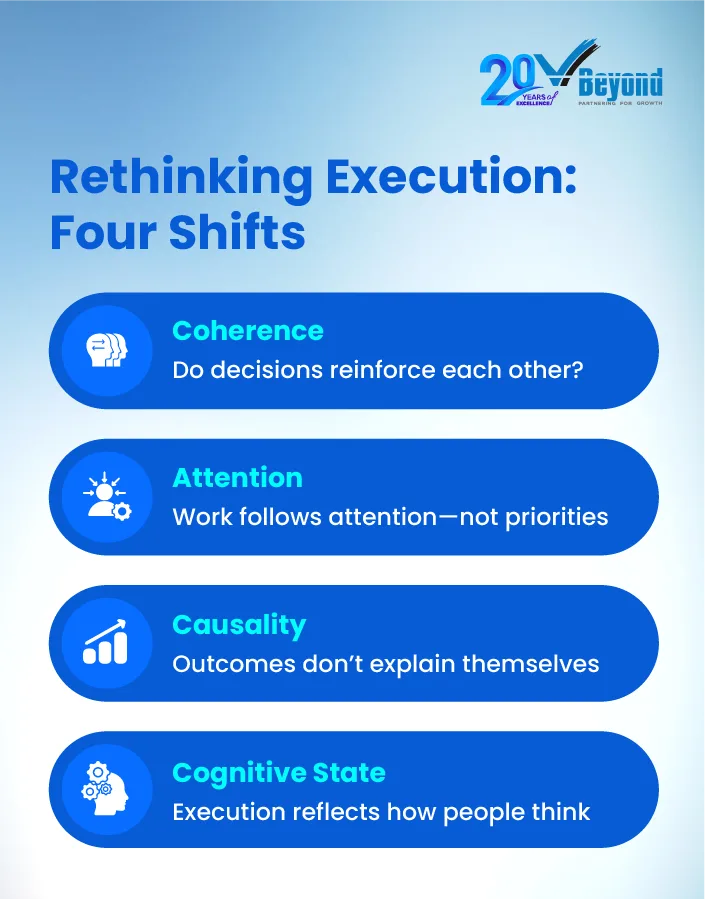
1. The Coherence Problem
The shift toward distributed execution introduces a second-order effect that is easy to miss: even when decisions are reasonable at the local level, they do not automatically reinforce each other at the system level.
This is where coherence begins to break down—not through misalignment in intent, but through misalignment in accumulation.
At any given moment, decisions across the organization are being made against slightly different interpretations of priority:
- one team optimizes for immediacy
- another for completeness
- another for long-term positioning
Each decision is defensible. None of them signal a problem in isolation.
The issue emerges only when these decisions begin to interact.
Instead of compounding, effort starts to interfere:
- progress in one area creates rework in another
- speed in one function introduces constraints in another
- short-term gains dilute longer-term positioning
This is not fragmentation in the traditional sense. The organization is not pulling apart—it is moving forward, but without reinforcing momentum, creating new challenges for leadership alignment and broader organizational alignment strategies.
What makes this difficult to detect is that traditional signals remain intact:
- activity levels are high
- milestones are met
- teams appear aligned in intent
There is no clear failure point. Only a gradual weakening of directional force.
Over time, this produces a distinct pattern: effort scales, but impact does not scale proportionally—not because work is visibly misdirected, but because it is not coherently aligned in how it accumulates. This shifts where alignment needs to be observed.
It is no longer sufficient to assess it at the level of plans, priorities, or communication. Those can remain intact even as coherence weakens.
The more telling signal lies elsewhere:
whether decisions made across the organization are compounding—or quietly offsetting one another.
Because once execution becomes distributed, alignment is not reflected in what is agreed. It is reflected in what accumulates, ultimately influencing long-term organizational performance strategy.
2. The Organization Is Increasingly Shaped by What Captures Attention—Not What Is Declared Important
As execution becomes more distributed, another shift begins to take hold: priorities defined at the strategic level do not always translate into sustained attention at the operational level.
In theory, organizations align around what matters most. In practice, attention is continuously redirected by what is immediate, visible, and actionable.
This creates a subtle but important distinction:
- priorities define intent
- attention determines execution
And the two do not always align.
At any given moment, individuals and teams are navigating a dense flow of inputs:
- messages, dashboards, and updates
- cross-functional requests
- system-generated alerts and metrics
- emerging issues that demand immediate response
Each of these competes for attention. Not equally—but persistently.
Over time, this creates a different operating reality.
Work does not always progress based on strategic importance. It progresses based on what surfaces most consistently in the flow of work.
This is rarely intentional. It is a function of how environments are structured.
- tasks that are easier to access get picked up faster
- issues that are more visible receive quicker response
- activities with shorter feedback loops feel more productive
Meanwhile, work that is:
- longer-term
- less visible
- or more complex to initiate
can lose attention—not because it is deprioritized in principle, but because it is less present in the day-to-day execution environment.
This leads to a gradual reordering of effort.
Not formally, but behaviorally.
Organizations begin to allocate time and energy toward what is most accessible and responsive, rather than what is most consequential, creating new challenges around workforce attention management and long-term business execution strategy.
And importantly:
- this shift does not require misalignment
- it does not require poor judgment
- it does not require lack of clarity
It emerges naturally from how attention is distributed.
The result is a second-order effect:
execution begins to reflect the structure of the environment more than the intent of the strategy
This shifts where alignment needs to be understood.
It is not enough to ask whether priorities are clearly defined. Those can remain stable.
The more relevant question is:
what consistently captures attention across the organization—and how closely that aligns with what actually matters.
Because in a distributed execution environment, priorities do not drive outcomes on their own.
Attention does.
Strengthen Organizational Alignment with VBeyond Corp
Strengthen Organizational Alignment with VBeyond Corp
3. Cause and Effect Is Becoming Harder to Trace
As execution becomes more distributed, another shift begins to take hold: the connection between actions and outcomes becomes less direct—and harder to interpret.
This does not show up as a lack of data. In most organizations, there is more visibility than ever before: more dashboards, more metrics, more reporting.
Yet a different problem begins to surface.
Leaders increasingly encounter situations where:
- similar actions lead to different outcomes
- outcomes improve or decline without a clear reason
- and what appeared to work in one context does not hold in another
A team scales a campaign that performed well, only to see diminishing returns.
A process is replicated across units, but results vary significantly.
Performance improves in one area, but the underlying driver remains unclear.
None of this reflects poor execution. It reflects a shift in how outcomes are produced.
They are no longer driven by a small number of clearly identifiable factors.
They are shaped by multiple, interacting decisions made across the organization—each influenced by context, timing, and interpretation.
As a result, cause and effect becomes less stable.
This introduces a different kind of risk for both executive decision-making and broader enterprise decision making processes.
It is not that decisions are wrong—but that organizations become less certain about why outcomes are happening.
When that clarity weakens:
- success can be misattributed
- ineffective approaches can be repeated
- and patterns that appear reliable may not hold over time
Execution continues. Results are delivered.
But the connection between the two becomes harder to explain with confidence.
This shifts what leaders need to pay attention to.
It is no longer sufficient to ask what worked or what did not. Those answers can be incomplete.
The more relevant question becomes:
what actually drove this outcome—and how confident are we in that explanation?
Because in a distributed execution environment, performance is not only shaped by what the organization does.
It is shaped by how well it understands why those actions lead to results.
4. Execution Is Increasingly Shaped by Internal Cognitive and Emotional States
As execution becomes more distributed, another factor begins to play a more direct role in how work unfolds, one that is rarely made explicit: the internal cognitive and emotional state of the workforce.
This does not refer to visible issues such as burnout or disengagement. In many cases, individuals remain productive, responsive, and actively involved in their work.
The shift is more subtle.
A growing proportion of the workforce operates in a state that is neither clearly unwell nor fully effective, marked by:
- continuous internal distraction
- difficulty sustaining attention on complex problems
- a tendency toward reactive rather than deliberate thinking
Work continues under these conditions. But the quality of engagement with work begins to change.
This becomes visible not in output, but in how work is approached.
- problems are resolved at a surface level rather than fully worked through
- decisions are made quickly, but not always with depth
- individuals move from one task to another without fully processing any single one
From the outside, this looks like productivity.
From the inside, it reflects fragmentation.
This internal state is not formed in isolation. It is shaped, in part, by how individuals experience the organization around them, particularly through the design and effectiveness of their workforce environment.
Clarity, consistency, and intent may be well established at the top. But what individuals respond to is how that intent is perceived in practice:
- whether priorities feel stable or frequently shifting
- whether expectations feel clear or open to interpretation
- whether decisions appear coherent or situational
These perceptions are rarely explicit, but they influence how individuals approach their work:
- how much they invest in depth versus speed
- how they prioritize competing demands
- how confident they feel in making decisions independently
Over time, this shapes not just what work gets done, but how it is done.
Execution begins to reflect:
- shorter attention cycles
- reduced tolerance for ambiguity
- and a preference for closure over exploration
This is not a capability issue. It is not a motivation issue.
It is a condition issue, one that sits at the intersection of individual cognitive state and the environment in which that state is formed, with broader implications for employee engagement and productivity.
And importantly:
- it does not trigger alarms
- it does not appear in performance metrics directly
- and it is often normalized as “how work gets done”
Which makes it difficult to address and easy to overlook.
The implication is deeper than it appears.
In a distributed execution environment, where outcomes depend on the quality of countless small decisions, even subtle shifts in how individuals think, perceive, and engage with their work can influence results at scale.
Execution, in this sense, is no longer shaped only by what people do or what they prioritize.
It is shaped by how they experience the organization—and how that experience influences the way they think and decide.
This shifts what needs to be understood.
It is not enough to assess alignment, capability, or process in isolation. Those can all be in place.
The more relevant question becomes:
what is the quality of attention, clarity, and confidence with which individuals are engaging with their work—and how is that being shaped by what they experience around them?
Because in a distributed execution environment, performance is not only a function of decisions.
It is also a function of the state of mind—and perception—through which those decisions are made.
Conclusion
Taken together, these shifts point to a broader reality: execution in modern organizations is no longer a linear outcome of strategy, structure, or intent. It is an emergent property, shaped by how decisions accumulate, how attention is directed, how outcomes are interpreted, and how individuals experience their work in real time. None of these operate in isolation, and none can be fully controlled. This is why similar strategies can produce different results across organizations, and why outcomes can vary even within the same organization over time. The question, therefore, is not whether execution is happening—it clearly is—but how reliably it holds together under varying conditions, particularly within evolving business execution strategy and organizational performance strategy environments.
This does not call for a single solution or a uniform response. Each organization operates within its own context, with its own constraints and strengths. What it does suggest is a need for more precise ways of seeing. Rather than focusing only on direction, activity, or outcomes, leaders may need to pay closer attention to the patterns beneath them as part of broader organizational alignment strategies: how work is combining, what is consistently drawing attention, how decisions are being understood, and what conditions shape how people engage with their work. These are not always visible through traditional measures, but they increasingly define how effectively organizations translate intent into results.
Partner with us to better understand how execution actually unfolds across your workforce.
And build the capability to translate intent into consistent outcomes.
FAQs
1. Why is organizational alignment becoming harder in distributed work environments?
As decision-making moves closer to teams and individuals, execution increasingly depends on how priorities are interpreted at the local level. Even when strategic direction is clear, different teams may act on priorities differently based on context, timing, and operational pressures. This makes organizational alignment more dynamic—and more difficult to sustain through authority alone.
2. What is the biggest challenge CEOs face in distributed execution models?
One of the biggest challenges is maintaining consistency without slowing agility. In distributed execution environments, organizations benefit from faster decision-making and responsiveness, but they also face greater variation in how strategy is interpreted and implemented across functions, teams, and regions.
3. How does Executive Decision-Making change in modern organizations?
Executive Decision-Making is becoming less about issuing direction and more about shaping conditions for coherent execution. Leaders today must manage not only strategy, but also how attention, priorities, communication, and workforce environments influence decision quality across the organization.
4. Why do aligned organizations still experience execution gaps?
Organizations can appear aligned at the strategic level while diverging operationally. This often happens because execution is influenced by countless small decisions made across the workforce. Over time, differences in interpretation, prioritization, and attention allocation can create gaps between strategic intent and actual outcomes.
5. What role does attention play in business execution strategy?
Attention increasingly determines execution outcomes. In complex operating environments, teams are constantly responding to dashboards, messages, cross-functional requests, and urgent issues. As a result, work often progresses based on what captures attention most consistently—not necessarily what is strategically most important.
6. Why is leadership alignment critical in modern execution environments?
Leadership alignment helps organizations maintain coherence as execution becomes more distributed. When leaders communicate priorities consistently, reinforce shared decision frameworks, and create clarity around organizational intent, teams are better able to make context-driven decisions without drifting away from broader strategic goals.