Table of Contents
Three Key Takeaways
• Workforce flexibility does not just change how organizations hire — it gradually reshapes how they think, operate, and respond under pressure.
• The long-term risk is not using external expertise, but unintentionally outsourcing the organizational instincts that drive resilience, judgment, and innovation.
• The future belongs not to organizations that maximize flexibility, but to those disciplined enough to know what should never become temporary.
The future of workforce strategy is no longer being shaped by talent trends alone. It is increasingly being shaped by volatility — economic uncertainty, AI-driven capability disruption, geopolitical shifts, and operational realities that organizations can no longer predict through traditional planning cycles. In this environment, workforce models built solely around fixed structures and long-term staffing assumptions are becoming harder to sustain. Yet enterprises are also discovering that excessive workforce fluidity carries its own risks, weakening continuity, institutional knowledge, and execution discipline.
The strategic challenge for C-suite leaders in enterprise workforce planning is therefore no longer simply retaining talent or expanding flexible workforce models in isolation. The real imperative in 2026 is building a hybrid workforce strategy resilient enough to absorb disruption, adaptive enough to access specialized capability at speed, and stable enough to preserve long-term organizational strength.
The Evolving Workforce Landscape
Industry data and workforce research increasingly point to a fundamental shift in how organizations are structuring talent strategies. More than 70 million Americans are now engaged in freelance or gig work, reflecting the growing mainstream adoption of flexible workforce models across industries. What was once viewed primarily as a tactical staffing solution is now becoming a more strategic component of enterprise workforce planning. Economic uncertainty, AI-led disruption, cost pressures, and rapidly changing operational demands are pushing organizations to rethink how workforce capacity is built, deployed, and sustained.
At the same time, enterprises are operating in an environment where capability requirements are evolving faster than many traditional hiring structures can respond. AI adoption is reshaping roles across functions, while transformation initiatives are compressing execution timelines and increasing demand for specialized expertise. As a result, organizations are increasingly turning to flexible talent models not simply to fill gaps, but to access critical capabilities with greater speed and agility amid ongoing AI workforce transformation and business change. However, the expansion of contingent workforce strategies is also exposing operational risks — including fragmented knowledge transfer, cultural dilution, workforce fatigue among core teams, and reduced continuity in long-term execution.
This is creating a more complex set of workforce challenges for business leaders. Organizations must now balance two priorities simultaneously: maintaining a stable core workforce that preserves institutional knowledge, leadership continuity, and organizational culture, while also building the flexibility required to scale expertise dynamically in response to shifting market conditions. Increasingly, the organizations best positioned for long-term success are not those choosing between permanent and flexible talent models, but those learning how to integrate both into a cohesive workforce strategy designed for resilience, adaptability, and sustained performance.
Strategic Priorities for Building a Balanced Workforce Model
The question for organizations today is no longer whether flexible talent should be part of the workforce strategy. In many industries, that shift has already happened. The real challenge is determining how far flexibility should extend — and where stability still matters most. Companies that get this balance wrong often find themselves at one of two extremes: workforce models that are too rigid to support organizational agility, or models so fluid that they weaken continuity, accountability, and institutional strength.
1. Segment the Workforce Around Strategic Capability
Critical functions tied to institutional knowledge, leadership continuity, customer relationships, and long-term strategic execution typically require stronger investment in retention and workforce stability. At the same time, specialized or rapidly evolving capabilities — particularly across AI, digital transformation, analytics, cybersecurity, and project-based initiatives — are increasingly being supplemented through flexible talent models, especially where demand volatility or execution speed makes permanent expansion less practical.
Conversations across industry platforms such as LinkedIn, executive forums, and workforce leadership discussions increasingly reflect this shift. Many business leaders are moving away from viewing contingent talent purely as temporary labor support and are instead integrating external expertise into broader capability-building and strategic talent development initiatives. The emphasis is shifting toward workforce agility — the ability to scale specialized skills quickly without permanently expanding fixed workforce structures in areas where demand, technology, or business priorities may change rapidly.
This requires a more deliberate approach to workforce segmentation that supports organizational agility without compromising long-term stability. Rather than asking which roles should be permanent versus flexible, organizations are increasingly conducting capability audits to determine which functions are strategically core, which are variable, and which require ongoing external specialization. Companies that approach workforce planning and organizational agility through this lens are often better positioned to respond to market shifts while still preserving operational continuity, cultural alignment, and long-term organizational resilience.
2. Build a Flexible Talent Pool Through Strategic Vendor Partnerships
C-suite executives in 2026 need reliable access to high-quality gig and flexible talent without constant sourcing friction. However, as flexible workforce models and contingent workforce management practices become more deeply integrated into business operations, organizations are increasingly evaluating workforce partners on far more than speed or hiring efficiency alone. The larger concern for many business leaders is whether external talent partners can consistently deliver capability continuity, contextual understanding, and execution alignment in environments where business priorities, technologies, and skill requirements are evolving rapidly.
Conversations across LinkedIn, executive workforce forums, and leadership discussions increasingly reflect the growing importance of preferred vendor ecosystems. As part of their talent recruitment strategies, many organizations are moving beyond transactional staffing relationships and building longer-term partnerships with specialized firms that maintain pre-vetted networks across domains such as AI, digital transformation, analytics, finance, cybersecurity, and operations. These partnerships are increasingly valued not just for faster deployment, but for their ability to provide talent that can integrate more effectively into organizational workflows, culture, and strategic execution priorities.
For many CEOs and business leaders, the question is no longer simply whether external talent can fill capability gaps. Increasingly, leaders are asking more fundamental questions: can external specialists integrate into the way the organization actually operates, make decisions, and executes under pressure? Will flexible talent strengthen internal teams over time, or gradually reduce internal capability ownership? As organizations become more dependent on specialized external expertise, concerns around continuity, accountability, institutional learning, and execution consistency are becoming far more prominent. This is why companies are placing greater emphasis on workforce partners that understand long-term business context, operating rhythms, and organizational dynamics — not just immediate hiring requirements.
3. Create Gig-Like Autonomy Within Full-Time Roles
Many organizations assume that retention depends mainly on compensation, career progression, or work-location flexibility. But for a growing segment of high-performing talent, the deeper issue is a loss of autonomy in the workplace and momentum. Employees are not always leaving because they want to become freelancers; often, they are leaving because full-time roles feel too fixed, too slow to evolve, or too disconnected from the kind of work that energizes them.
Conversations across X, LinkedIn, CHRO forums, and workforce leadership discussions increasingly point to this shift. Employees want more choice in how they contribute, which projects they take on, how they build new skills, and how visibly their work connects to business outcomes. For C-suite leaders, this means flexibility can no longer be treated only as a location or scheduling policy. It has to become part of the employee value proposition itself.
The opportunity is to bring some of the best elements of gig work inside the organization: project mobility, outcome-based work, cross-functional assignments, internal talent marketplaces, and greater ownership over growth paths. Done well, this gives core employees the variety and autonomy they might otherwise seek externally, thereby supporting employee retention strategies and allowing the organization to retain institutional knowledge, culture, and leadership continuity. The goal is not to make permanent roles behave like gig work, but to ensure they do not become so rigid that ambitious talent feels growth is only available outside the company.
4. Integrate Flexible Talent Without Fragmenting Organizational Knowledge
One of the less visible risks in hybrid workforce models and contingent workforce management practices is that organizations can become operationally connected but intellectually disconnected. As more specialized expertise flows in and out of the enterprise through contractors, consultants, and project-based talent, many companies are discovering that knowledge does not automatically stay behind once the engagement ends. In fast-moving environments, this can gradually create organizations that execute projects successfully in the short term, but struggle to build cumulative institutional learning over time.
Conversations across X, LinkedIn, executive workforce forums, and leadership discussions increasingly reflect growing concern around this issue. Many leaders acknowledge that flexible talent often brings fresh thinking, specialized expertise, and execution speed, particularly in areas such as AI, transformation, and emerging technologies. At the same time, organizations are recognizing that external experts frequently operate at the edges of teams rather than becoming fully integrated into how decisions, collaboration, and knowledge-sharing actually occur internally. This can create hidden silos even within highly collaborative environments.
At the same time, hybrid workforce models may be creating a less discussed organizational dynamic. Because external specialists often work across multiple companies, industries, and operating environments, they can sometimes identify execution bottlenecks, workflow inefficiencies, capability gaps, and cultural friction points that internal teams may no longer notice themselves. As organizations become more reliant on specialized external expertise, it is important to view this outside perspective as valuable beyond immediate project delivery alone. However, this also raises more complex questions around transparency, institutional exposure, and how deeply external talent should ultimately be integrated into the inner workings of the organization.
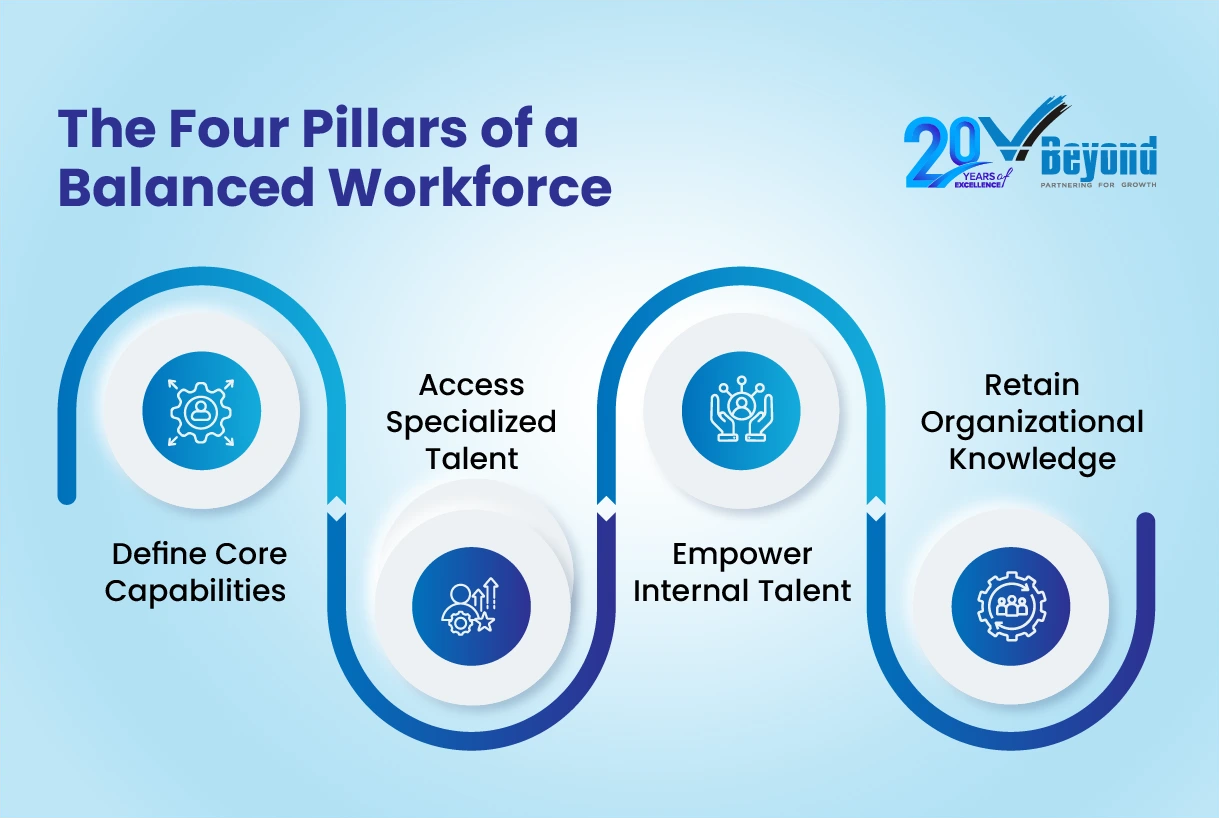
The Unintended Organizational Consequences of Workforce Flexibility
The responsibility of leadership is no longer simply deciding how much flexible talent the organization should use. The harder question in building a hybrid workforce strategy is understanding what repeated dependence on external expertise may slowly train the organization to stop doing for itself. Every workforce model teaches an organization how to think, how to respond under pressure, and where it instinctively turns when difficult problems emerge. Leaders therefore have to think beyond staffing efficiency and ask a more uncomfortable question: what organizational behaviors are we unintentionally reinforcing over time?
One emerging risk is that companies may begin externalizing not just execution but discomfort itself. The hardest transformation work, ambiguity, experimentation, and problem-solving increasingly move toward external specialists, while internal teams remain responsible for continuity and operational stability. Over time, this can create organizations that become highly efficient at coordinating change, but less capable of internally generating it. Another less visible risk is that repeated exposure to temporary expertise can subtly weaken institutional patience. Organizations begin expecting accelerated outcomes everywhere, even in areas where deep capability, leadership maturity, and cultural trust still require time to develop organically.
The long-term risk is not workforce flexibility itself but losing clarity around what should remain permanently owned by the organization — culturally, psychologically, and operationally. Some capabilities can be borrowed. Some expertise can be rented. But certain instincts — resilience under uncertainty, leadership depth, institutional judgment, and the confidence to solve difficult problems internally — may become extremely difficult to rebuild once organizations gradually stop exercising them. In many ways, this is what makes building organizational resilience far more challenging than improving operational performance alone.
Conclusion
The future workforce will not be built through a fixed formula, because the conditions shaping it will not remain fixed either. Every organization will calibrate this balance differently depending on its culture, leadership philosophy, operating pressures, and appetite for change. The real responsibility of leadership is therefore not to chase the perfect workforce model, but to remain deeply aware of what the organization may be gaining in agility while quietly losing in identity, judgment, resilience, or human connection. Ultimately, building organizational resilience requires more than workforce flexibility alone.
In the end, the strongest organizations may not be those that move fastest toward flexibility, but those that remain intentional enough in their pursuit of the right hybrid workforce strategy to know what should evolve — and what should never quietly disappear along the way.
As workforce models continue evolving, the right talent partner is no longer just a hiring provider, but a strategic enabler of resilience, adaptability, and long-term growth. Partner with us to build workforce strategies aligned with changing business realities.
Sources
Sentinel Group – Attraction, Retention Trends to Monitor in 2026
20+ Gig Economy Statistics and Facts for 2026 | Fortunly
5 Attraction and Retention Trends to Watch in 2026
Strengthen Organizational Alignment with VBeyond Corp
Strengthen Organizational Alignment with VBeyond Corp
FAQs
1: How can organizations determine which capabilities should remain internal versus externally sourced?
There is no universal formula. Organizations typically benefit from retaining capabilities tied to institutional knowledge, customer relationships, leadership continuity, and strategic decision-making. Specialized, rapidly evolving, or project-based expertise may be better accessed through flexible talent models. The key is to evaluate capabilities based on their long-term strategic value rather than simply the role itself.
2: What are the biggest risks of relying too heavily on flexible talent?
The most significant risks often extend beyond staffing. Over-reliance on external expertise can gradually weaken institutional knowledge, reduce internal problem-solving capability, create dependency on outside specialists, and make it harder to sustain organizational learning over time. Leaders should regularly assess what critical capabilities the organization continues to own internally.
3: Can workforce flexibility improve employee retention?
Yes, but not simply through remote work or flexible schedules. Many employees increasingly seek autonomy, variety, skill development, and meaningful ownership over their work. Organizations that create opportunities for internal mobility, cross-functional projects, and outcome-based work often improve retention while preserving institutional knowledge.
4: What should organizations look for in a flexible talent partner?
Beyond speed and hiring efficiency, organizations should evaluate whether workforce partners understand their business context, operating environment, and long-term objectives. The most effective partnerships help organizations access specialized expertise while maintaining continuity, alignment, and execution consistency.
5: How can companies prevent knowledge loss when external talent leaves?
Organizations should treat knowledge transfer as a strategic priority rather than a project closeout activity. Clear documentation, collaborative workflows, cross-functional participation, and deliberate knowledge-sharing practices can help ensure that expertise remains within the organization after an engagement ends.
6: What does a successful hybrid workforce strategy look like in 2026?
A successful hybrid workforce strategy balances flexibility with stability. It enables organizations to access specialized expertise quickly while protecting the institutional knowledge, leadership depth, cultural cohesion, and resilience needed for long-term success. The goal is not maximum flexibility, but intentional flexibility aligned with business priorities.