
Four Key Takeaways
• Healthcare burnout has shifted from a crisis-era concern to a sustained career decision driver, with a significant share of nurses and clinicians actively reconsidering their roles based on workload, stress, and long-term sustainability.
• Employers across the healthcare sector are responding by moving beyond salary, introducing flexible scheduling, structured mental health support, and digital tools that reduce administrative burden as active retention strategies.
• Candidates in 2026 are evaluating job offers across four dimensions: schedule predictability, day-to-day work experience, access to real support, and transparency between what is promised and what is delivered.
• For both candidates and hiring organizations, the takeaway is consistent: the value of a healthcare role is determined by how it is designed and experienced, not by compensation alone.
Introduction: From Burnout Crisis to a Shift in Expectations
Healthcare burnout did not peak and pass. It settled in. Years after the COVID-19 pandemic stretched clinical teams to their limits, the fatigue persists, embedded in workflows, staffing gaps, and daily career decisions.
McKinsey & Company notes that workforce shortages continue to be shaped by persistent burnout among physicians, nurses, and allied health workers, with many clinicians still reconsidering whether their current roles are worth staying in. The American Nurses Foundation’s 2025 Pulse of the Nation’s Nurses Survey reflects the same reality, tracking ongoing stress and staffing concerns that are actively influencing how nurses weigh their options.
The hiring conversation is beginning to reflect this. Filling a vacancy is no longer the full measure of a successful hire. Employers are starting to reckon with a harder question: how do we make this role worth staying in?
This blog examines what is beginning to define a strong offer in healthcare jobs beyond salary, how employers are rethinking the way they compete for talent, and what candidates should be looking for when assessing opportunities in 2026. The discussion here focuses primarily on frontline clinicians, including nurses, physicians, and allied health professionals whose experiences are increasingly shaping healthcare hiring trends and employer retention strategies.
Burnout Is No Longer a Phase—It’s a Career Decision Driver
Burnout now affects career direction. It shapes whether clinicians stay in direct care, change employers, reduce hours, or move into nonclinical roles entirely. The pressure often comes from a combination of emotional fatigue, staffing gaps, high patient demand, and administrative work that reaches far beyond patient interaction.
This matters because burnout is not only a personal wellbeing issue. It is also a staffing issue. McKinsey’s 2025 research on nurse managers reported that 20 percent of frontline nurse respondents intended to leave their jobs within six months. The same research highlights the critical role of frontline leadership in supporting nursing teams and directly influencing retention outcomes.
That reality is changing how candidates read job offers. Salary still matters. It always will in demanding clinical work.
But salary alone rarely answers the harder questions:
- Will the schedule allow recovery?
- Is overtime occasional or routine?
- Is support available during pressure, or only after burnout has already taken hold?
Healthcare worker burnout has made candidates more practical. Many are no longer asking only, “What does this role pay?” They are asking, “Can this role be sustained?” That shift sits at the center of what healthcare jobs beyond salary means in 2026, and it is something both candidates and employers are actively reckoning with.
How Employers Are Responding to Changing Expectations
The shift in candidate expectations has pushed healthcare employers to rethink what they offer beyond a paycheck. Deloitte’s 2026 Global Health Care Outlook identifies workforce flexibility and digital transformation as two of the most urgent priorities for health system leaders, with both directly tied to reducing burnout and improving retention.
Flexible Scheduling Becomes a Competitive Lever
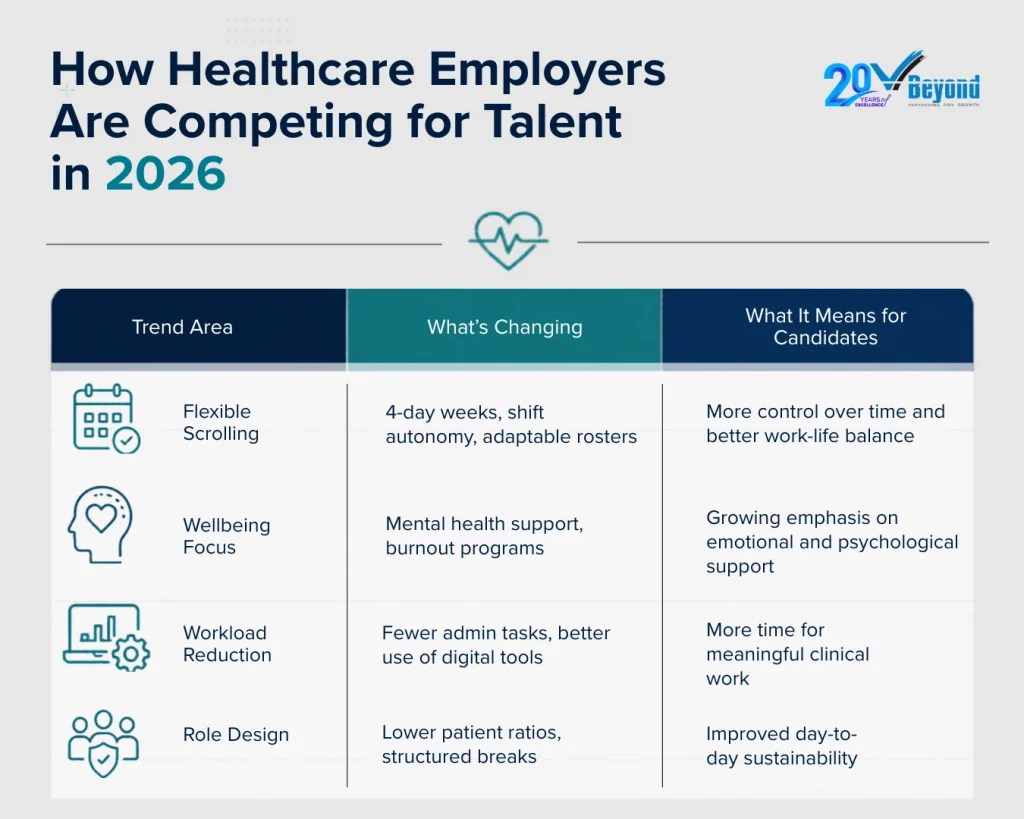
Forward-looking employers are moving away from rigid rotation models. Deloitte’s outlook explicitly calls on health system leaders to introduce alternative work models, including hybrid options, shift autonomy, and scheduling built around life responsibilities, as a direct strategy to retain talent.
For candidates, work-life balance in healthcare is no longer a perk they hope to find; it is a baseline they are beginning to expect. Control over time has become one of the clearest signals of whether a healthcare work environment is genuinely sustainable.
Access to mental health benefits for employees has grown from an add-on to an active differentiator. McKinsey’s Health Institute analysis found meaningful links between mental health support programs and productivity outcomes — reinforcing the business case for wellbeing investment.
Wellbeing Moves from Perk to Priority
The distinction candidates increasingly draw is not whether support exists, but whether it is accessible and culturally accepted. A mental health program that sits in an employee handbook but carries stigma in practice offers little real value.
Reducing the Hidden Burden of Work
Administrative overload ranks among the most cited contributors to burnout. Deloitte’s 2026 outlook highlights how AI and digital tools that automate documentation and clerical tasks directly address this burden, giving clinicians more time for meaningful patient work.
Roles that reduce non-clinical strain are increasingly reported as more sustainable day-to-day. When documentation is streamlined, support staff handle administrative responsibilities, and workflows are clear, clinicians can spend more time focused on patient care rather than tasks outside their core role. The clinical demands may remain high, but lower operational friction can significantly improve the experience of an entire shift.
The Rise of Better-Designed Roles in Healthcare
The next shift in healthcare jobs beyond salary is not only about benefits. It is about the structure of the role itself. A better-designed role gives healthcare professionals a fairer chance to deliver care without constant personal depletion.
This shows up in practical ways. Some employers are paying closer attention to staffing ratios, support roles, shift patterns, break coverage, and reporting lines. These details may look operational, but they define the workday. A nurse with proper support can spend more time with patients. A physician with less administrative drag can focus more on clinical decisions. A technician with predictable shifts can return to work with more energy.
Build stronger healthcare teams with VBeyond Corporation.
Build stronger healthcare teams with VBeyond Corporation.
These roles may not always carry the highest salary. That is an important point for both candidates and employers. A higher-paying role with chronic overtime and weak support carries a hidden cost. A role with slightly lower pay but stronger staffing, clearer expectations, and better recovery time is often more stable over the long term.
Looking Beyond Salary: What Candidates Are Paying Attention to Now
As hiring grows more discerning, four dimensions continue to define how healthcare candidates evaluate a role, and their weight will only grow stronger going forward.
Time and Schedule Control
Predictability has become a currency of its own. Candidates are looking at whether shifts follow a stable pattern or change week to week, and whether they have any real ability to influence their own schedules. A role that promises work-life balance in healthcare but delivers constant last-minute changes loses credibility quickly.
Day-to-Day Work Experience
Workload intensity, the availability of support staff, and how frequently overtime bleeds into personal time are all factors candidates now scrutinize before accepting. These details rarely appear in a job description, which is precisely why candidates are asking about them directly during interviews.
Access to Real Support
Candidates are asking whether mental health resources are genuinely usable, not just listed in a benefits summary, and whether managers are equipped to handle high-pressure situations with their teams. Nurse burnout solutions mean little if the culture around them discourages use.
Clarity and Transparency
McKinsey’s 2025 research on what to expect in US healthcare highlights transparency as a growing workforce expectation, with candidates increasingly unwilling to accept vague role descriptions or a gap between what is promised during hiring and what is experienced on the job.
For instance, a nurse may accept an offer that promises flexible scheduling and strong team support, only to find that shift changes are limited and overtime is frequent. In such cases, the issue is not only workload, but the gap between expectation and reality. Clear communication during hiring helps candidates understand the role before committing to it.
Across all four dimensions, the shift is consistent: healthcare jobs beyond salary are now evaluated through the lived experience of the role.
The Growing Role of Talent Partners in Navigating These Choices
Healthcare roles are hard to compare from a job posting alone. Two openings may share the same title, location, and pay range, yet differ sharply in schedule control, team structure, workload, and management style. Those differences often become clear only after the role begins.
That gap matters for both candidates and employers. Candidates need a clearer view before accepting an offer. Employers need to understand what the market now expects before presenting one. Healthcare recruitment increasingly rewards better fit, not only faster hiring.
Talent partners like VBeyond Corporation can add context to this decision. A staffing partner can clarify role expectations, compare compensation against work conditions, and surface details that may not appear in a job description. This includes shift patterns, reporting structure, hiring urgency, support levels, and the employer’s approach to staff satisfaction in healthcare.
The value is not only in matching people to open roles. It is in helping both sides see whether an opportunity is practical, stable, and aligned with long-term goals. In a market shaped by healthcare burnout, informed guidance can make sustainable healthcare roles easier to identify.
What This Means for Employers Competing for Talent
Salary remains relevant. But healthcare hiring in 2026 is decided on the full experience of a role, and employers who lead only with compensation figures are losing ground to those who lead with structure and transparency.
Deloitte’s 2026 Global Health Care Outlook makes clear that health systems investing in workforce wellbeing and flexible models are better positioned for long-term stability than those relying solely on financial incentives. Retention is shaped at the offer stage, by how honestly expectations are set and how clearly role conditions are communicated.
Employers who have reduced administrative burden, built manageable workloads into role design, and made mental health support genuinely accessible are already seeing the impact on staff satisfaction in healthcare. These are operational decisions that signal to candidates whether a healthcare work environment is worth committing to.
For HR leaders and talent acquisition teams, the hiring decisions made today will shape retention outcomes for years to come. (For more perspectives on building stronger hiring practices, read our blog on What Healthcare Leaders Need to Know About Staffing in 2026.)
Conclusion: Redefining What Makes a Role Worth Choosing
Healthcare professionals are redefining value at work. The strongest offer is no longer measured only by salary, title, or sign-on incentives. It is measured by the conditions that shape daily energy, patient care, and the ability to stay in the profession without constant depletion.
The move from healthcare burnout to balance is influencing both career decisions and employer hiring strategies. Candidates are looking for clearer expectations, better schedules, practical support, and healthier team structures. Employers that recognize this shift will be better placed to attract and retain skilled talent.
The strength of a healthcare role is increasingly being determined not just by what it pays, but by whether it is sustainable to perform over time. The strongest offers are not just competitive, they are livable.
If your healthcare hiring goals go beyond filling open roles, connect with VBeyond Corporation to strengthen staffing support, and build hiring strategies that align with long-term workforce needs.
FAQs
1. What are healthcare jobs beyond salary?
Healthcare jobs beyond salary refer to roles evaluated on the full quality of the work experience, including schedule flexibility, workload manageability, mental health support, and clarity of expectations. Compensation alone no longer captures what makes a role worth accepting. Candidates are increasingly weighing how a job is structured and whether it can be sustained over the long term.
2. Why is burnout influencing healthcare job decisions in 2026?
Healthcare worker burnout has become a sustained condition for a significant share of the clinical workforce, not a temporary phase that passes with time. It has pushed professionals to ask harder questions before accepting a role, moving the focus from immediate pay to long-term sustainability. When burnout becomes a daily reality, career decisions follow accordingly.
3. What should candidates look for in healthcare job offers?
Beyond salary, candidates should assess four key dimensions: schedule predictability, day-to-day workload intensity, genuine access to mental health support, and transparency between what is promised during hiring and what the role actually delivers. Structural factors like flexible work models and reduced administrative burden are now central to whether a role holds up over time.
4. How do flexible schedules improve healthcare job satisfaction?
Flexible scheduling gives clinicians greater control over their time, which directly reduces one of the most common sources of professional fatigue in healthcare work environments. When staff can influence their own schedules, the day-to-day experience of the role becomes more manageable and predictable.
5. Are mental health benefits important in healthcare jobs?
Mental health benefits for employees have moved from a supplementary offering to a meaningful differentiator in healthcare hiring. The distinction that matters is not whether support exists on paper, but whether it is accessible, normalized, and actively backed by leadership. A mental health program that carries stigma in practice offers little real value to the people who need it most.