Three Key Takeaways
1. Adaptability is a workforce design choice, not a change initiative.
Organizations move faster when execution flows cleanly, decisions happen within clear boundaries, and complexity is engineered out of everyday work.
2. Structural readiness must be matched by human alignment.
Workforces adapt when change advances careers, builds capability, and earns trust — not when transformation is imposed top-down.
3. Competitive advantage now depends on operating across fragmented environments.
Enterprises built to function across regulatory, geopolitical, and market differences retain strategic mobility while others stall.
Introduction
Organizational advantage today is defined by how quickly companies can sense change and respond with precision. As markets globalize, technology cycles compress, and workforce models become more distributed, adaptability has shifted from a cultural aspiration to a structural capability. Yet many enterprises still operate with workforce systems designed for stability rather than speed, limiting their ability to reconfigure talent, decisions, and execution in real time.
Competing effectively now requires leaders to redesign how work is organized, how capacity moves, and how human effort is directed — embedding adaptability into the very architecture of the workforce. This shift is central to a modern workforce strategy, where organizations must move beyond static models toward dynamic workforce planning and a truly future-ready workforce.
Why Workforce Adaptability and Organizational Speed Now Define Competitive Advantage
Deloitte’s 2026 Global Human Capital Trends report describes the current moment as a tipping point for organizations navigating compounding pressures. Technological advancement is converging with economic volatility, geopolitical tensions, societal expectations, and a rapidly shifting workforce — creating conditions where change is no longer gradual but discontinuous. As these forces intensify simultaneously, leaders are being pushed to act decisively rather than incrementally.
The research shows that speed and adaptability have become central to competitive strategy. Seven in ten business leaders identify being fast and nimble as their primary competitive priority, while also emphasizing the importance of accelerating how people and resources are mobilized to perform work and strengthening the workforce’s ability to adapt to change. At the same time, the traditional rhythm of long planning cycles followed by predictable execution is breaking down as the boundary between planning and execution collapses—reshaping how leaders approach workforce planning strategy in real time.
Deloitte further notes that many organizations remain constrained by models built for an earlier operating environment. Traditional functions are often too slow and siloed for today’s demands, even as work becomes more multidisciplinary and innovation requires seamless collaboration. In this environment, competitive advantage depends less on technology alone and more on how effectively organizations align people, capabilities, and ways of working to respond in real time—underscoring the need for a more agile workforce strategy.
Strategic Workforce Levers for Organizational Adaptability
Improving adaptability requires more than faster execution or new digital tools. It demands structural choices that determine how work moves, how people mobilize, and how organizations respond under pressure.
The following strategic levers reflect a more integrated workforce strategy, focusing on deeper system design decisions that enable enterprises to adapt with speed, clarity, and resilience. In a constantly shifting environment, these approaches support workforce adaptability strategies while strengthening long-term workforce resilience strategies.
I. Design for Execution Velocity
How work moves inside the enterprise
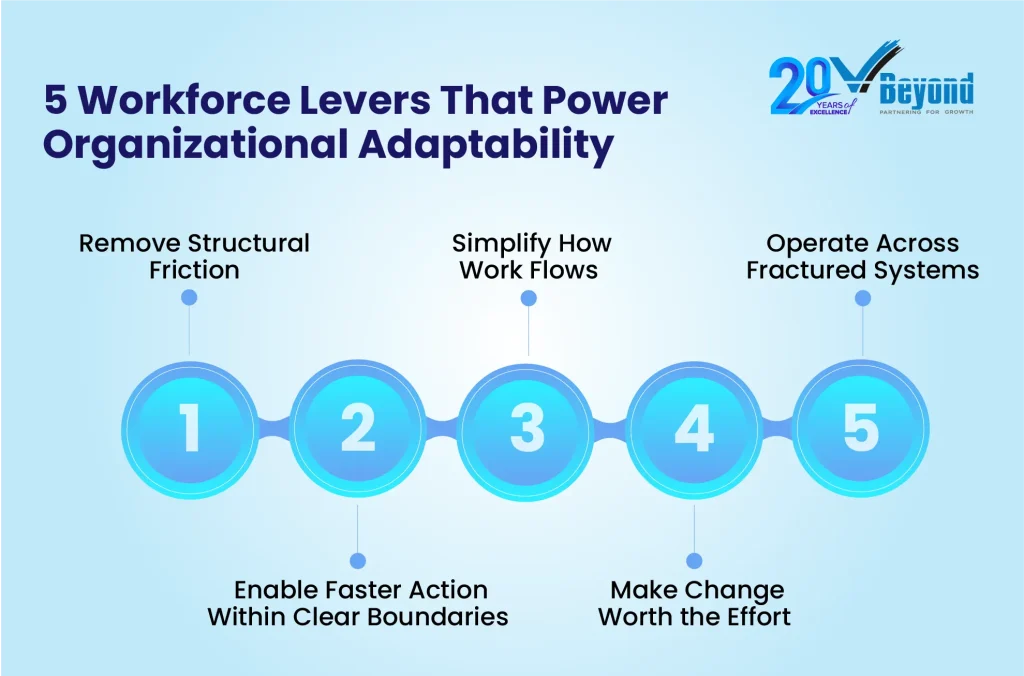
1. Structural Friction Elimination
Organizational adaptability rarely fails because people lack skill or intent; it fails where momentum dies between decision and execution. Structural friction hides in approvals, handoffs, legacy processes, and coordination rituals built for predictability rather than speed. These constraints silently tax execution, slowing response precisely when agility matters most, often due to gaps in business process optimization.
Leaders must treat friction as a design flaw, not an operational annoyance. The objective is not to push teams harder, but to remove the barriers that make responsiveness unnecessarily difficult.
Hard Questions Leaders Must Ask
- When we decide something today, what physically prevents action from starting tomorrow?
- Where does ownership become unclear the moment work crosses a team boundary?
- Which steps in our processes exist because they add value — and which exist because they’ve always been there?
- If we removed three approval layers, what real risk would increase — and what speed would we gain?
- If a competitor had our people but half our processes, would they move faster?
2. Enabling Faster Action Within Clear Decision Boundaries
Many organizations don’t struggle with capability — they struggle with waiting. Teams spot issues early, see opportunities forming, and know what needs to be done, but progress slows because even routine calls get pushed upward. The delay isn’t about complexity; it’s about habits that treat every decision as if it carries the same level of risk, often reflecting gaps in decision-making governance.
Adaptable organizations separate decisions that need oversight from those that don’t. Teams are trusted to handle the calls that sit squarely within their role, while higher-stakes moves follow clear escalation paths. This prevents minor choices from clogging senior bandwidth and keeps momentum where it belongs — close to the work, supported by clear decision-making frameworks.
Speed doesn’t come from people acting freely.
It comes from people knowing exactly which decisions are already theirs to make.
When that clarity exists, hesitation drops, execution accelerates, and leadership attention stays focused on what truly requires it.
Hard Questions Leaders Must Ask
- Where have we formally delegated decision authority — and where is empowerment implied but undocumented?
- Which decisions carry consequences significant enough to warrant escalation beyond the team level?
- Do teams granted autonomy possess the context, competence, and data to exercise it responsibly?
- Are escalation pathways triggered by genuine risk signals — or by uncertainty and habit?
- What behaviors does our governance model reinforce: accountable initiative or cautious dependency?
3. Simplify How Work Flows Across the Enterprise
McKinsey & Company’s The State of Organizations 2026 observes that many companies are hitting a productivity ceiling not because of strategy gaps, but because their organizations have become overly complex. Traditional fixes — restructures, flatter hierarchies, cost cuts — are delivering diminishing returns. What’s slowing performance is how work actually moves: fragmented processes, duplicated effort, and too many coordination loops across teams, highlighting the need for stronger business process optimization.
Adaptable organizations respond by simplifying execution. They focus less on redrawing org charts and more on making work flow cleanly from start to finish. That means removing duplicate steps, reducing handoffs, aligning ownership to outcomes, and streamlining decision routines. When work moves in a straight line instead of a maze, organizations respond faster and waste less energy on internal navigation.
Simpler flow improves speed, accountability, and capacity — the foundations of adaptability.
Hard Questions Leaders Must Ask
- Why does straightforward work become complicated inside our organization?
- How many times does the same work get reviewed, reformatted, or reapproved?
- Where do processes force teams to wait on each other unnecessarily?
- Are we organized for reporting clarity or delivery speed?
- If we rebuild this workflow today, what steps would we eliminate immediately?
II. Align Human Energy with Change
Why people choose to adapt
4. Make Change Worth the Effort
Most organizations treat adaptability as a structural or operational challenge. But over time, adaptability becomes an economic choice made by individuals. People constantly assess whether new priorities, new tools, new teams, or new ways of working justify the disruption they bring. When adaptation increases uncertainty, workload, or career risk without clear personal upside, momentum slows — quietly and predictably.
High-performing organizations design change so that movement creates advantage at both the enterprise and individual level. Role shifts expand capability portfolios. Cross-functional exposure accelerates leadership readiness. Mobility signals trust and progression rather than instability. Adaptation becomes a pathway to relevance, not a detour from it.
This is increasingly critical as work cycles compress and transformation becomes continuous rather than episodic. In such environments, organizations cannot rely on compliance or communication alone. They must align institutional change with human aspiration. When workforce incentives and enterprise direction move together, adaptability compounds. When they diverge, resistance accumulates beneath the surface.
Adaptability, then, is not just an operating model outcome; it is an incentive design discipline in building a truly future-ready workforce.
Hard Questions Leaders Must Ask
- Why would our best people want this change?
- Does adapting here feel like progress — or penalty?
- Who benefits first from change: the company or the individual?
- Are we asking for flexibility while offering rigidity in careers?
- If change creates winners and losers, who are we creating more of?
III. Build for Environmental Volatility
How the enterprise operates across fragmented systems
5. Build Organizations That Can Operate Across Fractured Systems
Markets no longer operate under a single set of assumptions. Regulatory regimes diverge, geopolitical blocks reshape trade and talent flows, data cannot move freely across borders, and digital technologies face different levels of acceptance and scrutiny across regions. What works seamlessly in one environment may stall or fail in another.
Adaptability now depends on multi-system operability: the ability to function coherently across different political, regulatory, economic, and technological contexts without redesigning the organization each time conditions shift—requiring more dynamic workforce planning.
Enterprises built for intelligence and speed cannot be optimized for a single environment. They must be designed to switch contexts fluidly.
That means building modular operating models where processes, technologies, and workforce configurations can be adjusted without disrupting the whole system. It means separating global standards from local adaptations so scale and flexibility can coexist. It means designing data, technology, and decision frameworks that remain functional even when rules, access, or partnerships change.
Regulatory and compliance readiness become part of this architecture, not as legal overhead, but as operational compatibility layers that allow the organization to function across jurisdictions without friction.
Enterprises built this way don’t just withstand fragmentation.
They retain strategic mobility inside it, supported by enterprise-wide workforce adaptability strategies.
Hard Questions Leaders Must Ask
- Are we built to operate in one environment — or many in parallel?
- What breaks first when we enter a market with different rules?
- Can our data, technology, and workforce models adapt without structural overhaul?
- Where are we globally standardized when we should be locally adaptable?
- Do regulations slow us because they’re complex — or because we didn’t design for them?
Conclusion
Most organizations still treat adaptability as a response capability, something activated when disruption appears. But the forces reshaping today’s environment are not episodic shocks; they are continuous accelerations. Technology evolves mid-strategy. Geopolitical boundaries shift operating assumptions. Workforce expectations change faster than planning cycles, demanding a more forward-looking future of work strategy.
In this environment, adaptability cannot rely on periodic restructuring or heroic transformation efforts. It must be engineered into the organization: into how work flows, how authority travels, how incentives align, and how operating models function across fractured systems.
But structure alone is not enough.
As thought leader Josh Bersin observes, modern leaders now guide what he calls a “voluntary army” — a workforce that chooses to opt in each day rather than comply by default. Authority is no longer guaranteed by hierarchy; it is earned through trust, clarity of mission, and meaningful empowerment. At the same time, the pace of change demands a shift from perfection to iteration, where progress is driven by learning velocity rather than flawless execution, reinforcing the need for a cohesive workforce strategy.
Adaptability, then, is both architectural and human.
Organizations must be designed to keep moving —
and led in ways that make people want to move with them.
Building an adaptable organization starts with adaptable talent.
Partner with us to design workforce strategies that keep your business moving.
Sources:
2026 Global Human Capital Trends | Deloitte Insights
The State of Organizations 2026 | McKinsey
The World Is Accelerating: What Has Changed About Leadership? – JOSH BERSIN
FAQs
1. What is a workforce strategy in the context of organizational adaptability?
A workforce strategy defines how an organization structures, mobilizes, and aligns its people to achieve business outcomes. In today’s environment, it goes beyond hiring and planning—it becomes a mechanism for enabling speed, decision clarity, and execution. Organizations that embed adaptability into their workforce strategy are better equipped to respond to continuous change without relying on reactive restructuring.
2. Why is workforce planning no longer enough for modern enterprises?
Traditional workforce planning assumes stable conditions and predictable execution cycles. However, with constant disruption, organizations need dynamic workforce planning that allows talent, roles, and priorities to shift in real time. The focus is no longer just on forecasting demand, but on building systems that enable rapid reallocation of capacity and skills.
3. How do decision-making frameworks impact organizational speed?
Organizational speed is often constrained not by capability, but by decision bottlenecks. Clear decision-making frameworks and governance structures define who can act, when, and with what level of authority. When decision rights are well-defined, teams can move faster, reduce dependency on escalation, and maintain momentum close to execution.
4. What role does talent mobility play in building a future-ready workforce?
Talent mobility enables organizations to redeploy skills across functions, roles, and geographies as priorities evolve. It helps build broader capability, accelerates leadership development, and ensures that workforce capacity aligns with shifting business needs. Without effective mobility strategies, organizations struggle to adapt even when talent is available internally.
5. How can organizations operate effectively in fragmented global environments?
Operating across different regulatory, geopolitical, and market conditions requires more than localized execution—it demands a flexible operating model. Organizations need modular systems, adaptable workforce structures, and governance frameworks that allow them to function consistently while adjusting to regional constraints. This enables continuity, compliance, and strategic mobility across environments.
6. How can leaders measure whether their organization is truly adaptable?
Adaptability is not measured by how organizations respond to disruption, but by how consistently they operate under changing conditions. Indicators include execution speed from decision to action, the ability to reallocate talent without friction, clarity of decision ownership, and how effectively teams operate across boundaries. Organizations that are truly adaptable demonstrate sustained performance even as priorities, environments, and operating assumptions shift.