Table of Contents
Three Key Takeaways
• Governance must evolve alongside the blended workforce.
• Shared principles matter more than standardized processes.
• The future belongs to organizations that govern change, not just technology.
Introduction
Organizations have spent decades building governance frameworks around two distinct entities: people and technology. One was expected to exercise judgment, the other to execute instructions. That distinction is becoming increasingly difficult to maintain. As AI in the workplace assumes a more active role—drafting communications, analyzing information, recommending decisions and collaborating across functions—it is beginning to influence organizational outcomes in ways that resemble participation rather than automation. This shift is prompting a fundamental AI workforce governance challenge. Existing frameworks were designed either to oversee human behavior or manage technological systems. They were never intended for a workplace where both contribute side by side. As the workforce itself evolves, the principles that govern it may need to evolve as well.
The Shift from Tools to Teammates
For much of the past two years, organizations have approached artificial intelligence with a mixture of urgency and uncertainty. The urgency is easy to understand. Competitive pressure, investor expectations and rapid technological advances have created an unmistakable race toward AI adoption in the workplace, across virtually every business function. The uncertainty is more difficult to resolve. How much decision-making should be delegated? Which roles should be redesigned? Where should human judgment remain non-negotiable? At what point does augmentation become replacement? These are no longer theoretical questions discussed at technology conferences. They are increasingly shaping workforce strategy inside boardrooms.
This uncertainty is beginning to leave visible organizational footprints. Companies are creating roles that barely existed a short time ago—from Chief AI Officers and Heads of AI Strategy to AI Governance Leads and Prompt Engineers—while simultaneously redefining the expectations of existing leadership positions. Employees are being asked not only to work alongside AI but also to supervise it, validate its outputs, and understand its limitations. Organizations that only recently announced AI-driven workforce reductions are, in some cases, returning to the market in search of talent capable of building, governing and integrating the very technologies that prompted those changes. The conversation seems to be shifting from automation to delegation. Organizations are increasingly asking what AI should be trusted to do—and where human judgment must continue to prevail.
Beneath these developments lies a more fundamental shift. For decades, workplace technologies remained firmly within the category of tools. They accelerated work but rarely influenced how organizations thought about accountability, collaboration or organizational design. AI is beginning to challenge those assumptions. It is drafting analyses before meetings begin, participating in hiring decisions, generating code, recommending strategic options and coordinating workflows across functions. Increasingly, organizations are not simply asking employees to use AI. They are redesigning work around human-AI collaboration, with the expectation that humans and intelligent systems will contribute together.
This makes the current governance challenge fundamentally different from previous waves of digital transformation. The question is no longer whether AI belongs in the workplace. For many organizations, that decision has already been made. The more difficult question is how to govern a workforce whose contributors no longer fit neatly into the traditional categories of people and technology.
Governance Shifting from Roles to Workflows
For generations, governance has been designed to bring order to organizations. It assumes that responsibilities are relatively stable, decision rights are clearly assigned, and changes to how work is performed happen gradually enough for policies and structures to keep pace. AI disrupts that rhythm. Workflows can now be redesigned in weeks rather than years, responsibilities can shift without a formal organizational change, and new forms of collaboration can emerge faster than AI governance frameworks are typically rewritten. The challenge, therefore, is governing an organization whose operating model is becoming increasingly fluid.
The shift is already reshaping how organizations think about governance. Rather than allowing individual teams to independently develop and deploy AI agents, many are beginning to centralize oversight through shared platforms, governance councils and enterprise-wide standards—elements of an enterprise AI governance framework. Others are defining explicit points at which human review becomes mandatory because accountability must remain visible even as work becomes increasingly distributed. Attention is also being given to questions that traditional governance frameworks rarely had to answer: How much autonomy should an AI agent have before escalation is required? Who has the authority to pause, redirect or retire an agent operating across multiple business functions? How should organizations govern workflows that evolve continuously rather than processes that remain relatively fixed? These developments suggest that the future of AI workforce governance may depend less on writing more policies and more on building organizations capable of governing change itself.
For workforce leaders, the evolution has consequences well before governance reaches the point of oversight. If part of a role can be performed by an AI agent, how should that role be defined in the first place? Job descriptions and statements of work may need to distinguish more clearly between responsibilities that require human ownership and those that can be augmented or delegated. Headcount planning may similarly need to move beyond counting roles toward understanding the capacity the organization needs—and whether that capacity is best built internally, staffed through talent, sourced externally or automated.
The Assumptions That Need to Change
Every major shift in organizational design eventually exposes the assumptions that quietly shaped the one before it. The emergence of the blended workforce model is no different. Many of today’s governance frameworks are functioning exactly as they were designed to—yet they were designed for a workplace where people performed the work and technology supported it. As this distinction becomes less clear, organizations may find that effective governance depends less on writing new rules than on reconsidering the AI governance principles those rules have always been built upon.
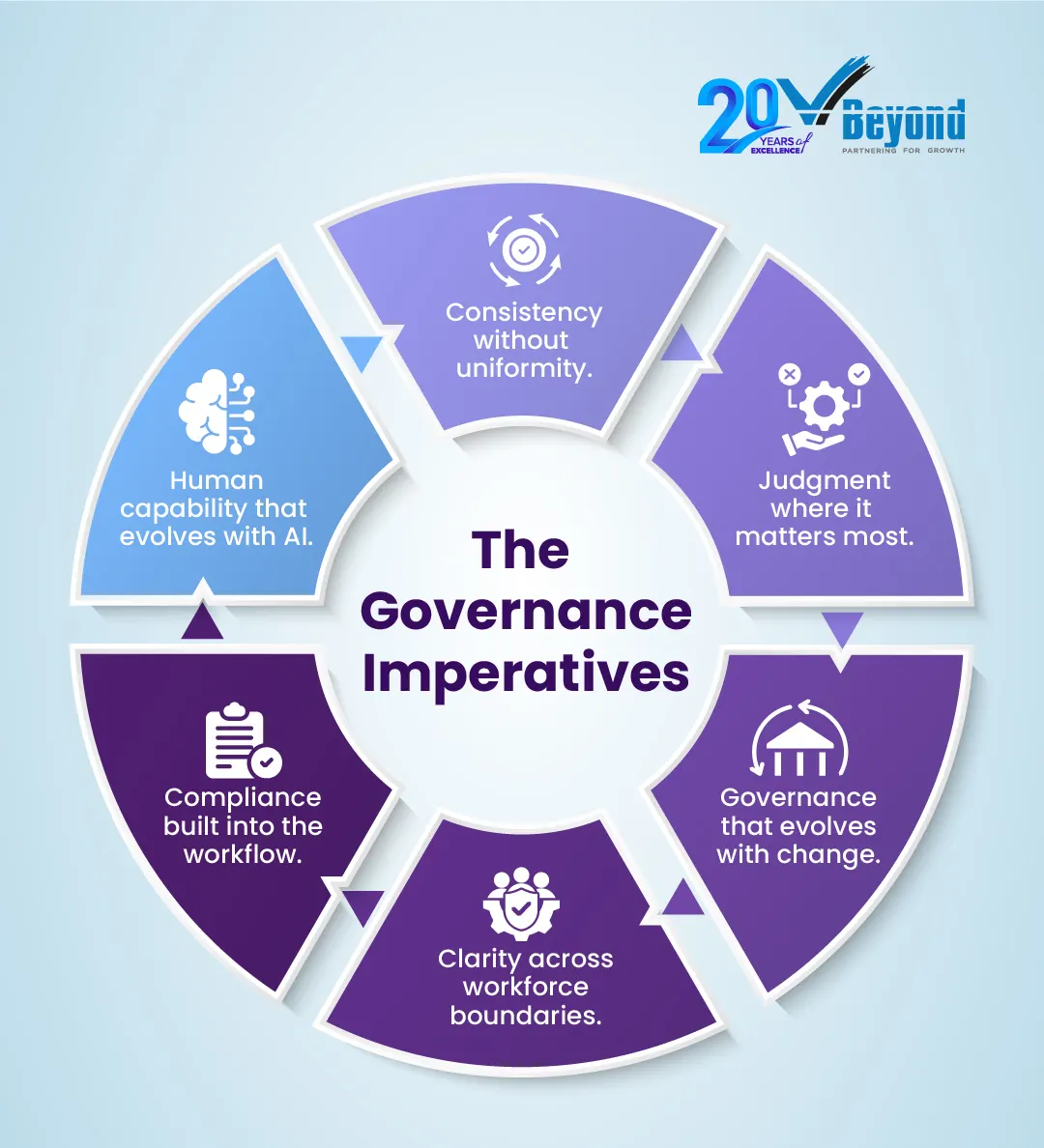
Standardize Principles, Not Practice
One of the more revealing shifts in early AI adoption is that organizations are not struggling because different functions use AI differently. They should. The demands of hiring, legal review, financial reporting and customer service are too distinct for a single operating model to apply across them all. The greater risk lies elsewhere. As functions independently define what constitutes acceptable AI use, organizations can inadvertently create multiple standards for judgement, oversight and risk within the same enterprise. Over time, governance begins to fragment—not because AI is inconsistent, but because the organization is.
Leading organizations are beginning to respond by distinguishing between governance principles and operational practice. Individual functions retain the flexibility to design AI around their own workflows, while the enterprise establishes a common philosophy around ownership, escalation, human oversight and acceptable risk. This explains the growing emphasis on enterprise AI platforms, central governance teams and shared policy frameworks. Their purpose is not to enforce uniformity, but to ensure that responsible AI governance reflects a coherent organizational standard even when its application varies.
Govern the Moments That Matter
The instinctive response to AI is to add more oversight. More approvals. More checkpoints. More humans in the loop. It feels responsible. Yet organizations do not become better governed simply because more decisions require permission. They become better governed when they are clear about which decisions deserve human judgement and which do not. The danger is not AI decision-making itself. It is that people will spend their attention on the wrong ones.
This is the shift beginning to emerge across leading organizations. Rather than treating every AI-enabled workflow as equally consequential, they are identifying the moments where organizational judgement carries disproportionate weight—decisions that shape trust, define customer relationships, influence strategic direction or carry lasting reputational consequences. Everything else is increasingly designed to flow. Governance, then, is becoming an exercise in discernment rather than supervision. In a blended workforce, the organizations that move fastest may not be those that involve people more often, but those that know precisely when people matter most.
Treat Governance as a Living System
Governance often arrives after the operating model has already changed. Policies are written, reviews are scheduled, and controls are added to systems that may look very different by the time those controls take effect. That approach worked when technology evolved in predictable stages. AI does not. Its capabilities, economics, and organizational uses are moving too quickly for governance to remain a periodic exercise.
This is why foresight matters as much as oversight. AI risk management requires organizations to ask not only whether an AI-enabled process is safe today, but what happens when it scales, becomes cheaper, crosses functions, or produces more work than the organization can absorb. A faster front end can still feed a slower organization. A stronger model can still sit inside a weak operating system. Human insight becomes critical here—not to second-guess every output, but to anticipate where new dependencies, bottlenecks, and unintended consequences are likely to emerge.
Governance, then, should not be designed to preserve today’s structure. It should help the organization remain coherent as that structure changes. The most resilient organizations may be those that treat governance not as a fixed set of controls, but as a continuing act of interpretation: understanding what the technology is becoming, what the organization is becoming around it, and where human judgment will matter next.
Redefine the Boundaries of the Workforce
Workforce leaders have long governed different categories of labor through different rules: employees, contractors and external providers each come with distinct expectations around ownership, access, accountability and risk. AI agents complicate those boundaries. Governing AI agents in the workplace raises a fundamental question: if an agent performs work alongside employees, accesses enterprise systems and contributes to business outcomes, should it be governed as a tool, a vendor capability, or something closer to a workforce participant? This is important because accountability cannot become ambiguous simply because the contributor is non-human.
For organizations accustomed to managing contingent workforces, the challenge is not entirely unfamiliar. Questions of classification, co-employment and MSP/VMS governance have long required clarity over who performs the work, who directs it and who ultimately owns the outcome. AI introduces a new variation of the same governance problem: organizations need visibility into where agents are deployed, who is authorized to direct them, what systems and data they can access, and who remains accountable for their work. As workforce boundaries expand, governance must expand with them.
Build Compliance Into the Workflow
For talent leaders, AI governance is also becoming a compliance question. Regulations are beginning to place explicit obligations around the use of automated systems in employment. New York City’s Local Law 144 requires bias audits and certain notice requirements for covered automated employment decision tools, while the EU AI Act identifies specified AI systems used in recruitment, candidate selection and certain employment-related decisions as high-risk. For staffing organizations operating across markets, this makes regulatory context an increasingly important part of how AI-enabled hiring workflows are designed and governed.
The implication is that compliance cannot be added after an AI-enabled hiring process has already been designed. Organizations need to understand where AI enters the talent lifecycle, what decisions it influences, and what requirements follow from that use, from testing and transparency to human oversight. As AI becomes embedded deeper into recruiting and workforce management, governance will increasingly need to be designed into the workflow rather than applied around it.
Govern the Human Transition, Too
A blended workforce cannot be governed only by deciding what AI should be allowed to do. Organizations also need to consider what happens to people as work moves between humans and intelligent systems. As roles are redesigned, redeployment and reskilling need to become part of the same workforce-planning conversation as hiring: which capabilities can be developed internally, which employees can transition into redesigned roles, and where new talent will still be required.
For TA and L&D leaders, this means planning not only for AI proficiency, but for the capabilities that become more valuable as AI takes on more execution. Judgement, problem framing, validation and relationship-building are likely to matter alongside the ability to supervise and collaborate effectively with AI systems. The challenge is therefore not simply to train people on new tools, but to anticipate how roles will change, identify the skills those roles will require, and create pathways for people to move into them.
The Conversation Worth Having Before the Next AI Decision
- Which decisions should never become more efficient?
- Where is AI accelerating work without removing organizational friction?
- What organizational capability are we quietly outsourcing along with the task?
- If every function adopted AI independently, would the organization still behave like one organization?
- Where are we redesigning workflows—and where are we simply automating yesterday’s ones?
- Which of today’s governance assumptions are least likely to survive the next three years?
- What forms of human judgement become more valuable—not less—as AI becomes more capable?
Conclusion
Perhaps the most important AI workforce governance question is no longer how organizations should manage AI. It is how they wish to be managed by it.
Every organization eventually embeds its values in the way work gets done. The blended workforce simply raises the stakes. Every workflow, every boundary, every decision about where judgement belongs quietly becomes a decision about the kind of organization being built. Technology will continue to evolve. Governance will have to evolve with it. The more enduring question regarding AI in the workforce is whether organizations remain intentional about what they choose never to delegate.
The future of work won’t wait for governance to catch up. Neither should your organization.
Partner with us to explore what the blended workforce means for your business.
Source:
Automated Employment Decision Tools (AEDT) – DCWP
Regulation – EU – 2024/1689 – EN – EUR-Lex
FAQs
1. What is AI workforce governance?
AI workforce governance is the set of principles, decision rights and oversight mechanisms organizations use to manage work performed across people and AI systems. It establishes where AI can operate autonomously, where human judgment remains necessary, and who is accountable when AI contributes to business outcomes.
2. What role can an AI governance framework play in a blended workforce?
As AI moves from supporting employees to performing parts of workflows itself, traditional governance structures may provide less clarity around ownership, escalation and accountability. An AI governance framework can establish shared enterprise principles while allowing individual functions to apply them according to their workflows and risk profiles.
3. How is a blended workforce different from traditional automation?
Traditional automation typically executes predefined tasks within relatively fixed processes. In a blended workforce model, humans and intelligent systems increasingly contribute to the same workflows, with AI analyzing information, generating outputs, recommending actions and, in some cases, performing work with greater autonomy. This changes how organizations think about roles, accountability and human oversight.
4. Which AI-related decisions may benefit from human oversight?
Not every AI-enabled action requires the same level of human involvement. Human judgment may be particularly important where decisions carry significant consequences for trust, people, customers, strategy, compliance or reputation. Effective AI decision-making governance is therefore less about adding human checkpoints everywhere and more about identifying where human judgment creates the greatest value.
5. How does AI affect workforce and headcount planning?
As AI takes on parts of existing workflows, organizations may need to assess workforce requirements in terms of both roles and required capacity. Leaders can consider which work requires human ownership, which can be augmented by AI, and which may be automated or sourced externally. These considerations can inform decisions about hiring, redeployment, reskilling and automation.
6. How can AI workforce governance remain adaptable as AI evolves?
Treating governance as a living system rather than a fixed set of controls can help organizations respond as AI capabilities, workflows and risks change. This can involve reassessing emerging dependencies, how risks are evolving and where human judgment remains important. In this way, AI risk management and governance can evolve alongside changes in the organization and its operating model.