Table of Contents
Four Key Takeaways
• A low number of vacancies can still carry significant business consequences when critical roles affect delivery, regulatory responsibilities, major programs, or leadership capacity.
• Recruitment capacity planning should account for where experienced TA time is being spent, particularly when recruitment execution reduces attention available for workforce planning, mobility, succession, or skills planning.
• Limited access to the relevant talent market can restrict candidate reach, while heavy dependence on individual recruiter knowledge can make critical searches difficult to repeat consistently.
• Some searches require market evidence before sourcing begins. Talent availability, compensation, location, competitor demand, and role feasibility can influence how the hiring requirement should be structured and supported.
Introduction: Beyond the Vacancy Count
A company may have only a handful of open roles and still face a serious hiring problem. One vacancy may delay a client commitment. Another may sit in a function where the available talent pool is already narrow. A leadership role may remain open long enough to affect decisions well beyond the hiring team.
PwC’s March 2026 workforce analysis found that nearly a quarter of CEOs said talent shortages were already inhibiting performance, while 22% said their businesses were highly exposed to a lack of key skills. For organizations hiring selectively, the significance of each vacancy can matter more than the total number of open roles.
Recruitment capacity planning looks at what those hiring requirements demand from the current TA model. It considers the business impact of leaving roles open, the TA capacity absorbed by recruitment work, access to the relevant talent market, dependence on individual recruiter knowledge, and the market information available before a search begins.
When several of these issues appear together, the current recruitment model may no longer be sufficient for the requirement at hand. HR leaders can then assess if the need calls for an internal change, targeted recruitment support services, or broader recruitment process outsourcing.
The five signals below provide a closer look at the conditions that can make that review necessary, even when hiring volume remains low.
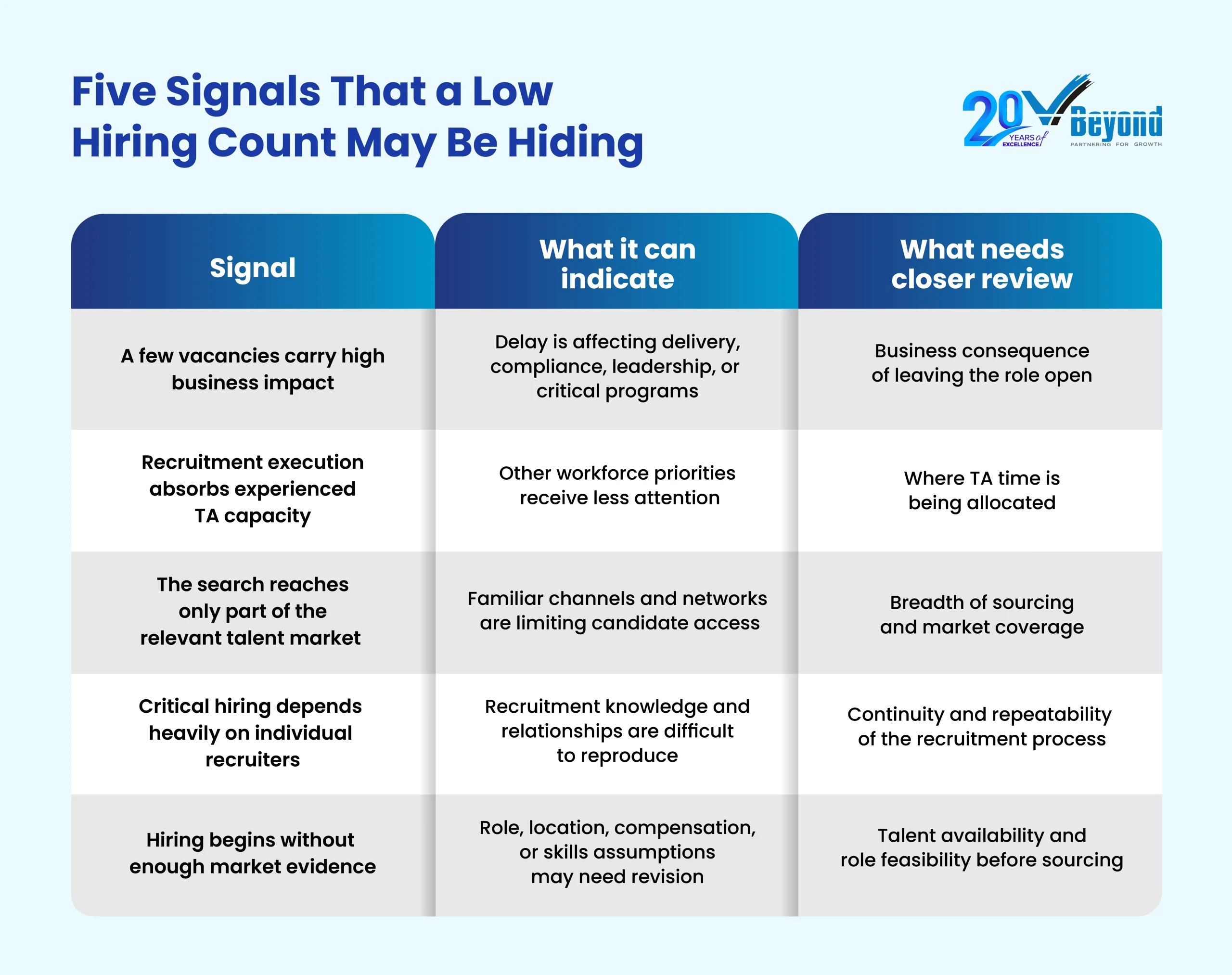
Five Signals That May Point to RPO
Low hiring volume can still expose weaknesses in the recruitment model that are easy to miss when attention stays on requisition count. The following signals examine where those weaknesses can affect business priorities, TA capacity, market access, recruitment continuity, and hiring decisions.
Signal 1: A Few Vacancies Carry Disproportionate Business Risk
A small number of vacancies can still create a material business problem when the missing roles sit close to revenue, delivery, compliance, leadership, or a critical program. The hiring plan may remain modest while the cost of delay keeps increasing elsewhere in the organization.
The pressure can show up through work that cannot move on schedule, responsibilities redistributed across already stretched teams, decisions waiting for the right expertise, or client commitments that become harder to meet. The effect depends on the role and the work attached to it, so vacancy count alone gives HR leaders very little indication of actual business exposure.
Recruitment capacity planning should include that exposure. Roles with a higher consequence of delay may require more focused recruitment attention, a broader search, or additional support even when the total number of requisitions is low.
If those critical searches continue to stall under the current talent acquisition strategy, HR leaders can examine if the existing recruitment model has enough reach and capacity for the requirement. Recruitment process outsourcing may then be considered against the specific hiring need and its business impact.
Signal 2: Recruitment Is Consuming Capacity That TA Should Be Using Elsewhere
A small number of demanding searches can absorb a large share of experienced TA time. Senior recruiters may spend weeks on market mapping, candidate outreach, hiring-manager discussions, interview coordination, and offer management for roles that require close attention throughout the process.
Those recruiters may also be involved in workforce planning, internal mobility, succession, and skills planning. A prolonged search leaves less time for this work, especially when several critical vacancies are active at the same time. The impact is felt beyond recruitment execution because these responsibilities contribute to the wider talent acquisition strategy.
Deloitte’s 2026 Human Capital Trends research found that 88% of leaders considered faster orchestration of people, skills, and resources extremely or very important, while only 7% reported making great progress. The finding is relevant to TA leaders deciding where limited internal capability should be used.
Recruitment capacity planning should account for this allocation of experienced recruiter time. If execution work repeatedly limits progress on workforce priorities, HR leaders may need to review recruitment process management, targeted recruitment support services, or selective talent acquisition outsourcing for defined parts of the hiring work.
Support specialist hiring needs with VBeyond Corporation
Support specialist hiring needs with VBeyond Corporation
Signal 3: The Organization Cannot See or Reach Enough of the Relevant Talent Market
A search can become narrow without appearing narrow. Internal recruiters may return to familiar databases, professional networks, target employers, sourcing channels, or locations because those routes have produced candidates before. The same search pattern can then keep producing the same part of the talent market.
That becomes a larger concern when the skills attached to a role are changing. PwC’s 2026 AI Jobs Barometer found that the skills required for the most AI-exposed jobs changed 2.2 times faster than those for the least AI-exposed jobs between 2019 and 2025. The finding applies specifically to AI-exposed work, but it illustrates how quickly established candidate definitions can lose coverage in parts of the labor market.
HR leaders need visibility into the actual reach of the current talent acquisition strategy. A search confined to familiar channels may miss relevant candidates in adjacent roles, different locations, less obvious employers, or professional communities that the internal team does not routinely access.
Expanding that reach may require additional sourcing capability, geographic coverage, or specialist recruitment support services. Recruitment process outsourcing services may be relevant when broader access to a defined talent market is part of the hiring requirement and the existing recruitment model cannot provide it consistently.
Signal 4: Hiring Outcomes Are Too Dependent on Individual Recruiters
Some critical searches rely heavily on one recruiter’s relationships, judgment, and knowledge of how the organization hires. That recruiter may know which candidates to approach, how a particular hiring manager evaluates talent, which objections tend to stall a search, and what has worked in similar assignments.
Problems emerge when that knowledge is difficult to transfer. A recruiter may take on another priority, change roles, or leave the organization. Candidate relationships, search history, hiring-manager context, and working methods can then become fragmented or lost, leaving another recruiter to rebuild parts of the search.
For recruitment capacity planning, this creates a continuity issue. HR leaders need to know if critical hiring can be repeated through documented processes, shared information, and consistent recruitment process management, rather than depending mainly on individual memory and relationships.
When several important searches rely on the same people, selective talent acquisition outsourcing or recruitment process outsourcing services may help create more consistent support around defined hiring needs.
Signal 5: The Business Needs Recruitment Intelligence Before the Search Begins
A search can go live before the business has tested if the role is realistic in the market. The required skill combination may be unusually scarce, the target location may have limited supply, or the compensation range may sit below what comparable candidates expect.
When those assumptions are weak, recruiters can spend weeks working against a brief that needs to be revised later. Hiring managers may change the specification, widen the geography, adjust compensation, or reconsider which skills are essential after the search has already started.
Deloitte’s April 2026 perspective on skills-based workforce planning recommends aligning skills data with job roles and business priorities so organizations can make better decisions about recruiting, upskilling, and other workforce options.
For recruitment capacity planning, the focus here is the evidence used to shape the search. Talent availability, compensation, location, competitor demand, and role feasibility can materially affect the talent acquisition strategy before sourcing begins.
Where the internal team cannot produce that market evidence alongside active hiring, recruitment process outsourcing services may be warranted, particularly where the scope includes market mapping and talent intelligence.
(Recruitment capacity also needs to be viewed alongside the outcomes the hiring process is producing. Read our blog: Talent Acquisition KPIs for 2026: Metrics That Matter Beyond Hiring Volume, which examines the measures that can help HR leaders assess recruitment performance beyond activity and vacancy counts.)
Conclusion
Recruitment capacity is easy to underestimate when hiring volume is low. But the number of open roles says little about the difficulty of filling them, the business consequences of delay, the internal capacity they consume, or the market knowledge required to make the right hiring decisions.
That is why recruitment capacity planning needs to look beyond requisition count. The more useful question is whether the current recruitment model has the capacity, reach, continuity, and market intelligence required for the hiring needs that matter most to the business.
The answer will not always be recruitment process outsourcing. Some gaps may be addressed through internal changes, while others may call for targeted recruitment support services. But when critical hiring repeatedly exceeds the reach or capacity of the existing model, RPO can provide additional capability without requiring the organization to build it permanently in-house.
Ultimately, the case for additional recruitment support may not always depend on how much an organization is hiring, but on what its most critical hiring needs require from the recruitment model supporting them.
If your hiring demand is placing pressure on internal recruitment capacity, speak with VBeyond Corporation about RPO support for full-cycle recruitment and specific hiring projects.
FAQs
1. What is recruitment capacity planning?
Recruitment capacity planning assesses what hiring requirements demand from the current TA model. It considers business impact, use of internal TA capacity, talent-market reach, dependence on individual recruiters, and the market information available before recruitment begins.
2. How is recruitment workload different from hiring volume?
Hiring volume measures the number of roles to be filled. Recruitment workload reflects the effort and capability those roles require, including market mapping, sourcing, coordination, and decision support. A small hiring plan can still place significant demands on TA.
3. What is project RPO and when is it used?
Project RPO provides recruitment support for a defined hiring requirement or specific hiring project. It can be useful when an organization needs additional recruitment capacity, market reach, or specialist support without changing the permanent structure of its TA team.
4. How is partial RPO different from full-cycle RPO?
Partial RPO supports selected recruitment activities or defined hiring needs, while full-cycle RPO covers a broader recruitment process. The appropriate scope depends on the recruitment requirement, internal capability, and the parts of hiring that need external support.
5. How do I know if my hiring capacity gap requires RPO?
RPO may merit consideration when critical vacancies carry high business impact, recruitment execution is consuming scarce TA capacity, market reach is limited, important searches depend heavily on individual recruiters, or better talent-market intelligence is needed before hiring begins.