- Volume creates a false signal
High activity often obscures low conversion; measuring offer acceptance and early retention provides a clearer view of recruiting health. - Success goes beyond the offer
Hiring outcomes for 2026 are better defined by confirmed starts and manager confidence in fit rather than just signature counts. - Tactical adjustments stabilize the funnel
Strategies such as close plans, Realistic Job Previews, and offer governance help reduce late-stage drop-offs and early attrition. - Metrics must track reliability
Talent acquisition KPIs that focus on joining and staying offer better control over business impact than volume alone.
Hiring teams often confuse activity with progress. Recruiters may schedule endless interviews and extend dozens of offers, yet still miss their true goal to secure high-quality talent who stay. While this disconnect between “busy” work and actual business impact has long existed, it is expected to become more pronounced and a central challenge in 2026.
Recent data reinforces this tension. The McKinsey HR Monitor 2025 indicates a troubling trend where offer acceptance rates hover around 56%, while nearly 18% of new hires exit during probation. These figures suggest that traditional volume-based HR recruitment KPI benchmarks fail to capture the full picture.
High funnel activity means little if candidates drop off at the final stage or leave within months.
This guide shifts focus from activity to outcomes. It groups talent acquisition metrics by funnel stage, introduces a lightweight review rhythm that fits monthly operating cadence, and outlines five process strategies that teams can test without redesigning the entire recruiting engine.
Why Volume Alone Can Mislead
For years, many leaders treated hiring as a numbers game. The logic was simple: fill the top of the funnel, and hires will follow. While reliance on volume has been common, in 2026, it will likely become a strategic error as high application numbers increasingly mask structural issues in recruitment process optimization. A pipeline can look active while recruitment funnel metrics show steep drop-offs at offer, joining, or early tenure.
Volume creates a false sense of security. It suggests market reach and recruiter output, but it does not measure process integrity. A pipeline inflated with misaligned candidates consumes interviewer bandwidth, delays decisions, and dilutes accountability.
It also pulls attention away from candidate experience metrics that often signal preventable friction, such as slow feedback loops, inconsistent expectations, or unclear role narratives.
The financial implications are not abstract. In a recent report, Gartner has noted that the cost of a bad hire can exceed three times the role’s annual salary when replacement costs and lost productivity are considered.
When teams prioritize speed and quantity over evidence of fit, they increase exposure to early attrition and rework. Strong talent acquisition KPIs need to test outcome quality, not just throughput.
A Clearer Definition of “Hiring Success” in 2026
A signed offer is no longer the finish line. Hiring success in 2026 needs a longer lens that reflects business continuity, not just transaction completion.
A tighter definition may include accepted offers, confirmed start dates, early retention through probation, and hiring manager confidence in fit. This reframing forces recruiting metrics benchmarks to align with operational outcomes, making HR recruitment KPI reporting accountable for post-offer reality, not just pre-offer activity.
Partner with Vbeyond Corporation for better talent outcomes
Five Process Strategies Worth Considering in 2026
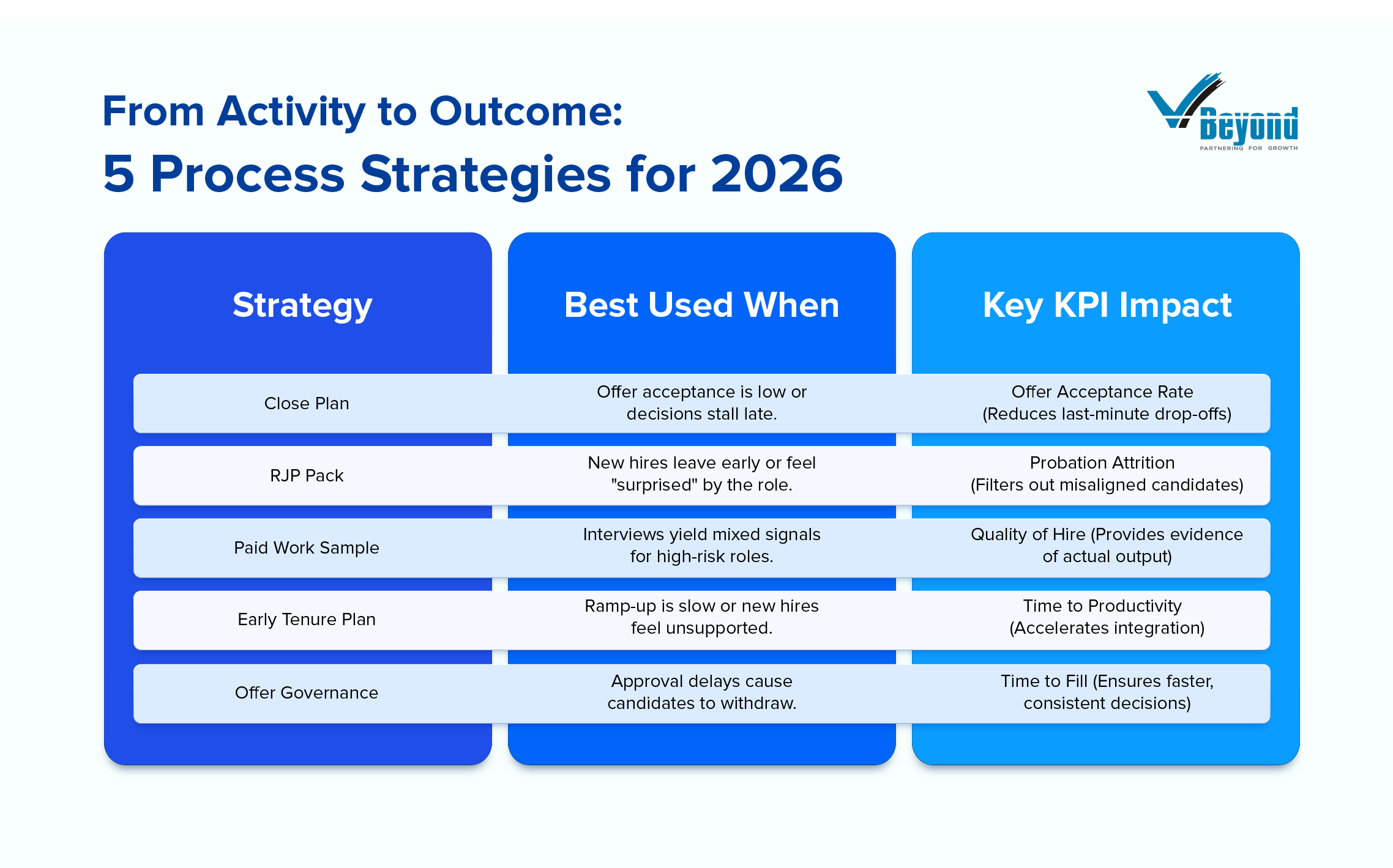
Many talent acquisition teams have enough data, but not enough insight into where the recruitment funnel actually breaks. The following strategies are built to act as levers that can be pulled selectively, based on the talent acquisition KPIs that look weakest.
Strategy 1 — Consider a Simple “Close Plan” From the First Recruiter Call
This approach can work best in senior or high-demand roles where late-stage surprises are common. When compensation expectations, relocation needs, or counteroffer dynamics at the candidate’s current employer show up only at the end, offers either slow down or fall through. A close plan may keep those elements visible from the first conversation, so hiring managers can align faster and make cleaner decisions.
In practice, this can support a tighter offer process and steadier offer acceptance.
Strategy 2 — Consider Adding a Short Realistic Job Preview (RJP) Pack for Finalists
An RJP pack gives finalists an honest view of the work before they commit. Instead of repeating the job description, it focuses on what the role feels like in a demanding week, where the pressure points are, and what a strong first 90 days actually look like.
This simple step can help in environments with high complexity, or shared services, where the job on paper and the job in practice often diverge. When finalists see the hard parts upfront, those who are not comfortable will opt out before an offer, which will protect downstream recruitment metrics related to early attrition.
Strategy 3 — For a Small Set of High-risk Roles, a Paid Work Sample May be Worth Testing
For certain roles, interviews generate more noise than signal. A short, paid work sample can restore balance by showing how a finalist actually approaches real work, under realistic constraints.
This can work particularly well in roles where a miss is expensive, such as engineering leaders, critical product owners, senior risk or compliance specialists, or niche IT and ITES profiles.
A focused assignment, with a clear rubric covering output quality, thinking, and collaboration, often surfaces strengths and gaps that a conversational panel would miss. Candidates can also gain a better sense of the day-to-day expectations, which will support stronger candidate experience metrics.
When used selectively rather than universally, this tactic can raise the quality of hire and reduce early attrition in critical roles. The interview-to-offer ratio becomes more meaningful, because decisions are grounded in observable performance rather than inference, giving HR leaders cleaner recruiting metrics benchmarks for high-stakes hiring.
Strategy 4 — If Early Exits Are a Pain Point, a Structured Plan May Help
High early exits usually signal an integration problem rather than a sourcing problem. A structured early-tenure plan can give new hires a clear runway instead of leaving onboarding to chance.
Such a plan may set out priorities for the first 30, 60, and 90 days; clarify decision rights; and map the people and tools a new joiner will rely on.
Regular check-ins, routed through this plan, may allow managers to catch misalignment or overload early instead of waiting for a surprise resignation.
Strategy 5 — Consider Light “Offer Governance” to Reduce Delays and Guesswork
The offer stage is where many otherwise strong processes stall. Light governance at this point can reduce indecision and inconsistency without creating bureaucracy.
The core elements are straightforward. One person owns the offer process for each role or band, approval paths are defined in advance, and decision timelines are explicit. Decline reasons are recorded in a few structured categories that are reviewed periodically, so patterns around compensation, brand perception, or process delays become visible and can be corrected.
This discipline can compress time-to-fill and improve offer acceptance rate, especially in markets where skilled talent has multiple options.
On the talent acquisition dashboard, it becomes easier to connect shifts in offer cycle time and candidate experience scores with specific changes in internal governance, making recruitment process optimization more evidence-based and less anecdotal.
Conclusion
The future of hiring belongs to teams that prioritize outcomes over activity. Talent acquisition KPIs for 2026 must evolve to track the reliability of the funnel rather than just its speed. Leaders who anchor their strategy in offer acceptance and early retention data will build a recruitment function that drives long term business stability.
These process changes offer a clear path forward. Implementing strategies like close plans or offer governance transforms the hiring engine from a reactive service into a proactive business advantage. This shift ensures that recruitment metrics serve as a compass for future growth and safeguards the organization against the high cost of turnover.
If you need strategic talent support, connect with Vbeyond Corporation for staffing solutions.
FAQs
1. What are Talent Acquisition KPIs?
Talent acquisition KPIs are measurable values that track the effectiveness of the recruitment process from sourcing through to retention. They go beyond simple activity counts to assess the reliability of hiring outcomes, helping teams understand if they are securing talent who will actually stay and perform.
2. What are the most important Talent Acquisition KPIs for 2026?
The critical metrics for 2026 focus on funnel integrity and stability rather than just speed or quantity. Key indicators include offer acceptance rates, the ratio of offers to confirmed starts, early attrition during the probation period, and hiring manager confidence in the final match.
3. Why is Quality of Hire a better metric than Hiring Volume?
Hiring volume measures effort and market reach, but quality of hire measures the actual business value and longevity of the placement. A focus on quality protects the organization from the high costs of replacement and ensures that recruitment effort translates into lasting performance.
4. Why is hiring volume alone a misleading metric for talent acquisition success?
Volume creates a false sense of security by showing high activity levels even when the funnel is leaking at critical stages. It fails to account for late-stage drop offs or early exits, meaning a team can be busy processing candidates without delivering stable results to the business.
5. What’s the recommended review rhythm for talent acquisition KPIs in 2026?
A lightweight monthly review rhythm helps teams track trends without turning reporting into a heavy administrative burden. This cadence allows leaders to identify shifts in offer acceptance or retention early enough to adjust process strategies before losses compound.