Table of Contents
Four Key Takeaways
• AI is reducing the routine work traditionally assigned to junior employees, increasing the need for interpretation, judgment, communication, and accountability earlier in their careers.
• Entry-level leadership potential should not be confused with senior experience. It appears through ownership, disciplined questioning, response to feedback, and the ability to recognize when guidance is needed.
• AI-assisted polish can make resumes, interviews, and take-home assignments appear stronger, but presentation quality alone does not prove reasoning ability, learning capacity, or responsible decision-making.
• Hiring companies and recruitment partners should use role-relevant tasks, new information, and structured follow-up questions to assess how junior candidates think, revise, and take responsibility for final work.
Introduction: Leadership Is Entering Entry-Level Work Earlier
Entry-level roles once gave new employees a protected space to learn through repetition. They drafted documents, gathered information, prepared reports, updated records, and completed defined tasks under close supervision. Through that work, they learned quality standards, business context, and professional discipline.
AI is changing that learning pattern. Drafting, research, reporting, analysis, documentation, and basic coding can now begin with machine-generated output. The junior employee’s contribution increasingly starts with the next question: Is this accurate, complete, relevant, and safe to use?
PwC’s 2026 Global AI Jobs Barometer found that entry-level roles with high AI exposure are seven times more likely to require capabilities traditionally associated with senior roles, including leadership and strategic thinking.
This does not mean entry-level hiring should demand managers in waiting. Junior candidates should not be expected to make high-stakes decisions independently or arrive with years of commercial judgment. The shift is more specific. Employers need early-career talent that can examine work, recognize limits, ask for help at the right point, and take responsibility for what moves forward.
That changes how leadership potential should be understood. Strong evidence is rarely found in a polished first response alone. It appears in what happens when the answer is challenged, revised, or placed in a real work context.
The AI Workplace Is Redefining Entry-Level Roles
Entry-level work has traditionally combined output with observation. Repetitive tasks helped employees see how a business operates: how teams check facts, resolve disagreements, protect sensitive information, and turn analysis into action.
AI does not remove that learning need. It does, however, reduce the time spent on some of the tasks that once provided the starting point. A junior analyst may receive a draft summary instead of building one line by line. A marketing coordinator may start with a suggested copy. A software trainee may review generated code before writing every component from scratch.
The role then shifts from producing a first version to judging whether that version deserves to be used. That requires attention to detail, but it also requires context. An answer can be grammatically clear, technically plausible, and still be wrong for the customer, the market, the policy, or the decision at hand.
The change will not look the same across all roles. AI and automation integration varies by function, industry, data access, risk level, and organizational readiness. Some entry-level positions will continue to rely heavily on structured execution. Others will place more emphasis on review, interpretation, and escalation.
The measured conclusion is simple: the future of artificial intelligence in the workplace will create different hiring needs across occupations rather than one standard model. Many junior roles now require human judgment sooner.
What Is Replacing Routine Work?
When AI produces a first draft, report, recommendation, or code output, the work is not complete. Someone still needs to decide whether the result is accurate enough, complete enough, and suitable for the task.
For junior employees, that often means:
- Interpreting what the output says and what it leaves unclear.
- Checking facts, sources, calculations, and assumptions.
- Identifying missing context, conflicting information, or weak logic.
- Asking questions before an error reaches a decision-maker.
- Recognizing when human review is necessary.
- Explaining what can be relied on, what needs revision, and what remains uncertain.
These are not generic soft skills added beside technical requirements. They directly affect work quality.
Judgment determines whether a flawed answer passes without challenge. Curiosity reveals information that a prompt, dataset, or draft did not include. Clear communication helps a manager, colleague, or client understand whether a recommendation is ready to use. Accountability keeps responsibility with the employee rather than shifting it to the tool.
This is where AI changes the nature of contribution. AI can support production, but junior employees still turn that production into work that a business can trust. That requires care, sound reasoning, and the willingness to raise a concern before a small error becomes a larger problem.
Identify Junior Talent with Leadership Potential Early.
Identify Junior Talent with Leadership Potential Early.
What Early Leadership Looks Like in Junior Roles
Leadership in a junior role does not mean managing a team, setting strategy, or making important decisions without supervision. It shows up through smaller actions that shape quality and outcomes long before anyone hands over formal authority.
Signs of leadership potential in junior employees may include:
- Taking ownership of assigned work: Completing tasks carefully, reviewing the final output, and resolving or clearly flagging problems before handing the work to someone else.
- Evaluating the reliability of information: Identifying figures, claims, sources, or AI-generated responses that appear inconsistent, unsupported, or out of context, and verifying them before they influence a decision.
- Seeking clarity when instructions are unclear: Recognizing missing information, conflicting expectations, or ambiguous directions and asking targeted questions before proceeding.
- Explaining the reasoning behind a conclusion: Showing how the available evidence led to a recommendation so that managers and colleagues can assess both the logic and the final answer.
- Judging when to act independently and when to escalate: Handling routine matters confidently while recognizing when an issue exceeds the role’s authority, expertise, or acceptable level of risk.
- Responding constructively to feedback: Considering new evidence, correcting mistakes, and applying feedback to improve future work without becoming defensive.
- Understanding the broader impact of individual tasks: Recognizing how one piece of work affects other teams, client decisions, project timelines, and the quality of the overall outcome.
These behaviors matter earlier now because junior employees are reviewing AI-supported outputs and adding context to automated work. Their decisions on what to accept, question, or flag can shape what managers and teams do next, which raises the stakes on judgment calls that used to sit lower on the priority list.
This does not mean employers should treat leadership potential as proof that a candidate can already perform a senior role. It indicates whether someone may be able to accept greater responsibility as they gain experience, coaching, and exposure to real workplace pressure.
The New Hiring Risk: Mistaking AI-Assisted Polish for Leadership Potential
AI-assisted applications can make candidates appear more prepared than their underlying work habits reveal. Candidates can improve resumes, refine written responses, rehearse interview answers, create presentations, and complete take-home assignments with generative tools.
None of this makes AI use inappropriate. Clearer communication can help qualified candidates present their experience fairly. The problem begins when hiring teams treat polished output as proof of sound judgment.
A crisp presentation may conceal weak reasoning. Confident delivery may not hold up under a follow-up question. Familiarity with several AI tools does not show whether a candidate can verify an inaccurate result, protect confidential information, or recognize when a tool should not be used.
Prestigious internships, fluent leadership language, and strong first answers remain relevant signals. They are simply incomplete. They show what a candidate can present under prepared conditions, not necessarily how that person responds when information changes.
A stronger junior talent hiring strategy looks beyond the first answer. It asks candidates to explain their assumptions, respond to correction, and account for the final result. This makes room for candidates who may have less polished experience but stronger learning habits, clearer judgment, and greater ownership of their work.
How Hiring Companies and Recruitment Partners Should Evaluate Junior Talent
Entry-level hiring in the AI workplace needs assessment methods that make reasoning visible. The process does not need to become longer or more stressful. It needs to produce better evidence.
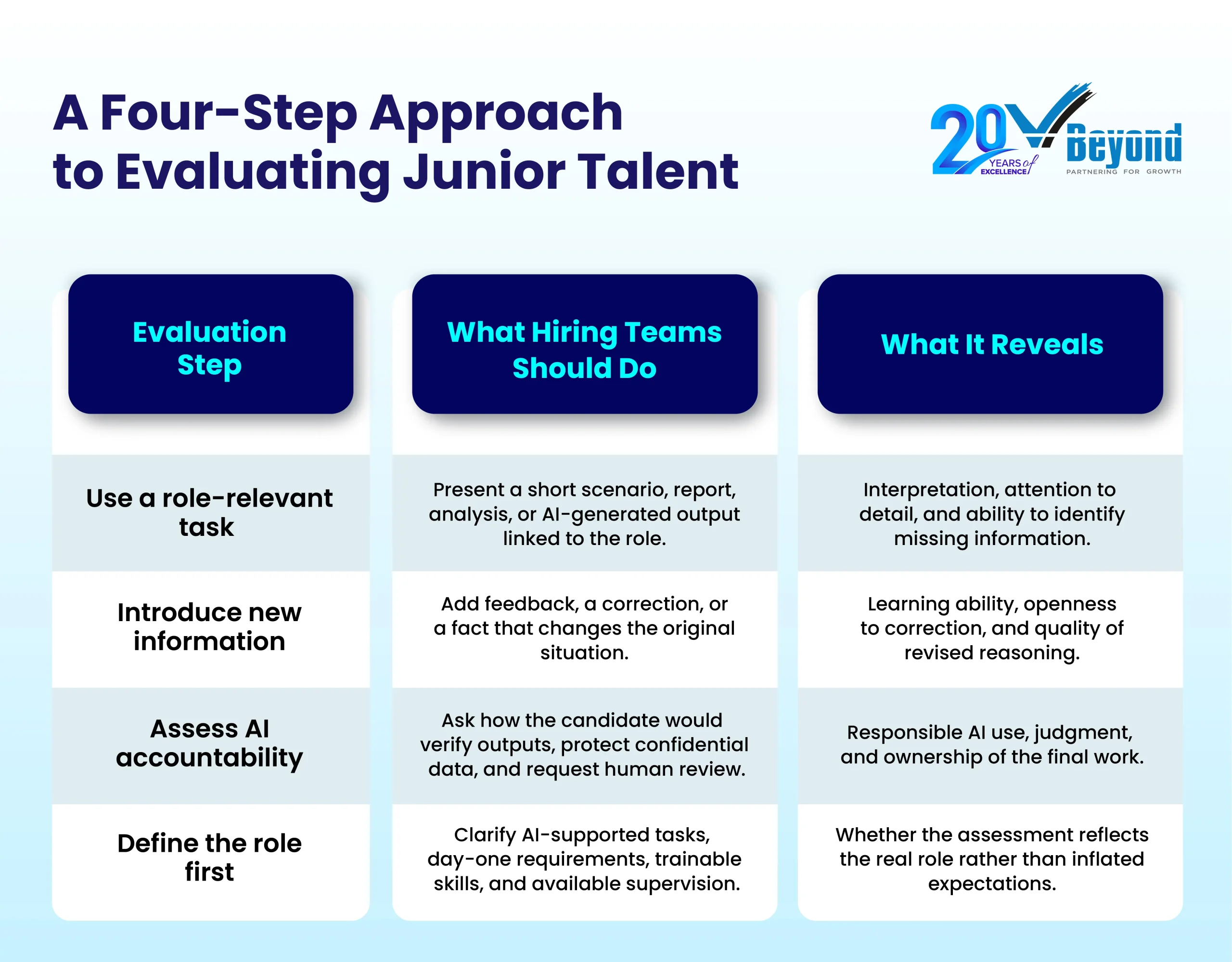
The strongest sequence follows the flow of real work: review information, form an initial view, receive new input, and revise the work where needed. This also shows how recruitment partners can help clients hire smarter.
Begin With a Role-Relevant Task
Hiring teams can use a short task connected to the position. This may involve a brief report, customer issue, data extract, draft recommendation, or AI-generated output containing a few weaknesses.
The task should be fair for an entry-level candidate. It should assess the capabilities needed on day one, not experience the organization expects to build after hiring.
Hiring managers can ask candidates to explain:
- What stands out first?
- What information may be missing?
- What they would verify before acting?
- Which assumptions shape their response?
- Whether more context is needed before reaching a conclusion?
This approach shows how a candidate handles information. The strongest answer is not always the fastest or most confident one. A candidate who identifies an unknown before reaching a conclusion may show stronger judgment than one who fills every gap with certainty.
Introduce a Correction or New Information
After the initial response, hiring teams can introduce a correction, conflicting fact, or new detail that changes the situation. The purpose is not to catch candidates out. It is to observe how they learn and adjust in real time.
Hiring teams should look for evidence that candidates can reconsider an original view, separate evidence from assumption, accept a valid correction, and explain what should change in the final response.
Examine Accountability for AI-Supported Work
Where AI is relevant to the role, hiring teams can assess how candidates would review AI-generated work before using it. The discussion may cover fact checking, confidential data, source quality, bias, and the point at which human review becomes necessary.
The assessment should not reward candidates for naming the greatest number of tools. It should examine whether they understand a basic principle: responsibility for final work remains with the employee using AI support.
Define the Role Before Applying the Assessment
Hiring managers and recruitment partners must first agree on what the junior employee will actually do.
Role intake should clarify which tasks AI supports, where human judgment remains necessary, what supervision will be available, and which capabilities are required from the first day. It should also identify which skills can be developed through training, feedback, and workplace experience.
This step prevents entry-level positions from carrying senior-level expectations without matching authority, experience, or compensation.
Recruitment partners can support clients by questioning inflated job briefs, separating immediate requirements from growth indicators, and establishing consistent evaluation criteria.
Evaluating future leadership potential is one part of building confidence in AI-assisted hiring. (For a broader approach to confirming identity, skills, and work ownership without adding unnecessary candidate friction, read our blog: AI-Assisted Hiring Verification: How HR Teams Can Verify Talent Without Hurting Candidate Experience.)
Conclusion: Look Beyond the First Answer
AI is changing the contribution expected from junior employees. As routine execution becomes less central in some roles, interpretation, judgment, communication, and accountability become relevant earlier in a career than before.
These capabilities can indicate leadership potential, but employers should not confuse them with senior-level experience or polished presentation. Hiring companies and recruitment partners need evaluation methods that show how candidates think after the first response.
How do they handle correction? Can they question an unreliable output? Do they explain assumptions? Will they accept responsibility for work completed with AI support?
Leadership may begin earlier in the AI workplace, but its strongest early evidence is not polish. It is how a junior candidate learns, responds, and takes responsibility when the first answer is not enough.
If your organization wants to identify junior talent with the capacity to grow into greater responsibility, connect with VBeyond Corporation for practical hiring support across functions, industries, and employment models.
FAQs
1. How is AI changing entry-level hiring?
AI is reducing reliance on routine tasks and raising the value of judgment, interpretation, communication, and responsible tool use. Hiring teams therefore need stronger ways to assess how junior candidates think, learn, and respond to changing information.
2. Does AI mean entry-level jobs are disappearing?
No. AI is changing the mix of tasks within many junior roles, not removing every role. Some routine work may decline, while demand grows for employees who can review outputs, add context, communicate clearly, and work responsibly.
3. What skills should companies look for in junior candidates now?
Companies should look for sound judgment, curiosity, learning ability, communication, accountability, and responsible AI use. These qualities help junior employees question weak outputs, explain their reasoning, respond to feedback, and recognize when guidance is required.
4. What does “leadership potential” mean for entry-level candidates?
Leadership potential at entry level means showing ownership, judgment, curiosity, and the ability to improve through feedback. It does not mean managing people or making senior decisions. It signals capacity to take on greater responsibility over time.
5. How can recruitment firms help clients adapt to this shift?
Recruitment firms can help clients define how AI has changed a role, separate day-one needs from trainable skills, question inflated job briefs, and build structured assessments that reveal reasoning, learning ability, and accountability rather than presentation alone.