Table of Contents
Four Key Takeaways
• AI-assisted applications are now common, but the real hiring challenge is not AI use itself. It is verifying real identity, real skill, and real work ownership behind a polished application.
• Traditional screening still matters. The stronger approach is to add candidate assurance on top of screening, so HR teams can validate talent without creating unnecessary friction.
• Work experience verification should move beyond dates and job titles. The most reliable interviews test ownership, decision-making, trade-offs, and actual contribution.
• The best hiring processes will balance verification with candidate experience. Clear expectations, role-based checks, and human judgment help protect both trust and hiring quality.
AI-Assisted Hiring Verification Starts with the Right Question
AI-assisted applications are now a standard part of the hiring process. Candidates use AI to polish resumes, prepare for interviews, organize their work history, or present their experience with greater clarity. None of that is inherently dishonest.
The shift worth noting is more precise: traditional hiring signals now require stronger proof behind them. A polished resume still tells hiring teams something useful. A confident, well-structured interview answer still matters. But neither is sufficient evidence on its own anymore.
According to Deloitte’s 2025 talent acquisition report, AI is actively reshaping how candidates engage across every stage of recruitment, from application to interview, making it harder for employers to distinguish genuine capability from well-prepared presentation.
The concern for HR teams sits one step deeper: can the process still tell who is real, who can do the work, and who actually owns the experience being presented?
That is where AI-assisted hiring verification becomes essential, not as a tool to screen out candidates who used AI, but as a way to increase hiring confidence without compromising candidate experience in recruitment.
AI-Assisted Candidates Are Not the Same as Misrepresented Candidates
Many genuine candidates now use AI as part of their standard job search. They may create CV drafts with AI tools, refine language in their applications, use AI interview preparation platforms to rehearse responses, or organize complex experience into cleaner narratives. None of this is inherently deceptive. It is, in many cases, simply good preparation.
The actual risk in AI-assisted hiring is misrepresentation. Fabricated work history, inflated credentials, proxy interviews where someone else answers on the candidate’s behalf, deepfake-assisted video interviews, or work samples that do not reflect the candidate’s own contribution. These are not new problems, but AI tools have made them easier to execute and harder to detect through surface-level screening.
This distinction matters practically. A blanket policy against AI use in applications risks screening out well-prepared, genuinely qualified candidates while doing little to stop those actively misrepresenting themselves. It also signals to the market that the employer is rigid rather than rigorous.
AI-assisted hiring verification should increase hiring confidence without weakening candidate experience in recruitment.
Why AI in Recruitment Has Put Traditional Hiring Signals Under Pressure
For decades, hiring teams used a familiar set of signals to assess candidates: a structured resume, a well-written cover letter, a confident interview performance. Those signals worked because they required genuine effort to produce. That assumption no longer holds.
A recent Harvard Business Review analysis found that generative AI is weakening the reliability of traditional hiring signals. It can help candidates produce polished resumes and perform convincingly in remote interviews with real-time assistance tools.
The same analysis warns that companies may end up selecting candidates who are better at moving through the hiring process, rather than candidates who are better equipped to do the job.
This is what talent acquisition professionals are now calling signal erosion.
Three specific pressures are now visible across hiring processes:
- Signal inflation: AI resume screening tools face more candidates who appear qualified at first review. When every application looks polished, volume increases, but differentiation decreases.
- Assessment noise: AI interview preparation tools allow candidates to rehearse structured answers with precision. This makes it harder to separate confident delivery from genuine capability.
- Ownership ambiguity: An AI-generated CV can describe a project with fluency and clarity. But hiring teams still need to know what the candidate personally decided, contributed, or delivered, versus what the broader team or context produced.
These are not conceptual concerns. Poor hiring decisions affect delivery timelines, team performance, client outcomes, and compliance. When presentation becomes easier to improve, proof becomes more valuable.
Partner with VBeyond Corporation to verify talent in an AI-driven market
Partner with VBeyond Corporation to verify talent in an AI-driven market
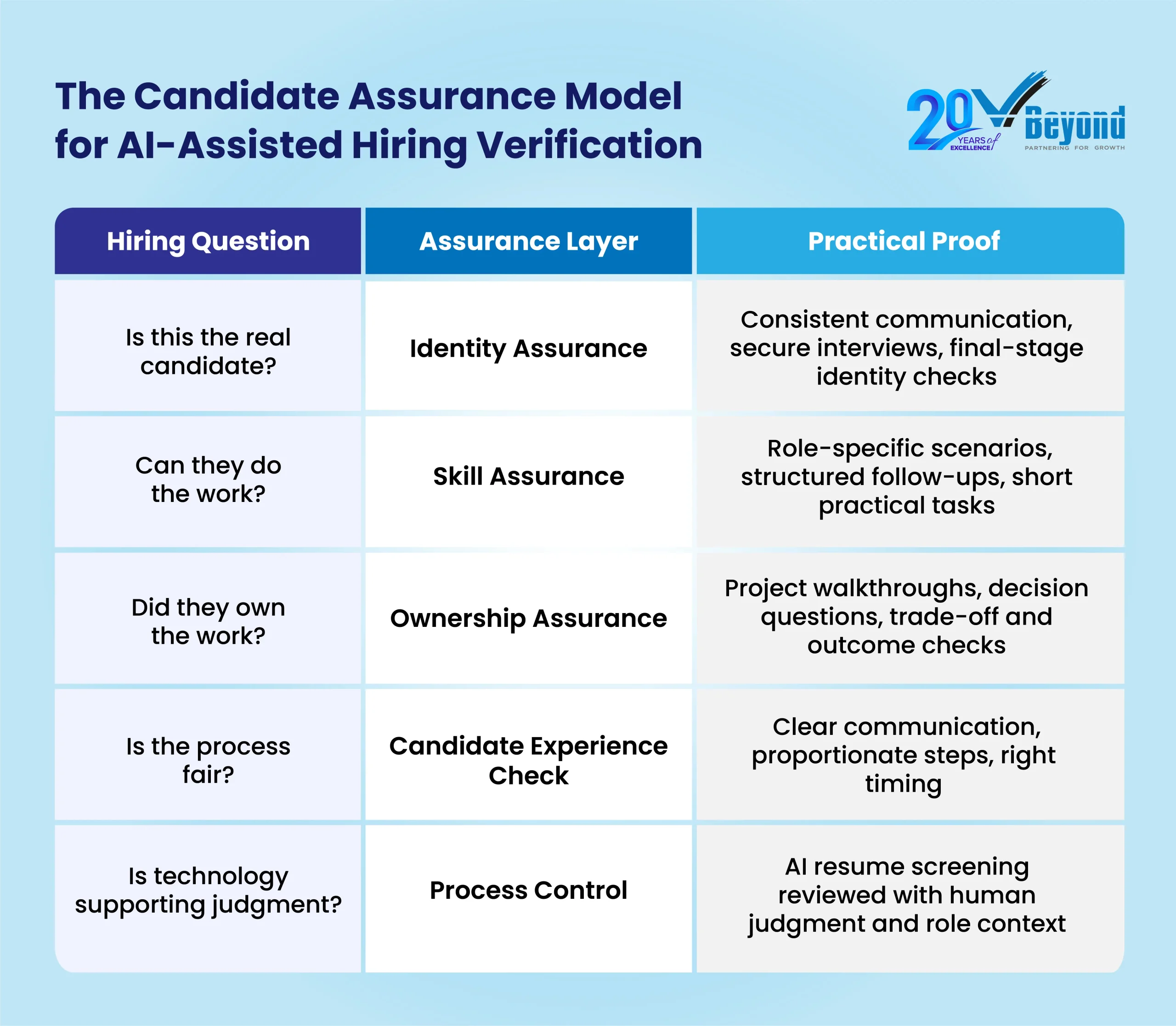
Candidate Assurance: A Better Model for AI-Assisted Hiring Verification
Traditional screening does exactly what it is designed to do; it filters the funnel efficiently and brings forward candidates who meet the basic criteria. Candidate assurance picks up from there. It is a complementary hiring approach that helps employers verify what matters most, without adding friction that does not serve a clear purpose.
The model works across three layers, each addressing a specific verification need in AI-assisted hiring.
Identity Assurance
This layer confirms that the person applying, interviewing, and joining is the same person throughout the process. It includes consistent communication patterns, secure interview practices, and final-stage identity checks calibrated to the role’s risk level and any applicable compliance requirements.
For roles that are senior, remote, or regulated, identity validation at multiple stages is worth the added time.
Skill Assurance
This is where skill verification in recruitment moves from screening criteria to direct evidence. Role-specific scenarios, structured follow-up questions, short practical tasks, technical discussions, and business problem conversations all produce clearer proof of capability than a resume alone.
AI resume screening supports early-stage filtering effectively, but skill assurance requires human judgment to interpret results with role context.
Ownership Assurance
Ownership assurance confirms that the candidate truly owned the experience being discussed. A candidate may have been part of a project, but that does not always mean the person led it, shaped it, solved the hardest problem, or delivered the outcome.
This layer matters because polished language can hide unclear contribution. Hiring teams need to understand what the candidate personally decided, improved, challenged, learned, or delivered.
Candidate assurance does not replace screening. It gives hiring teams the confidence to act on what screening surfaces.
How Evidence-Rich Interviews Support Work Experience Verification
Work experience verification should not stop at job titles, company names, or project summaries. Those details matter, but they do not always show what the candidate actually did.
A candidate can explain a project in clean language. AI can help make that explanation sound sharper. The more useful test is what happens when the conversation moves into the details: the constraint that changed the plan, the stakeholder who pushed back, the mistake that had to be fixed, or the decision that shaped the outcome.
That is where real contribution becomes easier to see.
Strong follow-up questions may include:
- What part of the project was personally owned?
- Which decision changed the direction of the work?
- What constraint forced a different approach?
- Where did disagreement happen, and how was it handled?
- Which outcome came from personal contribution versus the broader team?
- What would change if the same work had to be done again?
These questions are not meant to make interviews adversarial. They give strong candidates room to show how the work actually happened. Real experience often includes hesitation, correction, trade-offs, and practical judgment. A rehearsed answer usually becomes thinner when those details are missing.
For technical roles, evidence can come through code walkthroughs, debugging logic, system design trade-offs, or a discussion of why one solution was chosen over another. For business roles, it can come through prioritization choices, client decisions, process changes, or team outcomes. For leadership roles, it can come through accountability, conflict resolution, decision quality, and business impact.
The best interviews do not try to beat AI. They ask enough follow-up questions to show what the candidate actually did and how they think.
Protect Candidate Experience in Recruitment with Proportionate Verification
Candidate verification and candidate experience are not competing priorities. The tension between them only appears when verification is applied without proportion.
A useful way to manage this is to treat verification as a friction budget. Every added step asks something from the candidate: time, effort, patience, or personal information. BCG’s candidate-first hiring guidance supports a practical point here: checks should be clear, relevant, and added only where the role justifies them. That helps hiring teams protect the process without making genuine candidates feel delayed, doubted, or over-tested.
A staged approach may work well in practice:
- Early stage: Keep checks light. Focus on eligibility, basic fit, and clear communication. This is where AI in hiring can do meaningful work — filtering volume efficiently before human attention is required.
- Middle stage: Introduce role-relevant proof through structured interviews, practical discussions, or skill-based evaluation. This is where candidate verification starts to carry real weight.
- Final stage: Apply deeper identity checks, reference checks, credential validation, or work experience verification where the role justifies it.
- High-risk roles: Senior, remote, technical, regulated, finance, data-sensitive, and high-trust positions warrant stronger checks at multiple stages.
- Lower-risk or high-volume roles: Keep steps simpler, faster, and consistent so good candidates do not leave midway.
This approach applies equally to startups running lean hiring processes and larger organizations managing high-volume pipelines. The principle holds in both cases: verification should match the risk the role carries, not a default standard applied uniformly.
What HR Leaders Should Put in Place Now
AI-assisted hiring verification does not require a complex process. It requires clear rules, trained interviewers, and verification steps calibrated to role risk. A few deliberate design choices make a significant difference in practice.
Define Acceptable and Unacceptable AI Use
Clarify what candidates may use AI for, such as resume preparation, AI interview preparation, or organizing past experience into clearer narratives. Also clarify what crosses the line: impersonation, fabricated experience, proxy interviewing, or presenting AI-generated work as original output.
Stating this clearly in job communications sets the right expectations early and supports a transparent hiring process.
Match Verification Depth to Role Risk
Not every role needs the same level of candidate verification. Senior, remote, technical, regulated, and high-trust roles justify deeper checks.
Lower-risk roles need lighter, faster steps. Calibrating verification to role risk keeps the process proportionate and protects hiring speed where it matters.
Train Interviewers to Test Ownership
Recruiters and hiring managers should ask follow-up questions that show what the candidate personally did, decided, or delivered.
This is a skill that can be built through structured interview training and consistent question frameworks across hiring panels.
Keep the Process Transparent
Tell candidates what will be verified and why. A transparent hiring process reduces confusion, manages expectations, and protects trust on both sides.
Candidates who understand the process are more likely to engage with it seriously.
Use Technology as Support, Not the Final Judge
AI resume screening, assessment platforms, and identity tools add real value to candidate verification. But final hiring decisions should involve human judgment, structured evaluation, and business context. Technology informs the decision. People make it.
Candidate assurance should not be treated as another hiring checkpoint. It should connect to hiring quality, manager confidence, and process reliability. (For related context on measuring recruitment outcomes beyond activity and volume, read our blog on Talent Acquisition KPIs for 2026: Metrics That Matter Beyond Hiring Volume.)
Conclusion: The Next Hiring Advantage Is Trust
AI-assisted applications will continue to shape hiring. Candidates will use AI. Employers will use AI in recruitment. That is not the problem to solve.
The organizations that respond best will not be those that treat every candidate with suspicion or build processes designed to catch people out. They will be the ones that design hiring processes where real candidates can prove themselves clearly, fairly, and without unnecessary friction.
The goal is not to reject AI-assisted candidates. The goal is to identify real people with real skills, real experience, and real ownership of their work. That requires a process built on identity assurance, skill verification in recruitment, and ownership-based evaluation, not blanket restrictions on the tools candidates use to prepare.
In AI-assisted hiring, trust will not come from banning tools. It will come from better proof, better process, and better judgment.
If your hiring process needs to keep pace with AI-assisted applications while protecting the quality of every hire, connect with VBeyond Corporation to build an approach that works for your roles, your teams, and your candidates.
FAQs
1. What is AI-assisted hiring verification?
AI-assisted hiring verification is a hiring approach that checks whether a candidate is real, skilled, and accountable for the experience claimed. It combines identity checks, skill-based review, and ownership-focused questioning so HR teams can confirm what matters without creating unnecessary friction for genuine candidates.
2. What is the difference between AI-assisted and misrepresentation?
AI-assisted applications use AI to improve clarity, structure, or preparation. Misrepresentation happens when AI is used to fabricate experience, inflate skills, impersonate someone else, or submit work the candidate did not create. The difference is intent and truthfulness, not the use of AI itself.
3. How can HR teams verify if a candidate actually owns their experience?
HR teams can test ownership through follow-up questions that go beyond polished summaries. Ask what the candidate personally decided, changed, disagreed with, or delivered. Strong answers include trade-offs, constraints, outcomes, and lessons learned. That level of detail is harder to fake than a rehearsed project description.
4. What are the red flags of deepfake or proxy interview fraud?
Red flags include delayed responses, unnatural facial movement, mismatched audio and lip sync, scripted answers, repeated pauses, and a lack of detail when follow-up questions get specific. In proxy interviews, answers may sound polished but stay shallow, with weak recall of project details, context, or personal contribution.
5. How do you balance background checks with a good candidate experience?
The best balance comes from proportionate verification. Keep early-stage checks light, add role-relevant proof in the middle, and reserve deeper background checks for final stages or higher-risk roles. Clear communication also matters. Candidates respond better when they know what is being checked and why it matters.
6. What verification methods work best for technical roles?
6. What verification methods work best for technical roles?
Technical roles work best with live problem discussions, code walkthroughs, debugging exercises, and system design conversations. These methods show how a candidate thinks, solves problems, and explains trade-offs. They give stronger evidence than resumes or generic interviews, especially when AI has made written applications look more polished.