Key Takeaways
1. Workforce Intelligence — Build a Sensing-and-Response System
Data alone won’t save performance; early signal will.
Intelligence is the discipline of asking better questions sooner—about capacity, capability, and traction—so leaders act before the business feels the pain.
2. Capacity — Treat It as a Strategic Asset, Not a Line Item
Productivity isn’t about pushing harder; it’s about protecting solvency.
The best organizations run a “stop-doing” discipline, strip out friction costs, and use flex capacity early to prevent burnout before it spreads.
3. Civility — Rebuild the Quiet Contract
The new measure of maturity isn’t speed or engagement; it’s behavioral coherence.
Civility keeps truth moving faster than politics, restores peer respect, and holds the social fabric together long before pressure tests it.
The costliest workforce problems rarely announce themselves as workforce problems. They show up as stalled growth because teams can’t absorb another priority, drifting transformations because decisions bottleneck at the top, and missed customer commitments because managers are stretched thin. So, at the start of the year, workforce planning strategy matters less as a hiring forecast and more as an operating discipline: how early leaders build workforce intelligence to detect strain and capability gaps, how deliberately capacity planning protects the work that matters most, and how firmly pressure is prevented from turning into friction and workplace civility issues. That is the practical agenda behind three workforce bets for the year ahead: Intelligence, Capacity, and Civility.
A Quick Pulse-Check on the Workforce—and What it Means for Executive Decision-Making
PwC’s Global Workforce Hopes and Fears Survey 2025 (published November 12, 2025) is based on nearly 50,000 respondents across 28 sectors in 48 major economies, spanning senior management to frontline roles. While technology change is a major theme, the broader picture is about uneven confidence and rising strain. A little more than half of employees express strong optimism about the future of their role, but the divide runs deep: 43% among non-managers compared with 72% of executives. Day-to-day experience is mixed too: 70% say they feel satisfied with work at least once a week (22% daily), yet nearly as many report fatigue, and PwC says more than half are experiencing financial strain—broken down as 14% who can’t or struggle to pay bills and a further 42% who pay bills with little or nothing left for savings. The survey also points to fragility in the social system of work: barely half of respondents say they trust top management; roughly 58% express trust in their direct manager and feel comfortable speaking openly; and only 56% say it feels safe to try new approaches at work, while 54% say their teams see failure as a chance to learn and get better. Access to growth is uneven as well: 51% of non-managers report having adequate resources for learning and development versus 72% of senior executives.
Taken together, the picture is less about any single trend and more about what leaders are being asked to manage simultaneously: uneven adoption of new tools, uneven confidence about the future, uneven access to development, and a level of personal strain that seeps into decision-making and behavior at work. PwC’s survey spans far more ground than these indicators; these are simply the signals most relevant to workforce planning at the start of the year. In that environment, planning can’t stay confined to headcount spreadsheets or annual engagement cycles, and it can’t rely on slogans to do the heavy lifting. It has to operate as a practical system: one that builds workforce intelligence to spot capacity and capability risks early, deliberately protects capacity for the work that matters most, and raises the bar on civility so pressure doesn’t turn into friction, silence, or disrespect.
Why These Three Workforce Bets Matter Now for Executive Decision Making and Workforce Planning
The temptation at this point is to reach for a long list of initiatives – new tools, new training, new engagement drives – because the year feels like it demands “more.” But more activity isn’t the same as more readiness. The more useful question is simpler: what are the few choices that will shape how the organization behaves when priorities collide, when capacity tightens, and when uncertainty shows up in day-to-day work — the kind of choices that define a strategy for executives, not just a list of initiatives?
That’s what the three bets are meant to do. Taken one at a time, they create a practical playbook for leaders: first, see the workforce clearly; second, protect the capacity to execute; and third, hold a standard of behavior that keeps teams effective under pressure.
1. Workforce Intelligence: Building a Sensing-And-Response System for Executive Workforce Planning
Most organizations don’t lack data; they lack early signal. By the time problems become obvious –slipping delivery, quality drift, customer escalations, regretted attrition – the causes have already been building quietly.
Workforce Intelligence is the discipline of asking sharper questions earlier, doing it on a cadence, and acting before lagging indicators force reactive decisions: in other words, turning workforce insights into an early-warning system for leaders. The questions fall into three practical pillars: Capacity, Capability, and Traction. The output is a Workforce Risk Map for leaders to act on before the business feels the pain.
1) Capacity: Where is the organization silently running out of room?
A workforce plan counts heads. Workforce Intelligence tests bandwidth — revealing real workforce utilization under pressure:
- Where is work piling up right now: backlogs, approval queues, handoffs, unresolved decisions?
- Which teams are in permanent “urgent mode,” and what are they protecting by doing that—customers, quality, internal politics?
- Where are managers becoming the bottleneck because too many decisions rise to them?
- What’s the real load on critical teams: meetings, escalations, rework, context switching, after-hours churn?
The goal is early detection, because overload doesn’t stay contained. It eventually leaks into speed, quality, and behavior.
2) Capability: Do we have the skills to execute this year’s priorities?
This is where plans often get optimistic. Roles look fine on paper; execution fails in the details.
- Which capabilities, including emerging skills of the future, are essential to the top business priorities, and where are they currently concentrated?
- Where are you one resignation away from real risk?
- What skills are scarce in the market, and what skills are scarce inside your four walls?
- Are you hiring for labels (“AI talent,” “transformation leader”) or for evidence—people who’ve shipped outcomes in similar conditions?
- Where are you investing in training without changing who gets meaningful chances to apply new skills?
Capability intelligence surfaces uncomfortable truths: some teams look “fully staffed” but lack the skills the work now demands; others have talent, but not the clarity or conditions to use it well. And, this is exactly why it works.
3) Traction: Are the changes leaders talk about actually taking hold in daily work?
Every transformation has a gap between what’s announced and what’s experienced. Traction questions close that gap.
- Which processes or workflows have truly changed on the ground, and which are unchanged despite new tools and messaging?
- Where are new ways of working happening only at the edges (a few enthusiasts), versus in the core workflow?
- Where is quality improving, and where is it quietly worsening because work is being done faster without the right checks?
- Where are people overriding systems or tools, and what are those overrides telling you about risk, training, or trust?
- If you paused the transformation deck today, could a frontline manager describe what’s different in how work is done?
For example, in AI and workforce transformation, leaders often mistake access for adoption. Intelligence looks for evidence: usage patterns, workflow penetration, quality gains, time saved and repeat human overrides (often where risk and capability gaps hide). In non-AI contexts, traction shows up in process adherence, behavior change in critical moments, and whether the operating model is visible in day-to-day work, or only in slides.
Traction is where “rollout” gets separated from reality, and where confidence is built. When teams feel change removing friction and improving delivery, belief follows.
Talent intelligence about skills, capacity, and traction helps you see strain coming; capacity determines whether you can withstand it.
That’s why, while we’ve covered it as an attribute within Workforce Intelligence, we also elevate it as a bet in its own right because seeing pressure and staying strong under it are two very different capabilities.
2. Treat Capacity as a Strategic Asset: Capacity Planning for Workforce Solvency
Most leaders track financial solvency daily, but almost none track workforce solvency. Capacity is the company’s liquidity, and it depreciates when overdrawn. Hence, the need to manage operational liquidity efficiently.
Productivity is about designing enough headroom to absorb change without people snapping.
When capacity runs dry, performance doesn’t collapse overnight; it decays quietly in slower cycles, higher defect rates, and “good people turning average.”
What leaders could do better:
1. Run a Stop-Doing Discipline
Every new priority forces an explicit trade-off in resource allocation strategy. The healthiest organizations maintain a capacity ledger, a visible list of what stops or slows when something new starts.
It’s the operational equivalent of cash-flow forecasting: protecting solvency before the bills come due.
2. Reduce the Friction Tax
Approvals, duplicate reporting, and unclear ownership consume as much energy as the work itself.
Leaders who treat these as hidden costs (not cultural quirks) routinely reclaim 10–20 % of execution bandwidth without adding headcount.
3. Use Flex Capacity Intentionally
When big shifts hit — new tech rollouts, M&A, market pivots — elastic capacity becomes a safety valve.
Project squads, interim specialists, and contingent experts provide surge bandwidth that protects core teams from drowning.
Used early, flex capacity prevents burnout.
But even the best intelligence and capacity systems mean little if the social fabric of work frays.
Pressure only exposes what culture has already allowed — and civility is what keeps the system coherent long before strain appears.
That’s why the third workforce bet is Civility: not as a soft virtue, but as the everyday infrastructure that keeps people effective, decisions clean, and work dignified.
3. Workplace Civility — Rebuild the Quiet Contract
Civility is the social infrastructure that keeps organizations thinking clearly in anxious times, the foundation of respectful workplace behavior under pressure.
SHRM’s Q1 2025 Civility Index puts U.S. workplaces at 38.8 out of 100, meaning incivility isn’t an incident anymore; it’s ambient. The challenge for leaders anywhere across the world, not just the U.S. for that matter, is to stop everyday erosion: the quiet withdrawal of trust, fairness, and voice, instead of preventing flare-ups.
Civility is what makes Intelligence and Capacity usable. It ensures a healthy workplace culture, keeping signal from turning into noise, pressure from turning into politics, and teams from mistaking caution for professionalism.
When people are afraid to be wrong, they stop being useful.
What leaders can do better is:
1. Audit where truth is getting delayed.
Silence is easy to spot; delay isn’t.
In most organizations, truth may not disappear, but it could just arrives too late to matter.
Civility then is about whether candor can travel faster than politics.
Ask not “Do people feel safe to speak?” but “How long does it take for bad news to reach me?”
2. Replace charisma with consistency.
Charisma creates followership; consistency creates trust.
In uncertain workplaces, tone is volatile. People don’t remember what leaders inspired; they remember what leaders repeated.
Civility grows where predictability replaces performance: where people don’t have to read intent between the lines.
3. Peer Civility: The Next Layer of Intelligence
Civility doesn’t flow only downward; it circulates sideways.
Most workplaces still behave as if leadership tone sets the whole atmosphere. It doesn’t. The air quality of work is determined peer-to-peer in how colleagues handle tension, competition, and visibility.
The SHRM data is clear: when peer respect decays, engagement doesn’t fall immediately; cooperation does.
People still show up, but they stop showing their minds.
And once that happens, even the smartest systems lose texture: decisions get flatter, ideas safer, risk lower.
Peer civility is the reflex to preserve shared thinking even when incentives pull you apart.
It’s what lets disagreement stay about the work, not the worth.
Ask:
- Do peers amplify each other’s ideas in public, or only their own?
- Are cross-team interactions defined by curiosity or calibration?
- When someone struggles, do colleagues step in to help, or quietly step back?
The practical implication is simple but radical:
When organizations start measuring not just engagement, but the quality of connection between equals, they’ll finally know how intelligent their culture really is.
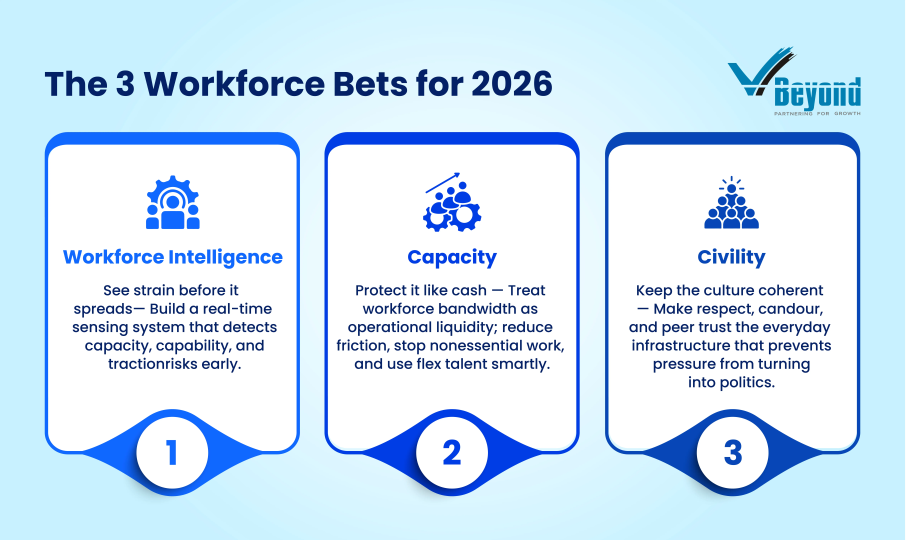
Together, these three bets—Intelligence, Capacity, and Civility—describe the operating rhythm of resilient workforces: see strain early, design to withstand it, and stay truthful while you do.
Conclusion
Many leaders today suffer from avoidance, not ignorance.
They know where the pressure is breaking people, where good talent is burning quietly, where civility is being performed instead of practiced.
So, what’s missing is not intelligence or intent but will.
As a workforce planning strategy, Workforce Intelligence, Capacity, and Civility are only as real as the choices that defend them when it’s inconvenient.
And, for that reason, the organizations that will endure aren’t the ones that understand their people best; they’re the ones that finally stop looking away.
Build a workforce that’s intelligent, resilient, and ready for change.
Partner with us to strengthen your talent edge.
FAQs
1. What is a workforce planning strategy?
A workforce planning strategy is not a headcount forecast or a hiring plan. It is an operating discipline that helps leaders anticipate where capacity, capability, and behavior will constrain execution before results suffer. At its core, it connects business priorities to real workforce conditions—how work flows, where skills are concentrated, and how pressure shows up in daily decisions—so leaders can act early rather than react late.
2. Why does workforce planning matter when organizations are under capacity pressure?
When capacity tightens, performance rarely fails all at once. It degrades quietly—through slower cycles, decision bottlenecks, rising rework, and burnout among strong performers. Workforce planning matters in these moments because it helps leaders make deliberate trade-offs instead of adding priorities indiscriminately. Without it, organizations overdraw their workforce the way companies overdraw cash: slowly at first, then all at once.
3. How does workforce intelligence help leaders anticipate risk before performance declines?
Workforce intelligence turns scattered data into early signal. Rather than waiting for lagging indicators like attrition, missed targets, or customer complaints, it helps leaders see strain building in capacity, skills, and traction. By asking sharper questions on a regular cadence—about bandwidth, skill concentration, and how change is actually landing—leaders can surface risks while there is still time to adjust course.
4. What role does capacity planning play in sustaining execution and resilience?
Capacity planning treats workforce bandwidth as a finite, strategic asset rather than an elastic one. It forces explicit choices about what work gets done, what slows down, and what stops when priorities collide. Organizations that plan capacity deliberately protect execution quality during change, avoid chronic overload, and preserve the resilience needed to absorb shocks without burning out their best people.
5. Why is workplace civility a strategic issue for workforce effectiveness?
Workplace civility is not about being polite; it is about keeping organizations thinking clearly under pressure. When civility erodes, truth travels more slowly, disagreement turns political, and people stop offering their judgment. That undermines both intelligence and capacity. A civil workplace enables candor, clean decision-making, and sustained performance—making it a strategic enabler, not a soft cultural concern.