Table of Contents
Three Key Takeaways
• Automating tasks is easier than preserving organizational capability.
• The quality of AI decisions depends as much on leadership judgment as on technology itself.
• Future-ready organizations will redesign work around capabilities, not just roles.
Introduction
First, companies laid people off because AI could do the work. Now, some of those same companies are hiring again. Not all of them. Not everywhere. But enough to raise an uncomfortable question: why are companies rehiring workers after AI layoffs? If the future of work is increasingly automated, why are organizations finding their way back to human talent? The answer may have less to do with the limits of technology and more to do with how leaders think about work itself. Because work is not just a collection of tasks waiting to be optimized. It is also judgment, context, relationships, trust, and a thousand small decisions that rarely appear on a process map. The emerging AI rehiring trend offers an opportunity to look beyond automation and examine a deeper issue about AI and the future of work: what truly drives organizational performance in an AI-enabled enterprise?
A Signal Worth Paying Attention To
Recent reporting by Emerald Book points to an emerging workforce trend that warrants leadership attention. Drawing on data from various research, the publication notes that 29% of organizations that reduced headcount following AI adoption have reportedly rehired for some of those roles, while 55% of executives surveyed expressed regret about replacing workers with AI. The article also highlights examples of companies such as Klarna, IBM, Salesforce, Amazon, and Google that have adjusted workforce strategies as they navigate the realities of enterprise-scale AI adoption.
It would be simplistic to interpret these developments as evidence that AI has fallen short of expectations. A more useful interpretation is that organizations are entering a new phase of AI workforce transformation—one in which the focus is shifting from what can be automated to what capabilities create sustainable business value. The emerging pattern of workforce recalibration raises important questions about what the AI rehiring trend means for organizations and the factors that continue to underpin enterprise performance, even as AI becomes embedded across functions.
Transform workforce strategy with future-ready talent solutions.
Transform workforce strategy with future-ready talent solutions.
Decision-Making: Were We Measuring the Right Things?
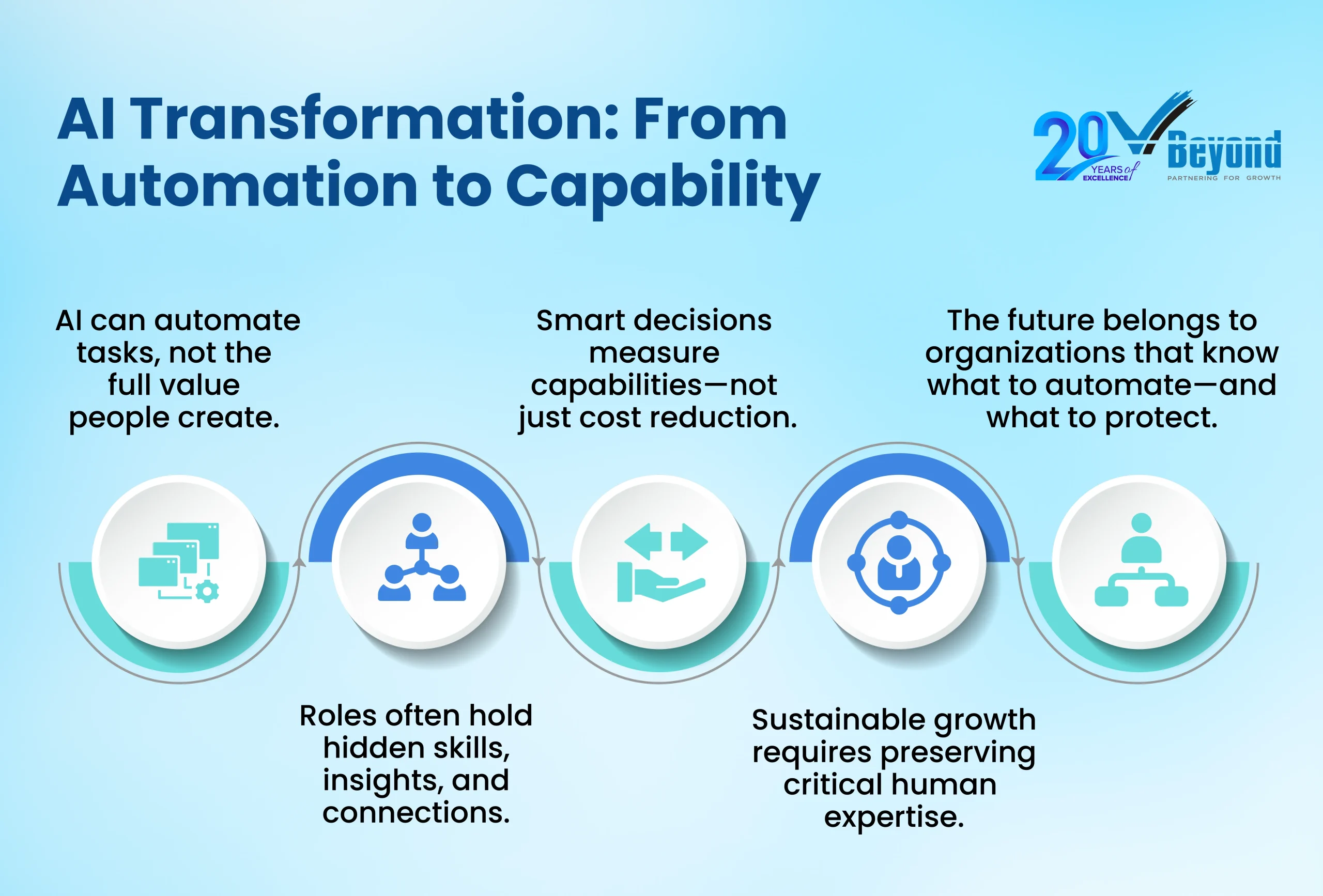
The AI rehiring phenomenon may ultimately have less to do with technology than with the decisions organizations made about technology as part of their enterprise AI strategy. When leaders approved workforce reductions tied to automation initiatives, most were acting on a rational premise: if a task can be automated, the cost associated with that task can be reduced. The logic is difficult to dispute. The challenge is that jobs are rarely just collections of tasks.
What if the real question was never “Can AI perform this activity?” but “What role does this activity play within the larger system?” A customer service representative may also be an early-warning sensor for product issues. An operations analyst may be identifying risks long before they appear on executive dashboards. A mid-level manager may be translating strategy into execution in ways that are difficult to quantify but easy to miss once they are gone. Organizations often discover the value of these contributions only after they disappear.
Viewed through that lens, some of the workforce recalibrations being reported today are not necessarily corrections to enterprise AI strategy. They may be corrections to assumptions about how value is created inside organizations. The issue is not whether leaders underestimated technology or overestimated it. The more relevant question is whether they fully understood the organizational consequences of removing certain roles in the first place.
There is another question worth asking. How many workforce decisions were driven by a clear understanding of organizational capability, and how many were influenced by the pressure to demonstrate progress? The past two years have been marked by an intense race to signal AI readiness—to investors, boards, customers, and competitors—as organizations accelerated enterprise AI implementation. In such an environment, speed becomes a competitive advantage. Reflection does not. Announcements travel faster than outcomes, and the pressure to act can sometimes outpace the discipline required to evaluate second- and third-order consequences.
Every technology wave creates its own form of organizational gravity. During the cloud era, leaders were expected to be cloud-first. During the digital transformation era, they were expected to be digital-first. Today, they are expected to be AI-first. There is nothing inherently wrong with that. The risk emerges when the urgency of adoption begins to replace the rigor of evaluation. Workforce decisions are not software upgrades. Once capabilities, relationships, and institutional knowledge leave the organization, rebuilding them is often more expensive, disruptive, and time-consuming than preserving them in the first place.
This is where the AI rehiring trend becomes particularly instructive. It suggests that organizations may need to become more deliberate about distinguishing between activities that generate output and capabilities that create value. The two are not always the same. A process can be automated. A workflow can be streamlined. A task can be accelerated. But judgment, accountability, contextual understanding, and organizational memory often reside across people, teams, and networks rather than within discrete job descriptions.
The next phase of AI adoption may therefore require a different decision-making lens. Instead of asking only what can be automated, leaders may also need to ask what should be preserved, what capabilities are difficult to rebuild once lost, and which roles serve as critical connectors within the organization, even when their contribution is not immediately visible on a performance dashboard. The organizations that navigate this transition most effectively are unlikely to be those that move fastest. They are more likely to be those that develop a deeper understanding of how value is created, sustained, and scaled in an AI-enabled enterprise.
Organizational Design: Are We Building Around Roles or Capabilities?
Organizations are built on a simple assumption: if a role disappears, the work can be redistributed, redesigned, or replaced. Most of the time, that assumption holds. But recent workforce recalibrations suggest that some roles were carrying far more than their job descriptions implied. The surprise is not that organizations are rehiring. The surprise is that they did not anticipate the need sooner, a reminder of the importance of building workforce capability instead of just roles.
Part of the reason may be that organizations are exceptionally good at tracking work and remarkably poor at tracking capability. Work is visible. Capability is not. One appears in workflows, budgets, and productivity reports. The other reveals itself only when a customer issue escalates unexpectedly, a decision takes longer than it should, or a problem that was once solved effortlessly becomes surprisingly difficult to resolve. By then, the capability is no longer being measured; it is being missed.
This raises an interesting possibility. Perhaps the challenge facing leaders is not determining which jobs can be redesigned, automated, or eliminated. Perhaps it is developing a clearer picture of where the organization’s real strengths reside as part of AI workforce development. Not the strengths described in strategy documents, but those embedded in the people who connect ideas, spot patterns, build trust, and keep the enterprise moving. The organizations that navigate change most effectively may not be the ones that move fastest. They may be the ones that know what they cannot afford to lose.
Why Organizations Keep Rediscovering Old Truths
Every generation gets its revolution. Electricity. Mass production. The internet. Smartphones. AI. The names change. The excitement does not. What changes most dramatically is our confidence that the old rules no longer apply. New technologies create new possibilities, and with them comes the temptation to believe that long-held assumptions about work, leadership, customers, and organizations are ready to be rewritten. Sometimes they are. More often, technology changes faster than human nature.
The curious thing is that organizations rarely abandon old truths altogether. They simply stop talking about them. During periods of disruption, certain questions become unfashionable. Questions about trust. Questions about judgment. Questions about experience. Questions about how people behave when conditions become uncertain. Not because these questions stop mattering, but because they are temporarily overshadowed by newer and more exciting questions. Attention shifts. Capital shifts. Conversations shift. And for a while, it becomes easy to mistake what is attracting attention for what is creating value.
Viewed through this lens, the AI rehiring trend is interesting for a reason that has little to do with AI itself. It is not forcing organizations to learn something entirely new. It is forcing them to revisit things they already knew. Customers remain unpredictable. Work remains more complicated than a process map. People continue to make decisions based on trust as much as information. None of these truths disappeared. They simply became harder to see while everyone was looking somewhere else. The question, then, is not whether AI changes the rules. Of course it does. The more important question is which rules have genuinely changed—and which ones we only convinced ourselves had changed. Those answers may become some of the most valuable lessons from AI automation workforce mistakes.
Conclusion
Perhaps the most surprising aspect of the AI rehiring trend is not that some organizations are changing course. Organizations have always adjusted when circumstances changed. The more interesting question is why so many seemed certain of the original direction in the first place. Every period of disruption creates winners, losers, experts, predictions, and playbooks. It also creates a temptation to believe that complexity has finally yielded to clarity. History suggests otherwise. The future of work with AI will undoubtedly look different from the past. The question is whether today’s leaders can embrace that future—and the realities of AI in the workplace—without becoming too certain they already understand it.
Building an AI-ready workforce requires more than filling roles—it requires building the right capabilities. Partner with us to develop talent strategies that strengthen long-term business performance.
Sources:
Companies Are Quietly Rehiring Workers They Fired for AI – Emerald Book
Companies Fired Workers For AI. Now They Want Them Back
FAQs
1. Why are companies rehiring workers after AI layoffs?
Companies are rehiring not because AI has failed, but because many organizations underestimated the value embedded in roles beyond their routine tasks. Employees often contribute institutional knowledge, cross-functional coordination, customer insight, and judgment that are difficult to replace through automation alone. The AI rehiring trend suggests that workforce decisions should be evaluated in terms of organizational capability, not just cost reduction.
2. What does the AI rehiring trend mean for organizations?
The AI rehiring trend signals a shift in how organizations evaluate work. Rather than asking only which tasks can be automated, leaders are increasingly assessing which capabilities create long-term competitive advantage. It reflects a broader move toward balancing AI adoption with resilience, organizational memory, and sustainable workforce design.
3. How can organizations build workforce capability instead of just roles?
Building workforce capability requires leaders to identify the knowledge, relationships, and decision-making skills that enable business performance, rather than focusing solely on job descriptions. As AI reshapes work, organizations benefit from designing around capabilities that can evolve alongside technology instead of static roles that may become obsolete.
4. What lessons should leaders take from AI-driven layoffs?
One of the biggest lessons from AI-driven layoffs is that organizations often discover the strategic value of people only after they leave. Successful AI workforce transformation depends on understanding how roles contribute to innovation, customer relationships, and operational resilience before making workforce decisions.
5. How can organizations preserve institutional knowledge during AI adoption?
Preserving institutional knowledge requires identifying the expertise that supports decision-making, customer relationships, and cross-functional collaboration before workforce changes occur. AI can automate many processes, but organizations still need mechanisms to retain and transfer critical knowledge as roles evolve.
6. How should enterprise AI strategy influence workforce decisions?
Enterprise AI strategy should extend beyond technology deployment to include workforce planning, organizational design, and capability development. Leaders should evaluate not only where AI can improve efficiency, but also which human capabilities remain essential to sustaining long-term business performance.