Key Takeaways:
• Resilience > Readiness: Building adaptive learning cultures is the best hedge against volatility — skill agility, not job titles, defines competitive advantage.
• Realism Builds Trust: Transparent communication about uncertainty sustains credibility and cohesion when optimism outpaces results.
• Slack Equals Strength: Efficiency without flexibility breeds fragility — leaders must design cognitive and structural “slack” to absorb shocks.
Goldman Sachs recently noted that while signs of an AI bubble remain inconclusive, exuberance around valuations and capital flow is unmistakable. At the same time, the World Economic Forum forecasts that nearly half of today’s workforce skills will transform within five years, and Accenture’s 2025 CEO study calls for a more “pragmatic sustainability” in business strategy. Together, these signals point to a single truth in workforce transformation in 2026: AI workforce resilience has become an enterprise asset, reinforcing the importance of future workforce planning and long-term AI transformation readiness.
What’s Behind the AI Bubble Talk: Why Adaptive Leadership Matters in Building an AI Workforce
Talk of an AI bubble has intensified as valuations rise and investment pours into every corner of the artificial intelligence ecosystem. Goldman Sachs’ AI: In a Bubble report presents a nuanced picture: some features echo earlier boom periods — accelerating capital expenditure, high valuations, and increasingly circular partnerships between model creators, infrastructure providers, and hyperscalers. Yet several fundamentals set this cycle apart. Today’s major technology firms continue to generate strong cash flows, repurchase stock, and sustain healthier balance sheets than their dot-com era predecessors. Analysts stop short of calling it a bubble — at least not yet — but acknowledge that the pace of capital deployment and the widening gap between public and private valuations could introduce strain.
The broader discussion remains divided. Venture investors see opportunity in high-quality AI business models, economists estimate that generative AI could unlock trillions in long-term value, while skeptics warn that the technology’s capabilities still fall short of its valuation narrative. This ambiguity is precisely why leadership foresight matters. In uncertain cycles, perception often moves faster than fundamentals. Optimism, even when justified, can migrate into overextension — in hiring, in skills investment, or in cultural confidence. The lesson for leaders is not to fear exuberance, but to manage its effects: to communicate realism without dampening ambition and to ensure the organization’s rhythm remains steady, even if the market’s tempo shifts.
Reading the Signals in Workforce Transformation 2026: How Adaptive Leadership Can Lead Beyond the AI Debate
The real question in future workforce planning isn’t whether AI enthusiasm is justified, but how companies can translate that momentum into durable capability as part of AI talent strategy. Sustainable innovation requires both speed and stillness, an ability to invest without inflating, to build confidence without chasing hype.
Rather than predicting peaks or downturns in AI adoption, organizations can center on workplace readiness training: building adaptive teams, fostering curiosity over compliance, and ensuring technology augments rather than replacing human judgment as part of AI transformation. By balancing investment in AI tools with investment in human capability, companies build AI workforce resilience that outlasts any single market cycle.
In this light, the question shifts from Is there an AI bubble to Are we strong enough to thrive regardless — a far more useful inquiry for adaptive leadership in 2026.
If the Air Thins: AI Workforce Implications of a Market Correction
If the AI momentum cools, its aftershocks will first register in the workforce. Over the past two years, companies have begun to restructure teams, job titles, and even organizational hierarchies around “AI-first” narratives. Should those promises pause or plateau, the resulting dissonance won’t just be financial; it will be psychological in terms of AI workforce impact. Employees hired into fast-scaling innovation functions may find themselves underutilized as priorities shift. Teams built around automation pipelines as part of AI transformation could face skill redundancy if capital tightening slows deployment. And leadership narratives that over-indexed on transformation may risk credibility when outcomes lag expectations.
The subtler risk lies in trust erosion. When the promise of endless growth recalibrates, engagement dips, and productivity follows. High-performing talent begins to drift toward organizations with clearer long-term purpose. What emerges is fatigue: the quiet slowdown that precedes attrition. Leaders who recognize these early signals can re-anchor confidence by reframing success: from disruption to continuity, from scale to stability — a hallmark of leadership resilience. In the face of hype cycles, calm execution becomes a competitive advantage and the foundation of lasting workforce resilience strategies.
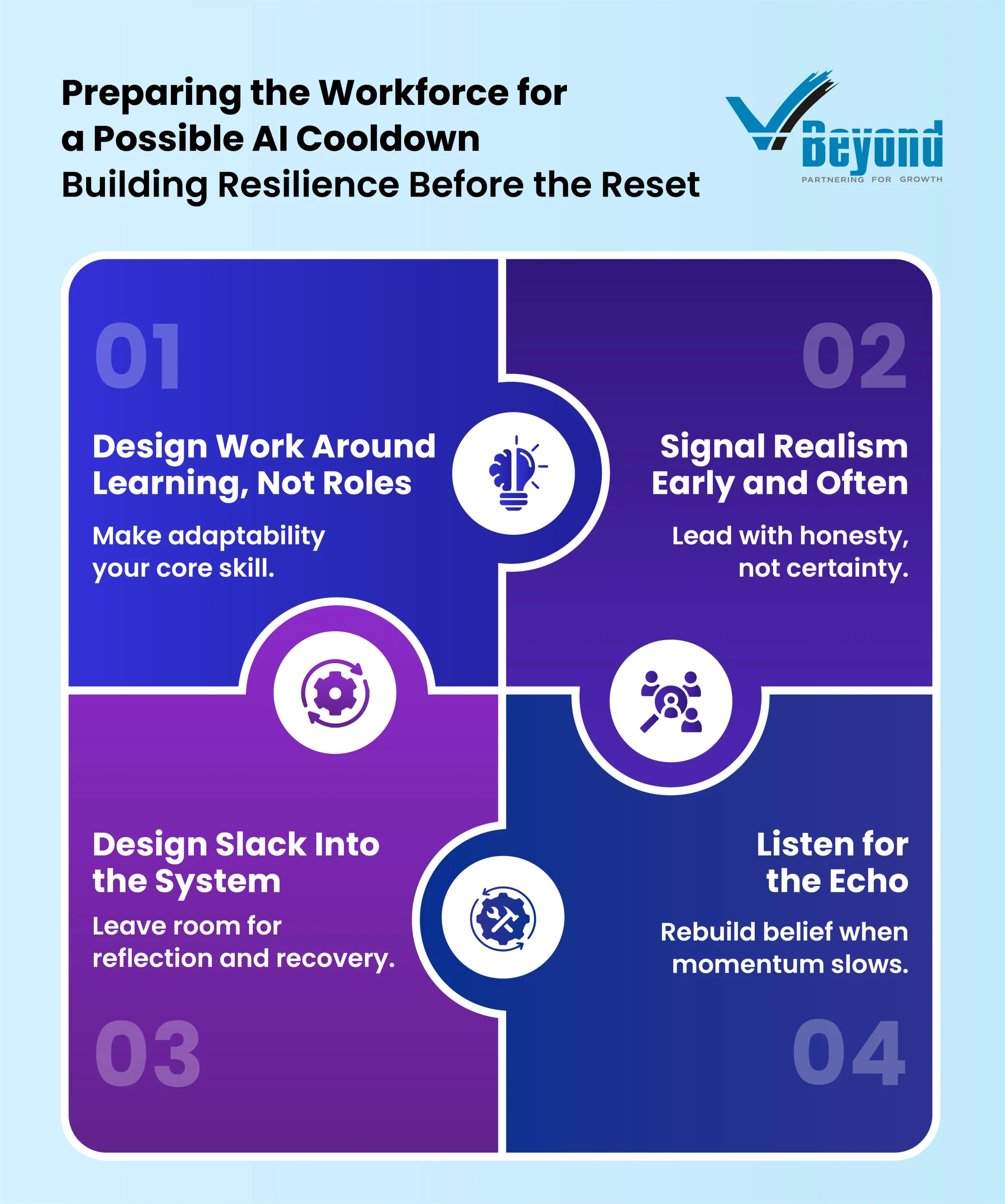
Preparing for a Possible AI Cooldown: Building AI Workforce Resilience Before the Reset
If 2024–25 was the year of acceleration, 2026 may be the year of adjustment. Whether or not the AI boom slows, adaptive leadership in AI adoption means preparing for that possibility: calmly, structurally, and ahead of time. A cooling phase in any technological cycle tests not just strategy, but stamina: how organizations sustain clarity, morale, and innovation when the external narrative shifts from euphoria to equilibrium.
Below are five leadership imperatives for AI workforce resilience that can help organizations remain steady, relevant, and human-centered — even if the AI tide begins to ebb.
1. Design Work Around Learning, Not Roles
If disruption has taught us anything, it’s that job titles expire faster than technologies do. In a cycle where AI can shift workflows overnight, resilience lies not in what people know but in how fast they can learn again. Leaders need to move beyond future workforce planning toward shaping organizations that embody AI workforce resilience — systems that flex and adapt through ongoing AI workforce transformation without losing focus or momentum when direction changes.
Before redesigning structures or reskilling programs, pause to ask:
- Are we building a learning culture or just running training cycles?
- Do our teams understand why they’re learning — or only what to learn next?
- How do we reward learning velocity — the ability to retool fast — compared to static expertise?
- When a major AI initiative slows or pivots, can our people redeploy their skills elsewhere in the organization, or are they locked into silos?
- Are we designing career paths that anticipate volatility — where growth means adaptability, not just promotion?
- How much of our leadership bandwidth is spent on capability mapping versus capacity building?
2. Signal Realism Early and Often
The hardest part of adaptive leadership in volatile markets is holding credibility when prediction itself loses meaning. As cycles accelerate, employees don’t measure leaders by certainty anymore; they measure them by how honestly they navigate the unknown.
So before drafting the next “AI transformation strategy update,” leaders might instead interrogate:
- What truths are we comfortable deferring, and what truths are we morally obligated to state now — even if incomplete?
- How do we ensure our internal story about progress ages well — not just inspires well?
- Do we have a shared definition of “proof” inside the organization, or does each function choose its own threshold for belief?
- When optimism outpaces operations, what’s our mechanism for publicly recalibrating expectations without eroding trust?
- Which of our communication rituals — investor calls, all-hands, executive memos — are genuinely informative, and which exist only to perform confidence?
- Can our culture tolerate a leader saying, “We don’t know yet” — and still interpret that as strength?
- Have we mapped where overconfidence turns into resource misallocation — and who has permission to call it out before it compounds?
Realism is the act of telling the truth at a pace the organization can metabolize. In uncertain cycles, that discipline becomes the new form of courage, and, paradoxically, the most sustainable kind of optimism there is.
3. Design Slack Into the System — Because Efficiency Isn’t the Same as Readiness
When confidence is abundant and capital flows freely, the instinct is to optimize everything: headcount, output, speed. But optimization without margin is a hidden liability. The paradox of a boom is that the stronger it looks, the more fragile it can become. “Slack” — whether in time, thinking, or structure — is not necessarily inefficiency always; it could become resilience by design.
As leaders look ahead to workforce transformation 2026, these five questions reveal whether the system can truly flex when momentum slows:
- What parts of our current model depend on continuous urgency — and what would break if we operated at 80% intensity for six months?
(Sustainability is tested not at peak performance, but at sustained restraint.) - Where in our structure does real reflection happen — not reporting or review, but actual sense-making?
(If there’s no institutional space to interpret what’s changing, agility becomes guesswork.) - Do we treat strategic pause as an act of leadership or as a loss of momentum?
(Cultures that equate stillness with stagnation rarely recover gracefully.) - Have we identified the minimum viable conditions for creative slack — the cognitive, temporal, and emotional room that keeps judgment sharp?
(Because innovation doesn’t survive in continuous motion; it needs oxygen.) - Who monitors the organization’s energy, not just its efficiency?
(Every bubble hides fatigue. Resilience begins where leaders start managing human energy as carefully as financial capital.)
As leaders look ahead to 2026, these five questions reveal whether the system can truly flex when momentum slows:
4. Listening for the Echo: What Happens When the AI Narrative Slows Down
If history has a rhythm, the dotcom bust taught us this: when belief outruns infrastructure, the correction is cultural, not just financial. In 2001, the market cooled, but what actually broke was conviction. Smart people stopped believing in the story they’d been building.
In AI adoption and AI talent strategy, the risk is that entire workforces built around the language of acceleration could lose orientation when progress pauses.
If the AI cycle plateaus, only clarity will keep teams steady. People who joined to “change everything” will need to know what remains worth doing when everything doesn’t change fast enough. That’s not sentimentality; it’s survival intelligence. Machines may predict patterns, but only humans can sustain meaning when patterns shift. Leaders who know how to listen for that quiet echo will know how to rebuild belief before disengagement sets in.
These are some of the questions employees could be asking long before panic sets in:
- Does my organization have a story beyond growth — one that still makes sense when numbers fall?
- If the projects I joined for stall, will my skills still matter, or were they only relevant in expansion mode?
- Who will tell the truth first when the metrics start slipping — and will it sound like leadership or excuse?
- Do we have a language for slowdown that isn’t coded as failure?
- If we’ve automated routine thinking, who’s protecting reflective thinking — the kind that helps us adapt?
- Will I still believe in the mission when the market stops believing in the valuation?
Questions like these remind leaders that resilience is a story people agree to stay inside, not one they’re forced to believe in.
When the Noise Fades: How Adaptive Leadership Thinks in Volatile Times
CEOs in 2026 will do well to remember that there is no fixed playbook for cycles like these, only patterns worth noticing. Every boom carries its own quiet data: the pace of hiring that begins to outstrip clarity, the projects launched faster than they’re understood, the meetings where conviction starts replacing curiosity. What leaders need to do most is to be observant. Rather than trying to time the next inflection, they should spend their energy studying where fragility hides: in assumptions, dependencies, and the stories organizations tell themselves when everything feels unstoppable. Foresight then is more about the discipline to see when momentum turns into noise. In practice, that discipline defines adaptive leadership and leadership resilience, guiding organizations through AI transformation and sustained AI adoption long after the AI boom begins to settle.
Conclusion – The Real Test of 2026: AI Workforce Resilience Before the Reset
The next few years will test not just the limits of technology but the steadiness of adaptive leadership. CEOs treating AI workforce resilience as infrastructure will keep their organizations agile, relevant, and credible throughout ongoing AI transformation. The future of work strategy won’t be defined by who predicts the next cycle, but by the leadership resilience of those who keep their people grounded when it turns.
Leaders can’t control the cycle, but they can shape how their people move through it. Start by investing in learning, truth-telling, and recovery — the real infrastructure of resilience. Partner with us to build the talent architecture your future demands.
1. What is AI workforce resilience, and why does it matter?
AI workforce resilience refers to an organization’s ability to sustain adaptability, innovation, and morale during rapid AI transformation or market slowdowns. It ensures teams stay engaged and capable when technological momentum shifts.
2. How can adaptive leadership strengthen workforce resilience?
Adaptive leadership helps leaders guide teams through uncertainty by balancing strategy with empathy. It turns volatility into opportunity, making leadership resilience and AI workforce readiness central to long-term success.
3. What strategies can organizations use to build AI workforce readiness?
Key workforce resilience strategies include continuous learning, workplace readiness training, and cultivating curiosity over compliance. These enable employees to adapt faster to change and align with evolving AI workforce transformation goals.
4. How does AI transformation impact future workforce planning?
AI transformation is reshaping how businesses design roles, skills, and structures. Effective future workforce planning ensures teams can integrate AI tools responsibly while maintaining human judgment and organizational stability.
5. Why should CEOs treat workforce resilience as infrastructure?
Resilience isn’t a soft skill — it’s structural. CEOs who embed AI workforce resilience into their systems create organizations that remain agile, relevant, and credible through every phase of AI adoption and market fluctuation.
6. What does workforce transformation 2026 mean for leadership?
Workforce transformation 2026 signals a period where technology, adaptability, and human capability intersect. Leaders must anticipate disruption by investing in AI talent strategy, adaptive leadership, and future of work strategy to thrive beyond the next cycle.