Table of Contents
Four Key Takeaways
• AI agents change the nature of human work. As routine processing becomes automated, employees retain responsibility for oversight, failure recovery, and consequential decisions that require business judgment and clear authority.
• Automation-led workforce estimates can overlook hidden workloads. Exception volumes, recovery time, and unassigned supervision duties can create staffing pressures that productivity projections do not adequately capture.
• Staffing decisions must reflect actual operational demands. Organizations need to assess existing capacity and capabilities before deciding whether to redesign roles, develop internal talent, or recruit additional specialists.
• Hiring for AI oversight requires evidence of practical judgment. Recruiters should assess candidates’ business process knowledge, incident prioritization, and escalation decisions through realistic scenarios that reflect the responsibilities of the position.
Introduction
An AI agent reviewing invoices might flag a disputed charge and pause a vendor payment. A finance manager must then check the contract, resolve the dispute, and authorize the next step. Such interventions can be necessary even when the automated process functions as intended. Yet the time employees spend handling them may receive little attention when workforce plans focus on productivity gains from automation.
Gartner’s October 2026 research highlights a related accountability gap. Its July survey of 297 CHROs found that only 24% of leadership teams were aligned on who should be accountable for AI agents. Unclear ownership can make it difficult to assign intervention duties, establish decision authority, and account for the human work supporting agent-driven processes.
For CHROs, recruiters, and hiring leaders, human-in-the-loop AI presents practical questions about workforce capacity and talent requirements. Organizations need to determine where human oversight is necessary, how employees should handle exceptions, and who remains responsible for outcomes.
These responsibilities influence existing workloads, job design, and decisions about additional recruitment. Accounting for them requires a clearer understanding of the work that remains after AI agents take on routine operational activities.
The Expanding Human Layer Behind Autonomous Systems
Autonomous software does not erase people from operations. It shifts the distribution of daily work. Agents complete high-volume, routine tasks while exceptions, sensitive decisions, and failures remain with employees. Deloitte’s September 2026 analysis recommends human intervention at points requiring consequential judgment, exception handling, or evaluation of agent performance. In daily operations, those human duties concentrate across three core areas.
Oversight
Human oversight of AI agents requires monitoring performance and identifying unusual or inaccurate outputs. Teams must determine which activities need periodic checks and which require approval before execution. Gartner’s May 2026 research identifies reviewing agent outputs and managing escalations as responsibilities that managers may need to formally assume.
Recovery
When an agent makes an incorrect decision or a process fails, employees investigate the cause, correct affected records, and resolve operational exceptions. A single error may require further action across connected billing, inventory, or customer systems, even after the immediate problem has been corrected.
Accountability
Clear AI accountability in the workplace requires employees with defined authority to approve exceptions, intervene in consequential decisions, and address their outcomes. Escalation procedures and records of agent actions help establish who authorized decisions and how incidents were resolved.
How Exceptions Escalate in Practice
For example, an autonomous agent matches supplier invoices against purchase orders and delivery records, approving routine transactions. When an invoice includes an unexpected price surcharge and charges for goods not yet received, the agent flags the discrepancy for review. A procurement lead checks the agreed terms, contacts the supplier, and determines whether the invoice should be held or corrected.
The remaining work requires operational judgment, coordination, and employee time, even when organizations do not create new positions to handle it. Moreover, as routine transactions become automated, the work that remains with employees may become more complex, less predictable, and more dependent on experienced judgment.
When AI Adoption Plans Overlook Human Staffing Needs
Many leadership teams build business cases around autonomous software before measuring the human effort needed to sustain it. Deloitte’s August 2026 survey on the AI readiness gap reflects this uneven preparation. Only 25% of surveyed leaders rated their organizations as prepared or highly prepared in workforce readiness, and half reported not making the necessary investments in AI-related workforce transformation.
Not every company faces severe operational bottlenecks. Still, AI workforce planning can overlook ongoing human demands for four primary reasons.
- Automation-led estimates. Leaders may base AI staffing expectations on tasks eliminated rather than measuring the operational work employees must continue performing.
- Unassigned supervision. Existing managers and operational teams may inherit human oversight in AI systems without formal adjustments to daily workloads or targets.
- Technical framing of recovery. Organizations may treat agent failures as occasional software glitches, overlooking the business judgment and decision-making required to resolve operational exceptions.
- Fragmented ownership. Responsibilities split across technology, operations, and risk functions can blur who is accountable for AI agent decisions and leave staffing needs unaddressed.
Operational Warning Signs of Understaffing
When human capacity trails adoption, daily friction surfaces quickly. Exception backlogs swell faster than analysts can clear them, while delayed interventions stall customer shipments or vendor payments. Teams perform recurring rework to catch repeat mistakes, and experienced staff spend unexpected hours correcting flawed agent outputs instead of executing core priorities.
These warning signs may stem from more than software defects alone. They can indicate that human-in-the-loop AI workflows lack sufficient capacity. Without realistic staffing plans, small exception backlogs can compound into costly operational delays as transaction volumes grow.
Discuss AI-related staffing needs with VBeyond Corporation
Discuss AI-related staffing needs with VBeyond Corporation
Implications for Staffing, Job Design, and Hiring
Turning oversight, recovery, and accountability into operational reality requires deliberate workforce choices. Deloitte’s August 2026 survey found that 43% of surveyed leaders expect significant workforce disruption within 12 to 18 months, including changes to job requirements and the creation of new roles. Effective agentic AI staffing translates those shifts into clear capacity plans, redesigned roles, and targeted hiring.
Capacity Must Reflect Human Intervention Requirements
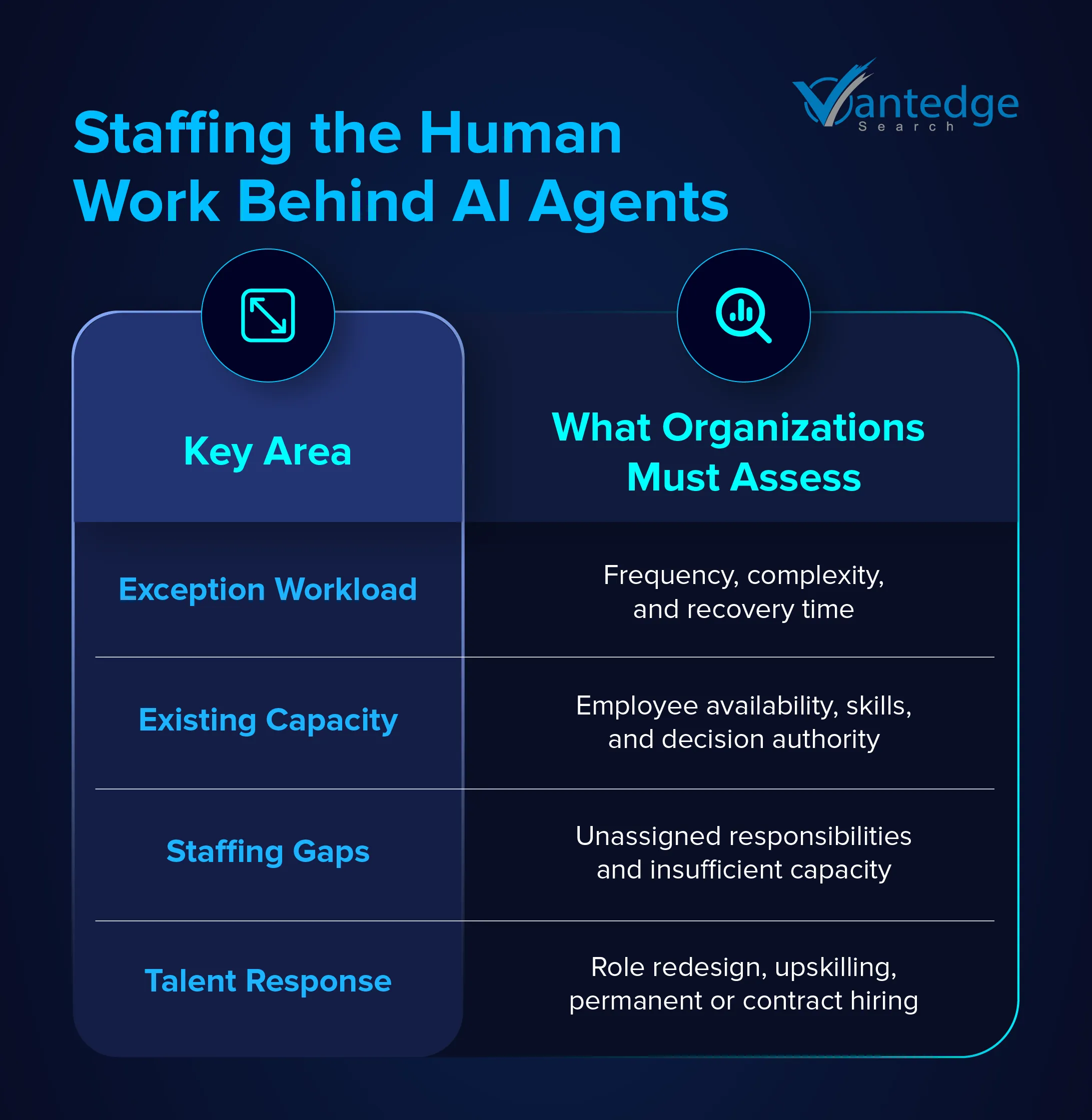
Workforce models cannot rely solely on the volume of automated tasks. Determining how to staff AI oversight teams depends on four practical variables, covering exception frequency and complexity, average investigation and recovery time, the urgency and commercial impact of delays, and staffing coverage alongside existing employee workloads.
No single staffing formula fits every organization. Instead, leaders can compare expected exception volumes and resolution times against available employee capacity to estimate where human capacity will tighten before backlogs build.
Redesign Existing Responsibilities Before Adding Headcount
Organizations do not always need net-new positions right away. Many oversight and recovery tasks fit inside existing operations, quality assurance, technology, or managerial roles. Gartner’s May 2026 analysis notes how agentic systems increase managerial complexity as leaders supervise both employees and autonomous tools.
Leaders must separate duties requiring business judgment from those demanding technical troubleshooting or specialist AI risk management. When current employees absorb these human-in-the-loop AI duties, companies may need to adjust daily workloads, add focused training, or define clearer approval authority.
When Additional Hiring Becomes Necessary
Role redesign reaches its limit when current teams lack the hours or capabilities to contain exceptions safely. Under those conditions, targeted hiring for AI-related roles can fill the gap. Permanent recruitment can address ongoing oversight needs, while contract staffing can support defined periods of specialist demand.
Possible examples include an AI operations specialist, workflow supervisor, or dedicated escalation analyst. While these titles are not uniform industry standards, employers should define the operational responsibilities associated with each position.
Hiring Assessments Must Test Practical Judgment
AI familiarity alone does not establish competence during operational failures. Recruiters should evaluate five grounded capabilities, spanning business process knowledge, analytical judgment, exception handling, systems understanding, and clear escalation decisions.
Scenario-based interviews and practical work samples can help assess these capabilities. Putting candidates in front of an incorrect agent output, a stalled multi-step workflow, and competing deadlines shows how they prioritize incidents and decide when intervention is necessary. Matching assessments to the actual operational duties of the position gives hiring teams clearer evidence of candidates’ judgment and readiness.
A Practical Agenda for HR Leaders, CHROs, and Hiring Teams
Deloitte’s September 2026 analysis of AI agents in the human workplace underscores why organizations must map actual workflows around human judgment rather than waiting for operational bottlenecks to form. HR leaders, CHROs, and hiring teams can apply five concrete actions to existing or planned agent rollouts.
1. Identify Where Human Work Enters Agent-Driven Processes
Workforce leaders should first audit priority workflows where autonomous software executes routine tasks. Teams can map every monitoring checkpoint, approval gate, exception queue, and recovery duty across those processes, then record who currently performs that work and whether formal job descriptions recognize it.
2. Establish Ownership for Oversight and Recovery
Leaders must assign specific employees or functions to review incidents, fix errors, and approve consequential decisions. Defining clear escalation authority alongside explicit AI governance roles and responsibilities can help prevent unresolved operational failures from falling between technology, operations, and risk groups.
3. Test Whether Current Teams Have Sufficient Capacity
Managers should measure actual or expected intervention workloads against available employee hours across affected teams. This operational check clarifies whether current staff can reasonably absorb human-in-the-loop AI oversight or whether existing workloads require deliberate rebalancing.
4. Translate Staffing Gaps Into Specific Talent Decisions
Hiring leaders can convert verified capacity gaps into concrete talent moves, choosing among employee development, internal reassignment, permanent recruitment, or temporary specialist staffing. Recruiting teams should then update job descriptions and candidate evaluation criteria to match the exact roles needed to manage AI agents.
5. Review Staffing Needs as Agent Usage Expands
HR and operations leaders should track exception volumes, recovery workloads, and employee bandwidth after launch. Whenever autonomous systems take on broader processes or handle higher transaction volume, organizations must revisit AI workforce planning assumptions before workloads become excessive.
When internal teams lack the bandwidth or specialist networks to source experienced oversight talent quickly, external staffing partners can handle targeted candidate sourcing and recruitment. Specialized firms help hiring leaders reach qualified operational and technical professionals on permanent or contract terms, keeping AI staffing aligned with actual business demand.
(Staffing decisions also depend on how organizations define authority across employees and AI agents. For a closer look at the governance considerations behind these responsibilities, read our blog, AI Workforce Governance: Managing the Blended Team.)
Conclusion: Staffing for the Human Work Ahead
AI agents can reduce routine work, yet they preserve and create responsibilities that demand human judgment, timely intervention, and clear AI accountability. Treating those duties as incidental additions to crowded roles can increase workload pressure and contribute to operational delays. Workforce capacity assessments must measure oversight and exception recovery with the same rigor applied to software output.
Closing these gaps requires deliberate choices across role design, internal talent development, and specialist recruitment. Organizations adopting agentic AI need workforce plans that account for both automated activities and the employees responsible for managing exceptions and outcomes in human-in-the-loop AI workflows.
When internal teams need broader sourcing reach or specialized talent, VBeyond Corporation supports hiring leaders with permanent recruitment and contract staffing built around operational needs.
FAQs
1. What is human-in-the-loop AI?
Human-in-the-loop AI involves human participation at defined points in an AI-driven process. Employees may review outputs, approve consequential decisions, correct errors, or intervene when automated systems encounter situations requiring human judgment.
2. Why do AI agents still need human oversight?
AI agents can produce incorrect outputs, misinterpret information, or encounter situations beyond their authorized responsibilities. Human oversight helps identify these issues, manage exceptions, and maintain accountability for decisions affecting business operations.
3. Which new roles are emerging to support agentic AI staffing?
Organizations may introduce or expand responsibilities associated with AI operations specialists, workflow supervisors, and escalation analysts. These positions can involve monitoring agent performance, investigating failures, and managing exceptions, although job titles and responsibilities vary across employers.
4. How does AI governance connect to staffing decisions?
AI governance defines responsibility, decision authority, and oversight requirements for AI systems. These requirements help HR leaders determine which employees need additional responsibilities, what capabilities are necessary, and where specialist recruitment or internal training may be required.
5. How can employers assess candidates for AI oversight roles?
Scenario-based interviews and practical work samples can help assess candidates’ judgment, business process knowledge, and exception-handling skills. Hiring teams can evaluate how candidates investigate incorrect agent outputs, prioritize incidents, and determine when escalation is necessary.