
- ATS-first screening will likely remain the default gate in 2026, ranking candidates in seconds based on structure, keywords, and role fit.
- Parsing failures from columns, graphics, and non-standard headings routinely strip key experience from the record that recruiters search.
- Job-description phrase alignment plus quantified results typically improves match signals without turning the resume into a keyword list.
- Recruiter-facing visibility still comes from parallel channels such as LinkedIn search alignment, referral pathways, and targeted outreach.
Introduction: The Rise of the Resume Bot
You can spend hours tuning a resume and still it may never reach human eyes. In 2026, that outcome will keep feeling more common for one reason: most large employers are likely to keep routing applications through an Applicant Tracking System (ATS) before a recruiter reviews anything.
Jobscan’s 2025 review found a detectable ATS on 97.8% of Fortune 500 career sites, which signals how often resume bots sit between candidates and recruiters. In practical terms, an ATS stores your application in a database, then helps hiring teams search and filter candidates by role keywords, skills, and titles.
That first screen can feel like AI resume rejection, even when your experience matches the role. The reason is rarely mysterious. Systems reward resumes they can parse cleanly, then rank or surface profiles that match the job’s language. If the file is hard to read or the signals are weak, the resume often sinks quietly.
The good news? You can make your resume AI-ready using proven resume optimization techniques and still sound human.
In this blog, we will focus on practical ATS resume optimization tips for 2026 so that your skills pass through the bots and reach the decision makers who need to see them.
What Is a Resume Bot — and Why It Keeps Rejecting You
When candidates say, “the resume bot,” they usually mean an Applicant Tracking System (ATS) plus the AI rules layered on top of it. The ATS stores applications, parses your resume into structured fields, and helps recruiters search and filter. Jobscan’s 2025 analysis detected an ATS on 97.8% of Fortune 500 career sites, which tells you how often your resume meets resume bots first.
If you have ever wondered what is ATS in practical terms, think of it as a database with a strict intake form. Your resume is the raw input. The system tries to convert it into clean, searchable data. If the conversion fails, your application looks incomplete even when your experience is strong.
Here is how AI-powered resume screening reads resumes in most modern hiring stacks.
Common Resume Mistakes That Trigger Rejection
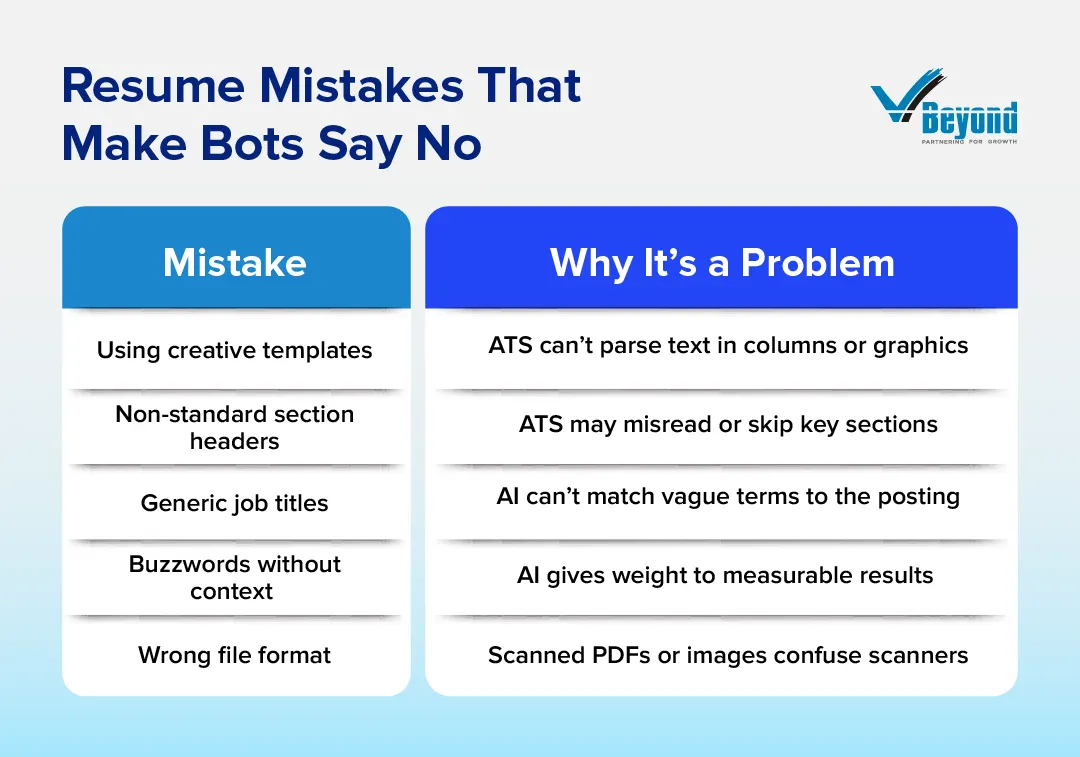
Most ATS resume mistakes are not about content quality. They are about readability and signal clarity. These patterns explain many reasons why resumes get rejected by resume bots before a human review.
- Using creative templates
Two-column layouts, tables, graphics, and photos can look polished, but they often degrade parsing. Jobscan calls out columns and tables as unreliable for many ATS, leading to scrambled or missing data. - Non-standard section headers
Creative labels like “My Story” can feel personal, yet ATS tools often recognize standard headers more reliably. Jobscan lists non-standard headings as a formatting issue that can reduce findability in recruiter searches. - Generic job titles
A quirky internal title may be accurate inside one company, but it can weaken matching outside. ATS databases and recruiter searches often rely heavily on recognizable titles and job language. - Buzzwords without context
Words like “strategic” or “results-driven” often appear with no proof. LinkedIn’s own guidance tends to favor impact and examples over vague claims. A resume that reads like generic branding may pass the parser yet still fail at the shortlist stage. - Wrong file format
The safest files are the ones that keep text selectable and readable. Indeed’sATS resume guidance warns that elements like text boxes, columns, headers, or images can interfere with ATS reading, and points to clean DOCX or text-based PDF formats.
One line captures the mechanics: if the resume bot cannot read it, it cannot rank it.
Resume Optimization Strategies to Beat the Bot
In 2026, the most effective resumes will likely behave like well-structured business documents: simple intake, clear evidence, fast relevance. ATS resume optimization in 2026 is expected to be less about tricks and more about signal design.
The resume optimization techniques below follow a simple idea. Make your resume easy to parse, easy to search, and hard to ignore.
Mirror the Job Description — Naturally
It often helps to begin with the job posting rather than a blank page. The repeated phrases usually reveal how the role is defined internally, and those exact terms are frequently the same ones the ATS expects to see.
If the posting mentions “cross-functional collaboration,” that wording can appear once or twice in your resume where it fits truthfully.
Before: “Worked with multiple teams to deliver projects.”
After: “Led cross-functional collaboration across product, sales, and engineering to launch a pricing update within 6 weeks.”
This approach is not about copying. It is about alignment through resume keyword matching. ATS search and ranking still relies heavily on job-specific terms, and resumes that echo the posting’s language tend to match more cleanly.
A practical pattern for resume optimization may look like this:
- Identify 10 to 15 must-have terms in the posting.
- Link each term to a real achievement or responsibility from your background.
- Place each term once in context, then move on.
One small but useful detail: When an acronym appears in the posting, both versions can help. “Customer Relationship Management (CRM)” and “CRM” cover the common search paths recruiters and systems take.
Simplify Formatting
An ATS-friendly resume format tends to look plain because plain reduces parsing errors.
Layouts that usually behave well in ATS parsing may include:
- Single-column structure
- Standard headers such as Summary, Work Experience, Skills, Education
- Bullets for achievements
- Simple fonts and consistent spacing
- Dates written clearly and consistently
Jobscan specifically warns that tables and columns can lead to ATS parsing errors, which can cause content to be skipped or misread.
For file type, many systems handle both Word and text-based PDFs; so, saving as .docx or a text-based .pdf is the safest default unless the employer requests a specific format.
Quantify Impact
Numbers cut through the noise because they make your claims testable. They also help a recruiter decide quickly whether your scope matches the role level. You can upgrade bullets using a simple formula: action + asset + metric + business effect.
Here are a few examples:
- Reduced ticket resolution time by 18% by updating triage steps and coaching 12 agents.
- Increased conversion rate by 9% after testing two landing page variants and tightening audience targeting.
- Cut monthly close time from 10 days to 6 by standardizing reconciliations across three teams.
If a metric is sensitive, you can use ranges or relative change. In short, precision matters, but credibility matters more.
Choose Relevant Keywords
Keyword strategy in 2026 is less likely to be about volume and more about coverage. The goal is to include the terms recruiters search for and that the ATS uses for resume keyword matching—then back them up with proof.
A straightforward keyword map may often include:
- Role keywords (the job title and close equivalents)
- Hard skills (tools, systems, programming languages, certifications)
- Domain terms (industry vocabulary the posting repeats)
- Human skills (communication, leadership, stakeholder management) only when supported by examples
Rezi’s keyword guidance emphasizes placing the target job title in the summary, listing key abilities in the Skills section, and then proving them in Experience bullets.
One tactic candidates sometimes miss: Many ATS parsers expect skills in a dedicated Skills section. Clear labels in that section can improve both parsing and recruiter search.
Test It Before You Submit
A simulated scan can reveal blind spots that are hard to spot in Word or PDF.
Jobscan’s ATS resume checker positions itself as a comparison against real job listings, checking keywords and formatting issues. Rezi’s resume checker describes a 23-point ATS analysis that includes file type, section headers, and keyword checks.
These ATS resume checker tools are most useful as diagnostics. Parsing comes first, alignment comes next, and the final pass is about readability for humans.
For more support, reach us today.
Go Beyond the Bot: Human Strategies That Still Work
In 2026, the hiring process is expected to run more on trust. As automation handles early screening, recruiters are placing greater weight on credible human signals: referrals, verified skills, and visible proof of work. That is why job search networking and smart visibility moves continue to matter. Beating resume bots is only half the job. Getting seen by humans is the outcome that changes your week.
Make LinkedIn Recruiter-Search Friendly
Recruiters will likely keep treating LinkedIn like a search engine. LinkedIn’s own guidance on keywords suggests aligning your headline, About section, and experience language with the roles you want, using the same terms found in job postings.
The highest-visibility areas tend to be:
- Headline
- About section
- Recent role bullets and Skills list
Small changes here can improve discoverability without making the profile read like a keyword dump.
Referrals Remain a High-Trust Signal
Referrals can move your application from anonymous to known, because someone inside the company can attach context that an ATS cannot infer. SHRM has reported examples where referrals convert strongly into hires in some organizations, showing why many teams treat referrals as a high-signal pipeline rather than a nice-to-have.
When possible, you must use more than one submission path:
- Apply through the official career page to keep your application compliant and complete.
- Also ask a relevant employee contact to submit an internal referral for the same requisition, if the company supports it.
The exact rate will vary by employer and industry, yet the logic is consistent: when a trusted employee vouches for a candidate, recruiters often treat the resume as lower risk.
Outreach That Gets Read
Many recruiter inboxes are crowded. Messages that earn replies tend to be specific, evidence-based, and low-effort to answer.
A structure that often works:
- One line on the role target.
- One proof point with scope or results.
- One clear question, such as whether the team is open to a short conversation.
This style lands as respectful and professional, and it fits common recruiter tips around clarity and intent.
Proof of Work Builds Credibility Fast
In 2026, portfolios and work samples will likely spread beyond design and engineering. A short case study, a project summary, or a compact link to results can move you from “maybe” to “worth a call” quickly.
Even for non-technical roles, a one-page example that shows constraints, decisions, and outcomes gives a hiring manager something real to evaluate.
AI Is Quietly Learning From Your Resume — Not Just Ranking It.
In 2026, optimizing your resume won’t just be about getting past the filters; it will also shape how those filters evolve. Every resume that passes through an ATS adds to a growing data set that teaches hiring systems what “qualified” looks like.
That means your document isn’t only being ranked. It is part of what the system learns from. Over time, phrasing patterns, structure choices, and achievement styles that correlate with successful hires begin to influence how future resumes are scored.
For candidates, that turns optimization into something bigger than strategy. The clarity and credibility of your language help shape what recruiters and algorithms come to value next. You’re not just responding to hiring AI; you’re quietly helping train it.
Conclusion: Don’t Game the System — Master It
AI is not replacing recruiters. It is shaping the front door.
In 2026, the most effective candidates will likely treat the resume as a decision document. The format must parse cleanly, the content must match the job language, and the evidence must feel specific. That is what reduces AI resume rejection and turns ATS resume screening into a predictable step instead of a mystery.
At the same time, a resume should not carry the whole job search alone. LinkedIn visibility, targeted outreach, and job search networking create parallel paths to human review. A referral or a direct connection often changes how quickly your profile gets attention, even when the ATS still sits in the workflow.
The system does not need to be tricked. It needs clear signals. With the right ATS resume optimization tips, resume bots can recognize your value, and a recruiter can act on it.
When ATS-led screening creates noise, strong sourcing and structured hiring matter more. For more information and career guidance, contact VBeyond Corporation today.
FAQs
1. What is ATS resume optimization?
ATS resume optimization is tailoring your resume’s formatting, structure, and keywords so applicant tracking systems can correctly parse sections like Skills and Experience, match job-description terms, and rank your application for recruiter review.
2. Why does ATS reject resumes that match the job?
ATS may reject a matching resume when it can’t extract text cleanly, or when crucial job-title and skill keywords aren’t present in the exact or semantically related wording the system scores.
3. How can I beat ATS resume screening in 2026?
To beat ATS resume screening in 2026, you should use a simple one-column layout with standard headings; mirror job-description keywords naturally in summary, skills, and bullets; and run an ATS checker to fix gaps before submitting.
4. What is the best ATS-friendly resume format?
The best ATS-friendly resume format is clean and text-based with a single column, standard section headers, consistent dates, no tables, columns, images, or graphics, saved as .docx or a readable PDF.
5. How does AI read resumes in an ATS?
In an ATS, AI typically parses your file into sections, strips formatting to extract raw text, compares it to the job description via keyword and semantic matching, then assigns a score or rank for review.