Key Takeaways
• Discomfort is a workforce reality, not a leadership failure.
High-performing teams aren’t shielded from uncertainty; they’re supported through it by leaders who understand how discomfort shows up across roles, generations, and work systems.
• Leadership performance is measured by how teams learn and adapt under pressure.
Leaders who prioritize learning, reflection, and psychological safety help teams convert friction into capability, rather than burnout or disengagement.
• Sustainable team performance comes from how work is designed, not just who leads it.
Micro-challenges, shared ownership, emotional steadiness, and clarity during change are practical leadership moves that strengthen workforce resilience and collective performance over time.
Practical Employee Experience Strategies for High-Pressure, Fast-Changing Organizations
Most teams want to grow and perform better, but few are truly prepared for the friction that real growth demands. In every organization, the defining moments of leadership don’t happen during smooth quarters or easy wins; they emerge in the uncertain middle, when projects stall, priorities shift, and comfort fades. That’s where effective leadership strategies make the difference.
Discomfort doesn’t weaken team performance; it exposes resilience: how people respond to pressure, adapt to change, and rediscover their capacity to lead (a dynamic widely noted in leadership research and practitioner writing, including Forbes, 2025). Leaders who can guide their teams through challenge and discomfort, instead of avoiding it, are the ones who build strong, sustainable workplace cultures and contribute to creating high performance organizations.
Setting the Context: Leading Organizational Change When the Ground Never Stops Moving
Something quiet has shifted in the way people experience work. It isn’t just that business moves faster; it’s that the ground itself keeps changing beneath them. Job titles that once felt secure now dissolve into temporary projects. Teams reorganize before they learn each other’s rhythms. Skill sets, once a source of pride, now come with an expiry date, a reality shaping how organizations think about building a future ready workforce.
Comfort hasn’t disappeared in the modern workplace; it’s been redefined in organizations navigating enterprise transformation. It now means maintaining balance while the landscape of work keeps tilting. The workforce is learning to exist in a constant state of motion: to live inside transition rather than move through it. And that constant motion brings its own kind of workplace discomfort — the disorientation of being permanently “in draft.”
There’s a quiet restlessness in every meeting room now, not always visible, but deeply felt. Senior professionals edit themselves mid-sentence, worried their experience sounds outdated. Early-career employees hesitate not from fear but from fatigue, the feeling that every contribution must double as a performance. Everyone is adjusting, constantly, silently. It’s not laziness or fragility; it’s a new form of vigilance, the human mind bracing for a world of continuous change.
Workplace discomfort today isn’t about occasional challenges but about velocity: the pace at which meaning, roles, and relevance shift. It’s the fatigue of having to learn, unlearn, and make sense faster than you can process. Yet hidden inside that unease lies an extraordinary possibility. People are developing a new kind of leadership intelligence: adaptive, integrative, collective. Teams are learning to improvise together, to respond to change not with panic but with purpose – the foundation of a resilient performance culture.
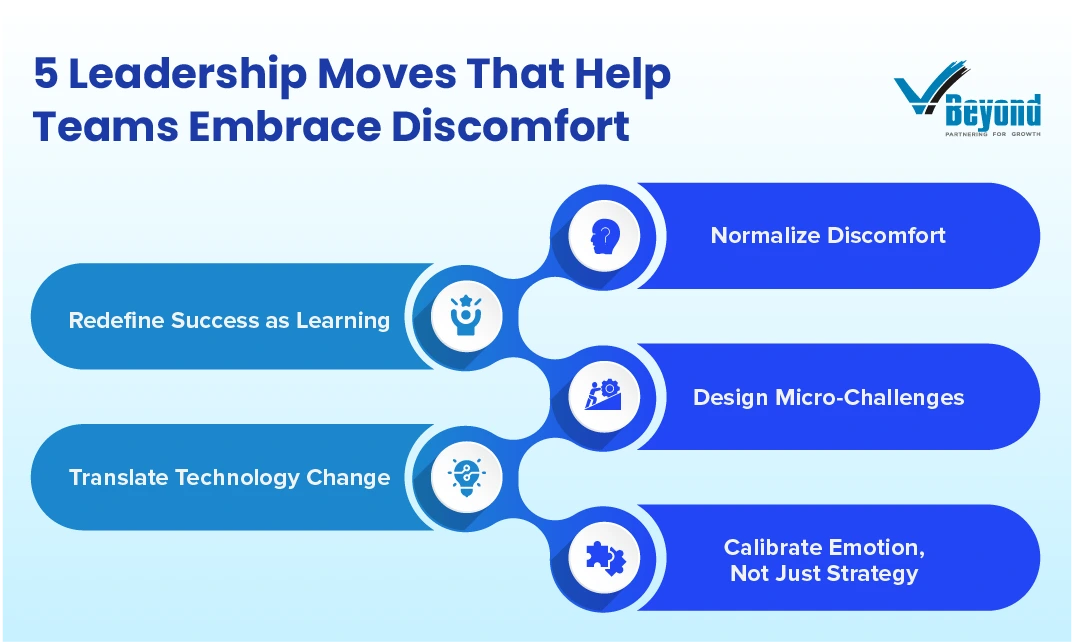
5 Leadership Strategies to Help Teams Embrace Discomfort
Given the backdrop, this moment demands a different kind of leadership. Not the kind that shields teams from uncertainty, but leadership strategies grounded in adaptability and clarity. These are strategies that help teams metabolize change, turning motion into mastery, confusion into curiosity, and discomfort into direction while leading organizational change.
1. Normalize Discomfort as a Catalyst for Growth
Not all discomfort is the same. There’s the kind that drains — uncertainty without direction, pressure without purpose. But there’s also constructive discomfort — the kind that signals growth in motion. It’s what people feel when they’re doing something they haven’t yet mastered, or when they’re in dialogue that matters enough to sting a little. Constructive discomfort isn’t chaos; it’s clarity under stretch, a core element of strong strategic leadership skills.
What leaders often miss is that discomfort doesn’t appear the same way for everyone. It’s contextual, shaped by generation, role, and even psychological wiring, a reality that makes effective multigenerational workforce management more important than ever.
For a Gen Z professional, discomfort often comes from ambiguity — unclear expectations, moving targets, or values misalignment. They grew up in a hyper-transparent, feedback-rich world; silence or vagueness reads as neglect. So, when tension surfaces, a leader might ask:
“What feels unclear right now — the task, or the why behind it?”
That small question separates confusion from miscommunication and restores agency.
For a millennial manager, discomfort tends to stem from competing identities — wanting to mentor while still proving competence, balancing ambition with fatigue. Their version of discomfort isn’t chaos; it’s compression. In one-on-ones, a leader could frame it by saying,
“You’re straddling two gears right now — growth and guidance. Which one feels harder to hold?”
That reframes pressure as evolution, not inadequacy.
For a Gen X or senior leader, discomfort often hides behind control. After years of equating stability with strength, they may struggle when experience no longer guarantees certainty. In those moments, a peer or coach might simply ask,
“Is this a moment to know, or a moment to learn?”
The question humanizes discomfort; it reminds even seasoned leaders that learning is not regression, it’s renewal — a hallmark of effective executive change leadership.
And for the organization itself, discomfort shows up systemically — in overlapping restructures, in endless “transformations,” in the quiet fatigue of teams that feel like experiments in perpetual motion. Leaders who name that pattern openly (“We’ve been changing so fast that we haven’t caught our breath — let’s make sense of what’s stable before we move again”) give their people the grounding they crave but rarely voice.
This is what it means to normalize discomfort — not to glorify stress, but to make space for it to speak. It’s recognizing that unease has dialects: frustration, fatigue, resistance, silence. Leaders who can translate those dialects into insight turn discomfort into intelligence.
Because discomfort, when read with empathy, doesn’t divide teams; it diversifies their learning. It teaches everyone — from the intern to the executive — that leadership isn’t about knowing what to do next.
It’s about staying open when everyone else wants to close.
2. Redefine Success Around Learning, Not Survival
Somewhere along the way, “learning culture” has turned into “survival culture.”
We’ve made adaptability sound inspiring while turning it into a permanent audition. Employees are asked to keep evolving, but without the time, trust, or psychological space that real learning requires. This is a tension many organizations face when trying to build a sustainable performance culture.
What happens to learning when every development conversation sounds like a veiled performance review?
People stop experimenting. They start curating themselves. They don’t ask, “What do I want to master next?” — they ask, “What will keep me safe this quarter?”
And what happens to innovation when curiosity starts to feel dangerous?
Ideas shrink. Teams start looking sideways for reassurance instead of forward for possibility. Growth turns defensive, not generative.
This is where leadership must step in: not with slogans about “continuous upskilling,” but with the courage to design conditions for humane learning.
Because learning under threat isn’t learning; it’s defense.
But what does humane learning look like, especially in environments focused on enterprise talent management and measurable outcomes?
It looks like giving people permission to pause, to think before reacting, to make sense before producing. It looks like managers who ask, “What did this teach you?” instead of “Why did this slip?” It’s systems that measure what’s been discovered, not just what’s been delivered. These are systems that support long-term scaling leadership, not just short-term output.
Leaders who truly want teams to embrace discomfort as part of performance culture must draw a line between productive stretch and chronic strain.
Ask:
“Are we challenging our people to grow, or cornering them into proving they deserve to stay?”
And what’s the difference, really?
Productive stretch expands capability; chronic strain erodes confidence.
The first builds resilience. The second breeds resentment.
A team under pressure may deliver output, but it won’t deliver innovation.
Innovation requires psychological oxygen: the ability to make sense of change without fear of erasure.
How do you know your team is running out of oxygen?
When meetings become quiet. When no one disagrees anymore. When progress reports sound smoother than reality. That’s not discipline; that’s depletion.
So redefine success not as who adapts fastest, but who learns most deeply.
That means rewarding reflection, not just reaction.
You could start with certain shifts, if not applicable already:
Start with some shifts that most organizations still avoid:
- Ask for slow answers.
In strategy meetings, tell people not to respond immediately. Ask them to come back tomorrow with what changed in their thinking overnight. You’ll learn who actually reflects and who just reacts. - Revisit decisions, not just outcomes.
When something succeeds or fails, deconstruct the decision-making process, not just the result. Most insight hides in the moments we never review. - Let silence stand.
In a culture addicted to speed, stillness feels awkward. Keep the silence after a tough question. Someone will eventually say what actually matters. - Ask “what surprised you?” more than “what went wrong?”
It’s the fastest way to surface pattern recognition — the real currency of intelligent teams. - Promote the person who helps others learn faster.
Stop glorifying lone problem-solvers. Celebrate the ones who expand collective capability — the invisible multipliers. - Show that changing your mind is an executive skill.
When leading organizational change, say it out loud when you’ve reversed a stance. It gives everyone permission to evolve without fear. This is what sustainable enterprise transformation actually requires.
3. Build Micro-Challenges Into Everyday Work
Sustainable adaptability comes from building micro-challenges as part of leadership strategies. These challenges are the kind that unsettle without overwhelming, stretch without snapping.
They’re friction by design: controlled turbulence that keeps teams alert, humble, and inventive. This is a practical pathway to creating high performance organizations without relying on crisis as a catalyst.
Here’s how leaders can design for it quietly, intentionally, and without turning performance culture into chaos:
1. Rotate ownership, not just roles.
Instead of giving the same people the same kind of challenges, rotate who defines success for a project.
Let a mid-level manager set the problem statement for a cross-functional initiative.
Let a junior designer facilitate a retrospective.
This doesn’t just redistribute responsibility; it builds strategic empathy. People learn what pressure looks like from different seats. This is an essential step in scaling leadership beyond a few visible individuals.
2. Introduce discomfort sprints.
Once a quarter, pick a live business issue and give a small cross-level team 48 hours to propose one nonlinear solution, something that would never survive a normal approval chain.
These short, time-boxed challenges keep risk-taking alive without long-term exposure, balancing innovation with thoughtful executive risk management.
3. Make friction part of meetings, not an interruption to them.
Every leadership or team review should include one stretch question, something that slightly destabilizes consensus:
“What would we do if this assumption stopped being true tomorrow?”
“Who would disagree with this plan if they were allowed to?”
This isn’t provocation for its own sake — it’s calibration. It keeps collective thinking elastic, which is critical during periods of enterprise transformation.
4. Pair opposites on purpose.
Deliberately match thinkers who see the world differently: an analyst with a designer, an engineer with a marketer.
Don’t ask them to agree; ask them to produce something that neither would have created alone.
That’s not collaboration, but creative friction by architecture.
5. Reward unfinished wins.
Instead of celebrating only the end of projects, celebrate the point where a team chose a harder path: rewrote a plan, challenged an assumption, took longer for the right reason.
That’s how you turn discomfort from a penalty into a badge of progress.
6. Install “reverse reviews.”
Once a month, flip the hierarchy: let younger or newer team members critique existing processes or leadership habits, anonymously if needed.
It builds upward feedback loops and keeps leaders slightly uncomfortable, which is often where their best insight lives.
Micro-challenges don’t need grand budgets or slogans.
They need leaders who understand the physics of pressure. That tension, when applied precisely, strengthens a system; when applied unevenly, it breaks it.
4. Reframe Technology Fear Into Shared Readiness
Every organization today lives in the tension between awe and anxiety.
The tools meant to expand human potential also seem to threaten it. This is a dynamic shaping how leaders approach AI in workforce management and broader digital adoption.
The fear is informational. It tells leaders that the emotional infrastructure around technology hasn’t kept pace with the technical one. In digital enterprise transformation, this emotional gap becomes the hidden risk.
When people worry that AI might replace them, they’re really saying, “I don’t yet see my place in what’s coming next.”
That’s the gap leaders must close as part of enterprise digital strategy.
Here’s what it looks like in practice:
- Translate disruption into direction.
Before announcing a new system, begin by answering the only question people really have: “Where do I still matter?”
Clarity strengthens confidence and supports long-term business resilience management, not just short-term compliance. - Turn demonstrations into discussions.
Bring teams into early pilots, not polished rollouts. Let them explore the tool, critique it, teach each other. Ownership erases fear and builds a more future ready workforce prepared to evolve with technology rather than resist it. - Make “human advantage” explicit.
Label the moments that still require judgment, empathy, or ethics. It reminds everyone that intelligence is only one dimension of value. - Balance learning with reassurance.
Every upskilling plan should include a clear statement of continuity — what will not change, what will remain human. Stability is as strategic as speed.
When leaders narrate change instead of merely enforcing it, AI stops feeling like an algorithmic shadow and starts becoming an ally in evolution.
5. Make Leadership a Source of Emotional Calibration, Not Just Strategic Direction
When the environment is unstable, leadership tone becomes the climate.
How a leader reacts under pressure is how the organization learns to feel under pressure.
- Stabilize through rituals.
- Regular check-ins, consistent one-on-one time, even predictable language (“Let’s pause and make sense before reacting”) signal reliability. Routine is resilience — and resilience is foundational to long-term business resilience management.
- Coach for self-regulation, not positivity.
- Instead of telling teams to “stay optimistic,” teach them to stay steady. Optimism is mood; steadiness is capability.
- Acknowledge collective emotion.
- “I can sense fatigue this week — let’s name what’s heavy before we push forward.”
Emotional honesty doesn’t weaken authority; it legitimizes it.
- “I can sense fatigue this week — let’s name what’s heavy before we push forward.”
Leaders today are not just strategy architects but emotional regulators of organizational systems.
When they keep the current steady while leading organizational change, teams find their own rhythm within uncertainty.
Conclusion
There is no single formula for leading teams through discomfort, and that is what makes leadership strategies both complex and deeply human. Every team experiences uncertainty differently, and effective leaders don’t rely on templates; they adapt in real time, turning discomfort into direction, a defining trait of those truly leading organizational change. Change will always create friction. The role of leadership isn’t to eliminate it, but to help people find their footing within it, and continue to perform while the ground is still shifting.
Building teams that perform under pressure starts with the right people.
If your organization is navigating change or growth, partner with us to help you find talent that can thrive through it.
FAQs
1. What leadership strategies are most effective during organizational change?
Effective leadership strategies during organizational change focus on emotional steadiness, clear communication, and structured opportunities for team learning. Executives who normalize discomfort and guide teams through uncertainty build stronger performance cultures and more resilient organizations.
2. How can C-suite leaders build high-performance teams in times of rapid change?
C-suite leaders build high-performance teams by creating psychological safety, rotating ownership of strategic initiatives, reinforcing accountability, and embedding micro-challenges into daily work. High performance emerges when discomfort is structured, not suppressed.
3. How does AI in workforce management impact leadership today?
AI in workforce management increases efficiency and insight, but it also raises workforce uncertainty. Executive leaders must connect digital transformation to human value—clarifying where employees contribute and how technology enhances, rather than replaces, their role.
4. What role does emotional intelligence play in executive change leadership?
Emotional intelligence is central to executive change leadership. In volatile environments, leadership tone shapes organizational behavior. Leaders who regulate their response under pressure help teams remain steady, focused, and adaptable.
5. How can organizations sustain performance during enterprise transformation?
Organizations sustain performance during enterprise transformation by aligning strategy with culture. This includes strengthening enterprise talent management, reinforcing resilience, and ensuring leadership behaviors support long-term adaptability—not just short-term output.
6. How can executives strengthen business resilience during periods of continuous disruption?
Executives strengthen business resilience by aligning leadership strategies with long-term capability building. This includes investing in enterprise talent development, reinforcing a performance culture grounded in learning, and ensuring that change initiatives support both operational stability and workforce adaptability.