
Table of Contents
Three Key Takeaways
• Removing management does not remove management work.
After delayering, leaders need to know where that work has gone—and what may have quietly stopped happening.
• Measure complexity, not just headcount.
The right span of control depends on how much judgment, change and complexity a manager must carry, not simply the number of direct reports.
• Protect the management capacity you’ll need tomorrow.
Short-term efficiency can create longer-term management debt—and make leadership roles less attractive to the people you most want to fill them.
The Middle-Management Gap Efficiency Drives Have Left Behind
For years, efficiency has meant taking things out: layers, roles, handoffs, cost. In many organizations, that worked. Structures became leaner, spans of control widened and decisions moved faster. But organizations may also have removed middle management faster than they have removed the need for it. The work of making judgment calls, developing people, connecting teams and carrying strategy into execution still has to happen, often with fewer people available to do it. And high-potential employees can see what the manager’s job has become. The next efficiency question for the C-suite may be less about what else can be removed and more about whether the organization left behind can lead itself well.
When Leaner Changes the Job of Managing
There was good reason to question how much middle management organizations had accumulated. Layers slowed decisions, responsibilities blurred across reporting lines, and managers sometimes spent more time moving information through the organization than acting on it. Technology has made some of that coordination unnecessary, while cost pressure has forced a harder look at work that no longer earns its place. For some companies, fewer layers have brought greater clarity and speed. There is no reason to assume that every management role removed should return, or that a particular span of control is right for every business.
What deserves more scrutiny is what happens after the structure gets leaner. Fewer managers can mean larger teams, broader responsibilities and less time for the parts of management that are difficult to compress: coaching someone through a difficult transition, noticing when execution is drifting, resolving friction between functions, exercising judgment when the process does not provide an answer, or preparing someone to take on greater responsibility. Some of this work can be simplified, redistributed or supported by technology. Some cannot. Companies need to know which is which, rather than discovering the difference when a decision stalls, a strong employee leaves or an important capability has quietly weakened.
There is another consequence that is easier to miss. Employees who might once have seen management as the natural next step can see the job being created by these changes: more people to lead, more ground to cover and greater accountability, sometimes with less support and authority. Some will still want that responsibility; others may decide that expertise, specialist careers or opportunities elsewhere offer a better path. That makes the middle-management gap more than a question of how many managers an organization has today. It also raises questions about the work managers are carrying, how much the organization can reasonably ask of them, and whether its strongest future leaders still want the jobs it will eventually need them to fill.
Build Stronger Middle Management with VBeyond.
Build Stronger Middle Management with VBeyond.
Closing the Gap Without Rebuilding the Layers
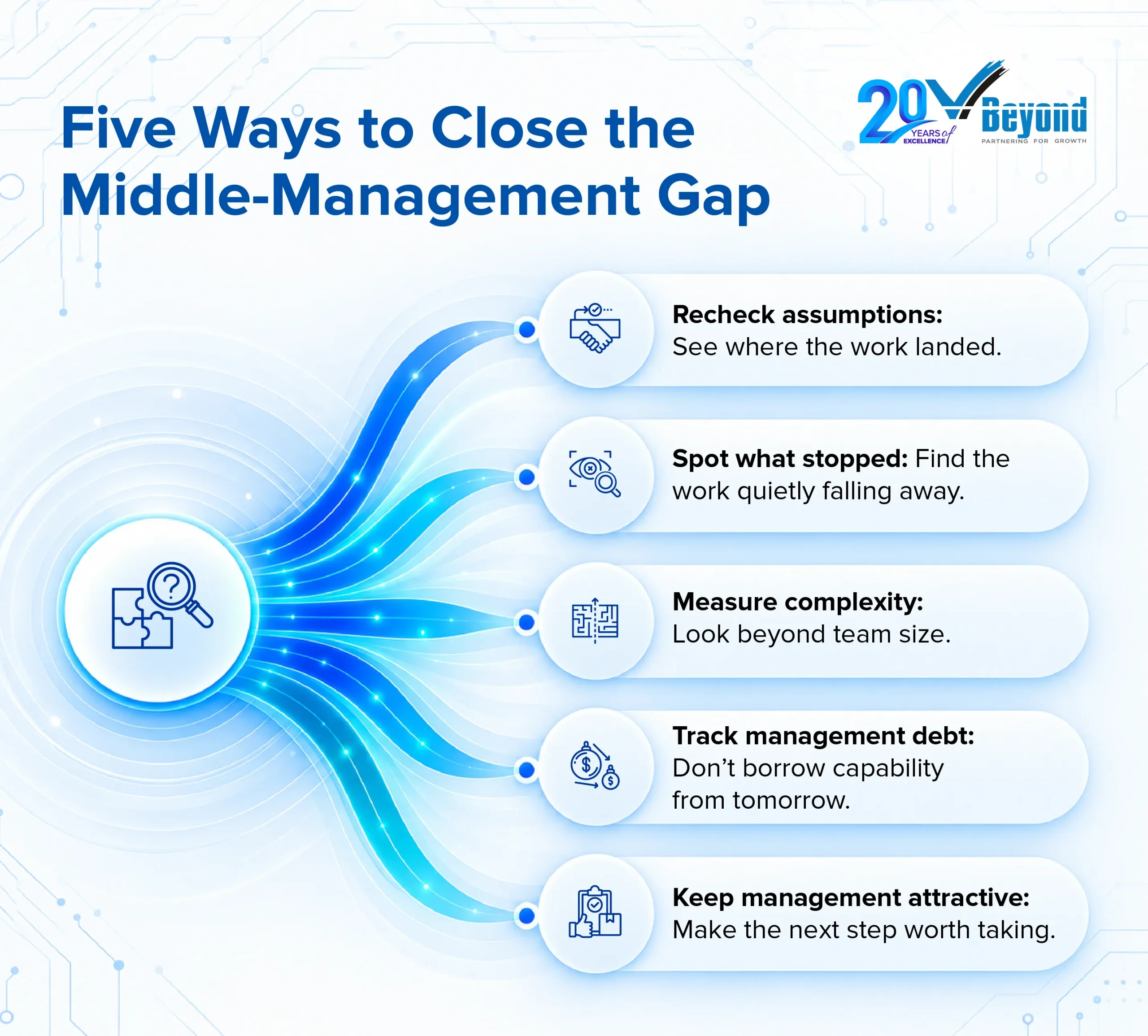
The answer is unlikely to be hiring back every manager who left. Nor is there one management model that will work across businesses, functions or stages of growth. The better starting point is to look at what the leaner organization is actually asking middle management to carry now, and whether the choices made during the efficiency drive still hold up in practice. Five areas deserve a closer look.
1. Revisit the Assumptions, Not the Decision
Few leadership teams remove a layer of management without doing the arithmetic. Costs are modeled, spans are examined, responsibilities are reassigned and a new structure is designed. The more interesting test comes later. An org chart can predict where work is supposed to go; it cannot always predict where that work will actually end up.
Once the new structure has had time to settle, some responsibilities will have disappeared as intended. Others may have moved upward to senior leaders, downward to employees, across to another function, or simply joined the workload of the managers who remain. None of this necessarily means the original decision was wrong. It does mean that the original assumptions have now had something they did not have when the decision was made: a chance to meet reality.
A useful review, then, is less about asking whether too many managers were removed and more about following the work. What disappeared because it genuinely no longer needed doing? What is still being done, just somewhere less visible? And where has a saving in one part of the organization quietly become somebody else’s Tuesday afternoon?
That last question can be surprisingly revealing. A role can disappear from the payroll while much of its work survives in fragments across the business. Knowing where those fragments landed is the first step toward deciding whether the leaner structure is working as intended.
2. Look for the Work That Leaves No Alarm When It Stops
Some management work announces itself when it is neglected. A deadline slips, a customer complains, a target is missed. Other work can disappear for months without producing an obvious warning: developing someone who could take on a bigger role, noticing that a capable employee is becoming disengaged, helping two teams resolve a recurring tension, or passing along the context that allows someone to make a better judgment next time.
Leaner structures put this work under particular pressure because urgent work usually wins. A manager with a wider span will still deal with the escalation, approve the decision and get the deliverable over the line. What gets postponed is often the work whose value arrives later. One missed coaching conversation means very little. A year of them can mean a great deal.
This is worth examining separately from workload. What important management work in your organization can be postponed repeatedly without appearing on a dashboard? Who notices when developing people gives way to managing deadlines? And what are your managers no longer doing—not because anyone decided it was unnecessary, but because something more urgent always gets there first?
The danger is not simply that managers become busier. It is that the organization can remain apparently efficient while slowly consuming capabilities it will need later.
3. Put a Price on Managerial Attention
Businesses are accustomed to thinking about capacity. A plant can only produce so much. A sales team can only cover so many accounts. Capital gets allocated because everyone accepts that it is finite. Managerial attention is finite too, yet organizations often behave as though another team, another priority or another responsibility can be added without changing what a manager is capable of seeing and doing well.
Headcount alone tells us surprisingly little. Ten experienced people doing familiar work may require less management attention than five people navigating a new market, a difficult transformation or rapidly changing customer expectations. Two teams of identical size can place entirely different demands on the person leading them. A span of control that works beautifully in one part of the business can become unmanageable in another.
That suggests a different conversation about capacity. Where does one hour of a good manager create the most value in your business? Which teams consume more managerial judgment than their headcount would suggest? And when you give a manager one more responsibility, what are you assuming will require one hour less?
Perhaps the useful number is not how many people report to a manager. It is how much complexity reports to them.
4. Ask What Management Debt You Are Building
Some efficiencies pay for themselves and stay paid for. Others come with a bill that arrives later. Middle management can fall into the second category because some of its value only becomes visible over time: a successor who was ready when needed, institutional knowledge that survived a transition, a difficult team that did not lose its best people, or a problem that was dealt with before it became an expensive one.
This creates something worth thinking about as management debt. It is not a reason to preserve roles simply because they existed before. It is a way of recognizing that today’s leaner structure can borrow against capabilities the business may need tomorrow. The organization can appear to be performing well while its bench gets shallower, knowledge becomes concentrated in fewer people, and recovery from an unexpected departure or business change becomes harder.
The useful questions are therefore forward-looking. What are we relying on today that we are no longer replenishing? Where would the business feel the loss of an experienced manager only after that person was gone? And which savings would look different if we included the cost of rebuilding a capability two years from now?
Management debt does not appear as a liability on the balance sheet. That does not make it free.
5. Make Sure the Job Is Still Worth Wanting
For a long time, moving into management was an obvious signal of progress. More influence, greater responsibility and a clearer route upward made the trade-offs worthwhile. Efficiency drives may be changing that calculation. High-potential employees can see the jobs their managers are doing, and the view matters.
A middle-management role with a wider span, greater accountability and less support can still be an important step forward. But organizations should not assume that their strongest talent will automatically see it as the next desirable move. Some may prefer to deepen their expertise, pursue specialist careers or look elsewhere rather than accept a promotion that appears to offer considerably more responsibility without enough authority, support or opportunity in return.
This deserves a different kind of conversation with high-potential employees. If your best people could design their next role, how closely would it resemble the management role you are offering them? What do they see when they watch their own managers at work? And if someone you expected to move into management said, “I don’t want that job,” would you know what had made them say no?
A strong management pipeline depends on capable people continuing to take that next step. The roles along the way have to remain worth choosing.
Leaner Still Has to Be Led
The answer to the middle-management gap is unlikely to be putting back every layer that was removed. Many of those changes made sense, and returning to yesterday’s structure would miss the opportunity that made organizations leaner in the first place. The harder work is understanding what the business now needs from middle management and making deliberate choices about where that capacity should sit.
That requires looking beyond the number of managers on the payroll. It means paying attention to where management work has travelled, what is no longer getting done, how much complexity the remaining managers can carry, what capabilities are being depleted over time, and whether talented people still see management as a role worth pursuing. The answers will differ by company, function and business model. They should. A management structure should reflect the work rather than conform to a fashionable ratio.
Perhaps the next efficiency review should begin somewhere different. Instead of asking how much more management the organization can remove, ask how much good management the business cannot afford to be without.
Build the Middle Management Your Business Needs Next.
Partner with us to find the leadership talent and capabilities your leaner organization needs to keep performing. The future of hiring starts before the search does.
FAQs
1. u003cstrongu003eWhat makes forward-deployed engineer hiring so difficult?u003c/strongu003e
The role combines production engineering, implementation, customer interaction, and problem solving. Relevant experience is often spread across different job titles, making title-based sourcing and standard technical assessments less reliable.
2. u003cstrongu003eWhere should companies look for forward-deployed engineer candidates if the exact title is rare?u003c/strongu003e
Relevant candidates may come from software engineering, applied AI, solutions engineering, implementation, technical consulting, customer engineering, or infrastructure roles where past work shows coding depth, integration responsibility, and direct customer involvement.
3. u003cstrongu003eHow is a forward-deployed engineer different from a solutions engineer or AI engineeru003c/strongu003e
The distinction depends on the mandate. FDE roles often combine hands-on engineering with customer implementation, while solutions engineering may emphasize technical discovery and AI engineering may focus more heavily on building AI systems.
4. u003cstrongu003eWhat should hiring teams test for in an FDE interview?u003c/strongu003e
Assessment should examine production engineering judgment, problem solving under incomplete requirements, systems integration, technical trade-offs, customer communication, and evidence that the candidate has retained responsibility through implementation.
5. u003cstrongu003eHow can companies compete for FDE talent without matching top AI-company compensation?u003c/strongu003e
Companies can compete through meaningful technical ownership, clear role scope, strong product influence, challenging implementation work, and a focused hiring process. Compensation still needs to remain credible for the specific candidate pool being targeted.