
Table of Contents
Three Key Takeaways
• Scarce talent changes the economics of growth. The question is not only whether an opportunity can generate returns, but whether it warrants the hard-to-replace expertise required to pursue it.
• Workforce constraints do not always appear as vacancies. They can surface as delayed revenue, slower execution and valuable expertise waiting—or being underused—inside the organization.
• Timing matters as much as talent availability. Delaying a workforce commitment may preserve flexibility today, but some capabilities require time, context and experience that cannot be acquired the moment demand returns.
Growth has never come from headcount alone. Businesses have always combined people, technology, capital and better ways of working to create more capacity. What may be changing is the balance. Demographic shifts are slowing labor-force growth, retirements are taking experienced workers and their knowledge out of the market, and demand for labor is moving unevenly across occupations. This does not mean growth will suddenly run out of people. It means a greater share of future capacity may have to come from what businesses can do with the workforce they have and the capabilities they can access. That puts a different question at the center of workforce planning strategy: not simply how many people the business will need as it grows, but how much more capacity it can create without assuming that workforce growth will keep pace.
Why the Balance Is Shifting
he demographic pressure behind this shift is already visible. In its August 2026 analysis of long-term labor-market trends, the American Staffing Association notes that the ratio of adults aged 25–64 to those aged 65 and older has fallen from 3.7 to 1 in 2014 to about 2.7 to 1 today, and is projected to decline further to roughly 2.4 to 1 by 2034. The report also points to slower population growth, continued retirements that remove skills and institutional knowledge from the labor market, and markedly different employment trajectories across occupations. Its conclusion is consequential: as labor becomes scarcer, businesses and the broader economy will increasingly rely on productivity growth to create economic opportunity.
For businesses, the important point is not that people are disappearing or that every role will become harder to fill. It is that growth may increasingly have to be supported by a different mix of inputs. Where additional capacity once could come partly from expanding the workforce, more of it may now have to be created through productivity, better deployment of existing talent, access to capabilities beyond the permanent workforce, and choices about where additional people genuinely create the most value. The demographic story, in other words, becomes a business story when growth continues but one of its traditional sources of capacity becomes less abundant, making effective workforce planning increasingly important.
Rethinking Where Capacity Comes From
For the C-suite, workforce capacity planning is not simply about how to operate with fewer people or how to make the existing workforce more productive. The question is whether the business understands which kinds of capacity its growth depends on and how each is best created. Some will still require additional people; some will depend on scarce expertise; and some may already exist inside the organization but be poorly deployed. As workforce expansion becomes a less dependable answer on its own, five distinctions become increasingly useful when deciding how the business will support its next stage of growth.
1. Growth May Need to Become More Selective
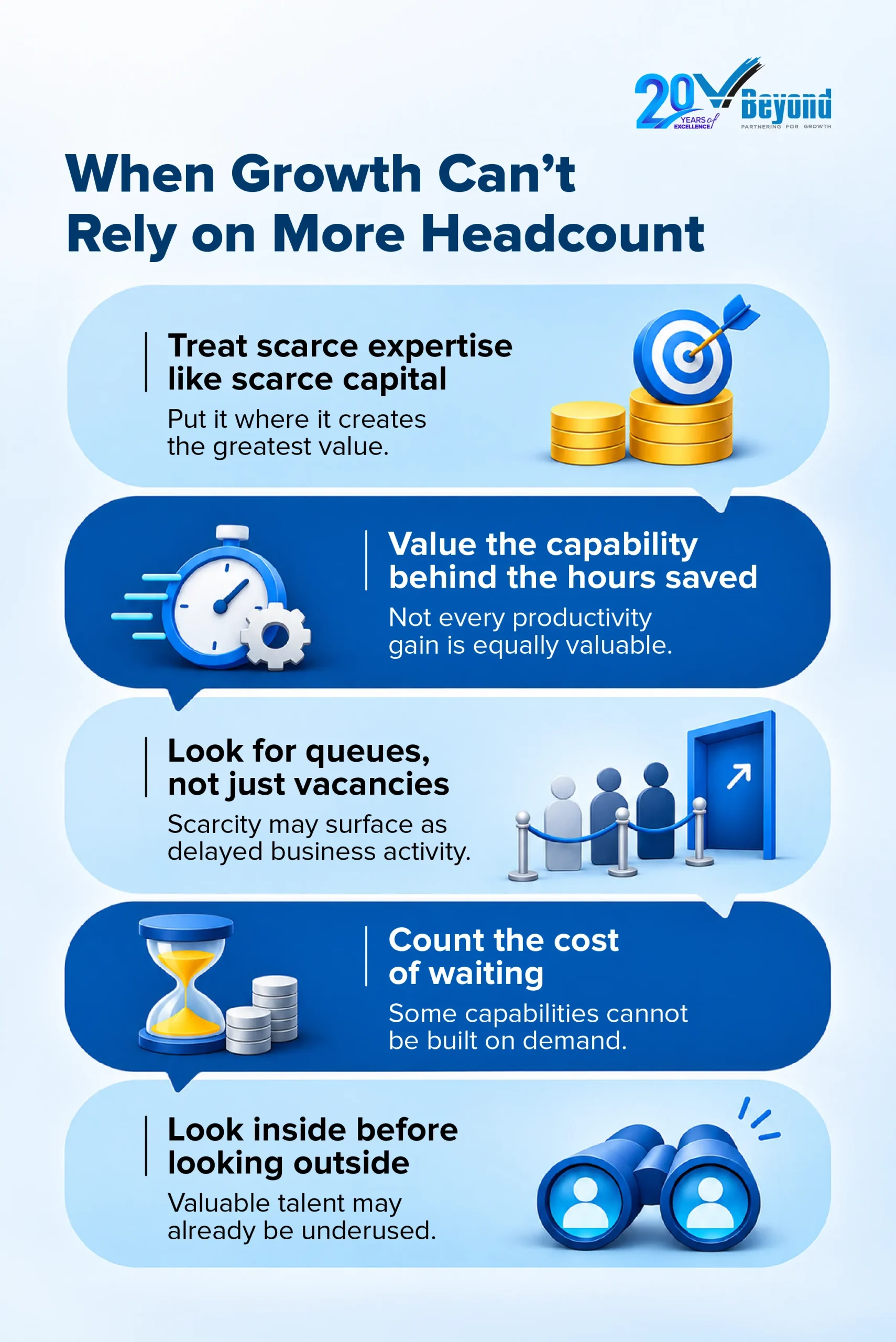
Companies are accustomed to deciding where to allocate scarce capital. They may increasingly need to think the same way about scarce expertise. A scarce talent allocation strategy becomes particularly relevant when a capability is difficult to hire, slow to develop or concentrated among a small number of experienced people, because using it in one part of the business necessarily limits where else it can be used. At that point, talent is no longer simply a resource required to execute a growth decision. It becomes part of the decision about which growth is worth pursuing.
That can change how apparently similar opportunities look. Two new markets, products or customer segments may offer comparable revenue and margins while making very different demands on the organization. One may scale through capabilities the company can readily expand; the other may depend repeatedly on people whose judgment or technical expertise is difficult to replicate. The second opportunity carries an additional cost that conventional forecasts may not make sufficiently visible: it consumes capacity that another opportunity may value more.
Consider a company choosing between two expansion opportunities with similar projected returns. The first can be supported largely through existing infrastructure and capabilities that are relatively easy to add. The second requires sustained involvement from a small group of specialists already supporting the company’s most valuable business. The question is no longer simply whether the second opportunity produces an acceptable return. It is whether that return justifies where the company is choosing to spend a capability it cannot easily replenish. In a tighter labor market, some growth decisions may increasingly resemble capital-allocation decisions—with expertise, rather than money, as the scarce asset.
2. Productivity Gains May Become More Valuable in Some Parts of the Business Than Others
Companies usually pursue productivity where the economics are easiest to see: high-volume processes, large cost bases, repetitive work. But a tighter labor environment introduces another way to value productivity. A productivity gain may be strategically more valuable where it releases a capability that is difficult to replace than where it simply removes the greatest number of hours.
Suppose automating a process in a large administrative function saves 20,000 hours a year, while redesigning work around a small engineering team saves only 5,000. On a conventional efficiency calculation, the first initiative may appear more attractive. But if administrative capacity is relatively easy to add while experienced engineering talent is scarce and already limiting product development, the smaller time saving may create more valuable capacity for the business. The hours are not economically equivalent because the capabilities behind those hours are not equally available.
That changes the way leaders can think about where to invest to improve workforce productivity. The question is no longer only “Where can we save the most time or cost?” It can also be “Which capacity is hardest for us to replace?” As labor becomes more unevenly scarce, the best productivity opportunity may not always be the one that eliminates the most work. It may be the one that gives back the most strategically constrained hour.
3. The Cost of Scarcity May Show Up in Waiting
When a capability becomes scarce, the most visible consequence is often assumed to be higher compensation. For the C-suite, the more consequential cost may be time. A product launch waits for specialist input. An expansion moves more slowly because a critical team cannot support another implementation. Decisions queue behind the few people qualified to make them. None of this necessarily appears as a vacancy, and the company may not even describe itself as short-staffed. Yet growth is being paced by the availability of particular human capabilities.
This matters because waiting behaves differently from an ordinary labor cost. Paying more for scarce talent is visible in the P&L; waiting for scarce expertise can surface elsewhere—as delayed revenue, slower customer response, postponed projects or management attention spent deciding which priority goes first. A business can therefore appear fully staffed while carrying a significant capacity constraint. The real price of scarce talent may be measured less by what the company pays to employ it than by what the rest of the business has to wait to do.
Consider a manufacturer with several expansion projects ready to proceed but only a small group of engineers able to validate the technical changes each requires. Hiring data may show no open positions because the engineering team itself is complete. Compensation may be within budget. Yet projects are being sequenced around when those engineers become available. The constraint is visible only when someone asks why commercially attractive work is waiting. For leaders evaluating talent shortage solutions, that suggests a different way to locate workforce risk: look for the queues around scarce expertise, not only the vacancies for it.
4. Caution Has a Workforce Cost Too
The discussion around uncertainty usually focuses on the risk of committing too early. But there is an opposite risk that becomes more important the longer uncertainty persists: organizations can become very good at postponing commitments. Roles remain unfilled longer, teams stretch a little further, investments wait for greater visibility, and temporary workarounds acquire surprising longevity. Each decision may be entirely rational on its own. Collectively, however, they can leave the business entering its next period of growth with less depth than the organization chart suggests.
The subtle cost is that capability has a gestation period. A person hired today does not instantly acquire the relationships, context and judgment that make them valuable a year from now. Nor can every internal successor be developed at the moment a need becomes urgent. Caution therefore has a time dimension that financial restraint does not always reveal: delaying a talent decision saves commitment today, but it may also delay the point at which that capability becomes fully productive.
Imagine a company that has sensibly postponed adding a layer of experienced commercial talent while demand remains uncertain. Eighteen months later, the market turns faster than expected. The company can reopen the requisitions immediately, but it cannot purchase the eighteen months of organizational context those hires would already have accumulated. The risk was never simply being short of people. It was discovering that some forms of readiness cannot be created on demand.
5. Some of the Scarcest Talent May Already Be Underused
In mid-sized and larger organizations, talent scarcity and talent underuse can exist at the same time. This is particularly easy to miss at senior levels, where people are often hired not simply for a defined set of responsibilities but for the experience, judgment and range they are expected to bring as the business develops. Circumstances, however, do not always develop as expected. Priorities change, investments are reconsidered, growth takes longer, or the mandate around a role becomes narrower. The executive may remain highly valued, yet the organization may no longer have the same opportunity—or immediate need—to draw on the full capability it originally hired.
Neither side necessarily has an obvious decision to make. The organization may see good reason to retain experience it could need again, while being understandably cautious about manufacturing a broader mandate simply to use it. The executive may recognize that the role is not providing the scope originally anticipated, yet see equally good reasons to remain while the business and the wider market find their direction. A perfectly rational holding pattern can emerge. The risk is not simply dissatisfaction or eventual attrition. It is that temporary underuse gradually becomes the accepted definition of what that person can contribute, until both the organization and the executive begin making decisions around a diminished version of the original capability.
There is a broader leadership question here. Organizations tend to notice capability when they need to acquire it and again when they are about to lose it. The period in between receives less scrutiny. Yet in a more uncertain environment, the value of senior talent may depend increasingly on whether the organization can periodically separate the person from the position and ask what experience, judgment and range it actually has at its disposal now. Roles are necessarily defined; capability is rarely so tidy. For a larger organization with room to redeploy experience across businesses, functions or priorities, that distinction matters. In executive talent management, before searching the market for a capability that appears scarce, it may be worth asking whether some of it is already present—just hidden inside a role that no longer reveals its full value.
Conclusion
Perhaps the most useful caution is against averages. A company does not see aging workforce trends, a tighter labor market or productivity growth in the abstract; it experiences them role by role, location by location and capability by capability. A business can have no overall shortage and still have one missing skill slowing an important part of the enterprise, just as it can operate in a supposedly tight market while having little difficulty finding most of the people it needs. As labor-market conditions become more uneven, broad indicators may become less useful as a guide to individual business decisions. The workforce story that matters most may increasingly be the one hidden beneath the average.
Growth may ask more of the workforce, but the answer will not always be more people. Build the mix of talent and capability your business needs next. Partner with VBeyond.
Reference: Where the Data Point Toward Industry Growth – American Staffing Association
FAQs
1. What should a workforce planning strategy prioritize when business growth outpaces labor-force growth?
A workforce planning strategy should identify the capabilities most critical to growth and determine how to secure or expand them. This means looking beyond projected headcount to assess scarce expertise, productivity opportunities, internal talent availability, and the time required to develop new capabilities. The objective is to ensure that workforce constraints do not determine which commercially attractive opportunities the business can pursue.
2. How can CEOs determine where scarce talent should be allocated?
CEOs should evaluate scarce expertise with the same discipline used to allocate capital. Two growth opportunities may offer comparable financial returns but require very different levels of specialist involvement. Where a capability is difficult to replace, leaders should consider its opportunity cost: deploying that expertise in one initiative may prevent the organization from pursuing another with greater strategic value.
3. How can organizations improve workforce productivity without simply reducing headcount?
Organizations can improve workforce productivity by prioritizing investments that release their most constrained capabilities. Automating a high-volume administrative process may save more hours, but redesigning work around a small team of scarce specialists could create greater business value. Productivity initiatives should therefore be evaluated not only by cost or time savings, but also by the strategic importance of the capacity they make available.
4. How can CHROs identify workforce capacity constraints when vacancy rates are low?
Low vacancy rates do not necessarily indicate sufficient workforce capacity. CHROs should examine where projects are delayed, decisions accumulate, or teams must sequence commercially important work around a limited number of specialists. These bottlenecks can reveal a skills gap in the workplace that conventional staffing reports may overlook, even when positions are filled and compensation remains within budget.
5. Why should workforce capacity planning account for the cost of delayed hiring decisions?
Workforce capacity planning must recognize that some capabilities take time to become fully effective. Experienced hires need organizational context, relationships, and judgment that cannot be acquired immediately. Delaying appointments may preserve financial flexibility, but it can also leave a business unprepared when demand returns. Leaders should distinguish between positions that can be filled quickly and capabilities that require longer-term development.
6. How can executive talent management help organizations address skills shortages internally?
Executive talent management should assess the full capabilities of senior leaders, not only the responsibilities attached to their current roles. Changing business priorities can leave experienced executives underutilized even when their expertise remains valuable. Before pursuing external hires, organizations should consider whether existing leaders could contribute across functions, business units, or strategic initiatives where their experience is more urgently needed.