
Table of Contents
Four Key Takeaways
• Applicant volume does not guarantee access to qualified talent. Specialized and business-critical hiring requires relevant expertise, careful assessment, and an understanding of why experienced professionals may hesitate to change employers.
• EVP credibility depends on the employment offer itself. Financial security, working conditions, role responsibilities, and professional development carry different importance across talent groups. Employer commitments must reflect the actual position and opportunities available.
• Candidate experience influences how professionals assess employers. Recruitment interactions provide an early view of organizational practices. Consistent role information, credible assessments, and transparency around AI-led interviews help candidates make informed decisions.
• Strategic staffing partnerships connect talent expertise with hiring requirements. Specialized sourcing, role knowledge, candidate engagement, and recruitment coordination help organizations identify suitable professionals and gain relevant insights throughout the hiring process.
Introduction
An attractive compensation package and a prestigious title do not always persuade experienced professionals to leave established positions. Even compelling opportunities can raise questions about security, expectations, and what a move would require. In a survey of 3,072 employees, Gartner found that 30% said they would prefer to remain with their current employer because of economic volatility, even if offered a better opportunity. The finding reflects the caution some professionals bring to a job change.
That caution matters in specialized appointments where technical expertise and commercial accountability carry significant weight. Professionals assessing these roles may look beyond the job description to examine leadership expectations, decision-making authority, and the resources available to deliver results.
Candidate experience in recruitment can shape how they judge the opportunity. Conversations with recruiters and hiring managers offer an early view of the organization’s working practices. When internal teams work with a strategic staffing partner, specialized recruiters can clarify role demands, communicate employer-approved information, and engage professionals who may not be actively seeking a new position.
The Current Reality: Why Candidate Availability Does Not Resolve Hiring Challenges
High application counts can create a misleading impression of talent availability. Findings from McKinsey’s HR Monitor 2026 show that labor market conditions have become more favorable to employers across its surveyed markets, with improvements in offer acceptance and hiring success. Yet companies may face heavier screening demands as applications accumulate, while lengthy recruitment cycles persist. Greater applicant interest does not necessarily make specialized appointments easier to fill.
The gap between raw candidate volume and role-ready capability becomes apparent during screening. Open job postings may attract broad interest, but positions requiring niche technical skills or deep industry knowledge can produce a much smaller pool of qualified applicants. Reviewing applications that lack essential requirements absorbs recruiter hours without necessarily bringing hiring teams closer to a suitable shortlist.
Employer selectivity and candidate selectivity can therefore coexist. Companies may apply rigorous evaluation criteria when appointments carry significant commercial consequences. Experienced professionals, meanwhile, may scrutinize the responsibilities and working conditions of an unfamiliar position before accepting it. For specialized appointments, understanding what might persuade qualified professionals to consider a move deserves attention early in the search, rather than only when an offer is being discussed.
What Makes an Employee Value Proposition Relevant to Candidates?
A standard employee value proposition often relies on broad cultural claims and generalized perks. In high-scrutiny searches, these claims may offer little guidance to specialists evaluating concrete employment terms. Credibility requires direct alignment between initial representations and day-to-day working realities.
Employment Security and Rewards Are Receiving Greater Attention
Workforce research from Gartner in August 2026 highlights a marked shift toward financial stability. Its survey of 10,055 employees identified stronger preferences for future base pay increases, long-term incentives, and medical benefits that protect against unexpected costs. Economic uncertainty has brought greater attention to financial security within the employment offer.
Total rewards structures cannot apply a uniform template across all talent segments. Priorities may differ according to employment arrangements and professional requirements. Permanent candidates may examine long-term compensation and benefits, while contract professionals may place greater importance on assignment duration, payment terms, and continuity of work. Technical specialists may also consider project responsibilities, available resources, and opportunities to develop relevant skills.
The EVP Must Reflect the Work Being Offered
Discrepancies between advertised positioning and actual working conditions can undermine hiring credibility. Gartner’s January 2026 research highlighted organizations expecting longer working hours and higher performance while offering limited flexibility, without corresponding improvements in compensation or benefits. When advertised flexibility differs from actual work requirements, candidates may question the credibility of the employment proposition.
An effective proposition connects directly to daily responsibilities, reporting lines, and clear performance expectations. In technology searches, commitments to AI-related skill development should be supported by identifiable projects, responsibilities, or training opportunities. Concrete information about the work gives skilled professionals a stronger basis for assessing the opportunity than broad cultural promises alone.
Candidate Experience as a Business Consideration in Recruitment
Candidate experience in recruitment covers every direct and indirect interaction a professional has with an employer throughout the hiring process, from initial outreach to the final hiring decision. Far from being an administrative formality, these interactions offer an early view of how an organization communicates expectations, manages decisions, and engages prospective employees.
Recruitment Interactions Influence How Candidates Assess the EVP
Interviews, technical evaluations, and panel discussions give applicants an opportunity to test the credibility of an employee value proposition. Employer branding materials may present an idealized view of workplace culture, while direct interactions offer insight into how teams approach decisions, address technical questions, and respect professional time.
For specialists considering business-critical positions, discussions about responsibilities, budgets, and reporting lines can reveal whether the authority attached to a role matches its stated expectations. Consistent information from recruiters and hiring managers helps candidates assess the opportunity on realistic terms.
Positive recruitment interactions cannot guarantee long-term retention or job performance, but they can establish a clearer understanding of the position before either party makes a commitment.
AI Is Changing Expectations Around Recruitment Processes
The integration of AI in recruitment introduces additional considerations around assessment transparency. In research published in June 2026, Gartner found that only 30% of 254 candidates surveyed in the third quarter of 2025 were open to AI-led interviews. Just 31% reported being informed in advance that they would participate in one.
An important distinction exists between administrative automation and AI-led assessment. Automated scheduling can simplify interview coordination, while AI-led interviews raise questions about how responses are evaluated and where human judgment enters the process.
These findings concern AI-led interviews specifically. Explaining assessment methods beforehand and providing access to clarification can help candidates understand the process without limiting the practical benefits of recruitment technology.
Why Candidate Experience Deserves Business Attention
Unclear role specifications, uncoordinated interviews, and prolonged silence can introduce unnecessary uncertainty into recruitment. For senior professionals considering significant career moves, procedural ambiguity may raise questions about how the organization manages responsibilities and decisions.
When several qualified candidates withdraw after a particular interview stage or raise similar concerns about assessment requirements, talent acquisition leaders have reason to examine the process more closely. Such patterns do not establish why candidates withdrew, but they can reveal areas that warrant further investigation.
Addressing substantiated concerns helps organizations maintain a more consistent recruitment experience while keeping suitable candidates engaged throughout business-critical searches.
Discuss Specialized Hiring Needs with VBeyond Corporation
Discuss Specialized Hiring Needs with VBeyond Corporation
The Strategic Partnership Opportunity: Connecting EVP, Candidate Experience, and Hiring Needs
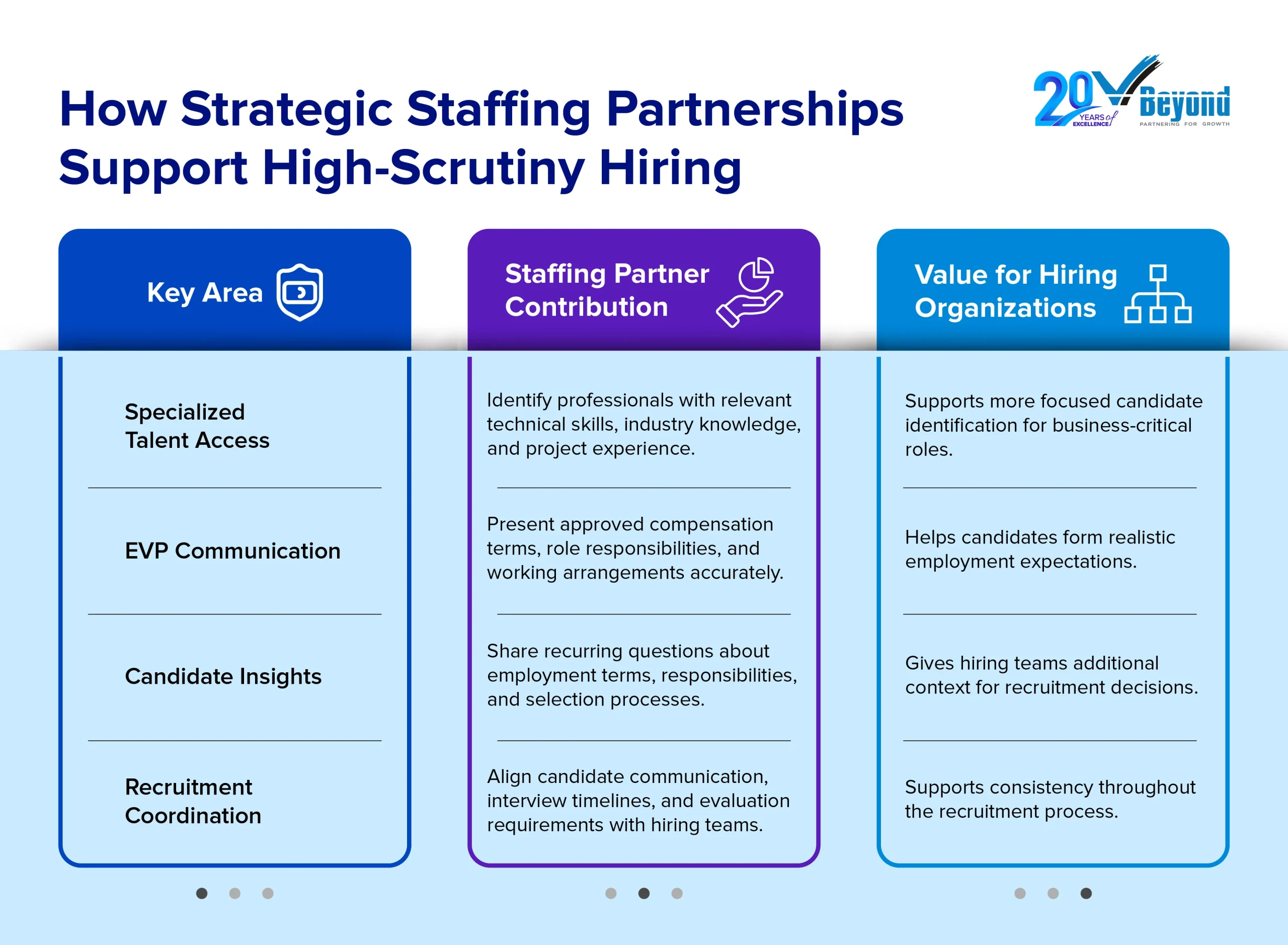
Connecting organizational employment terms with candidate expectations requires coordination between hiring teams and external recruiters. In specialized hiring, staffing partnerships bring together technical role knowledge, access to relevant professionals, and insights from recruitment conversations that can inform hiring decisions.
Specialized Talent Access and Role Understanding
Specialized recruiters maintain networks across industries and technical disciplines. For critical engineering, data, and functional appointments, candidates with similar titles may bring significantly different experience. A strategic staffing partner can assess qualifications against specific business requirements, examine relevant project experience, and engage professionals who may not be actively seeking new positions.
Accurate representation of role responsibilities and employment conditions helps candidates assess opportunities on realistic terms. When staffing specialists communicate approved compensation parameters, project expectations, and working arrangements during initial discussions, professionals gain a clearer understanding of the position before formal interviews begin.
Candidate Engagement Provides Additional Hiring Insight
Direct recruiter interactions can reveal considerations that application records alone may not capture. Experienced professionals may raise questions about reporting structures, compensation competitiveness, or workload expectations while discussing the suitability of an opportunity.
These conversations help distinguish feedback on the employee value proposition from concerns about the selection process. Questions regarding compensation structures or performance expectations indicate which employment terms candidates are examining closely. Remarks about evaluation timelines or assessment formats may point to aspects of recruitment that warrant attention.
Individual reactions cannot establish broader talent-market trends. However, recurring observations can provide talent acquisition leaders with useful context when reviewing role requirements, candidate expectations, and recruitment procedures.
Collaboration Supports a More Consistent Recruitment Experience
A cohesive recruitment strategy requires clear coordination between client teams and external recruiters. Agreed job descriptions, interview timelines, and evaluation criteria provide a consistent basis for communicating opportunities and assessing candidates. Defined responsibilities also help both parties address questions or changes during an active search.
This coordination differs across hiring structures. Permanent placement generally focuses on employer-defined vacancies and candidate selection. Contract staffing may involve additional responsibilities concerning assignment terms, employment arrangements, and applicable compliance requirements. Recruitment Process Outsourcing (RPO) can cover selected recruitment activities or a broader hiring process, depending on the agreed service scope.
VBeyond Corporation’s Tech Staffing and Recruitment Process Outsourcing services support specialized sourcing, candidate assessment, and recruitment coordination. These capabilities connect employers with relevant talent while supporting the communication and collaboration needed throughout the hiring process.
(The quality of a recruitment experience also depends on how candidates are engaged at each stage of hiring. Clear job descriptions, structured interviews, and relevant feedback help candidates understand the opportunity and make informed decisions. For a closer look at these practices, read our blog: The Importance of Candidate Experience in Recruitment Success.)
Actionable Takeaways for Talent Leaders
Hiring effectiveness in high-scrutiny searches draws on three connected disciplines: aligning the employee value proposition with actual role requirements, treating candidate experience in recruitment as an early reflection of organizational practices, and engaging a strategic staffing partner when specialized appointments require focused talent access.
Competitive advantage depends on how these elements work together rather than as isolated initiatives. Clear employment terms help candidates assess opportunities, while well-managed recruitment interactions provide a more reliable understanding of the position. Specialized staffing expertise can support employers in reaching and engaging suitable professionals.
Long-term employee retention strategies depend on conditions extending beyond recruitment, including management practices, career progression, and the resources available after joining. A rigorous recruitment strategy can establish realistic expectations from the outset, although it cannot guarantee subsequent retention.
Organizations managing complex hiring requirements can connect with VBeyond Corporation to discuss specialized sourcing, candidate assessment, and recruitment support.
FAQs
1. What is candidate experience in recruitment?
Candidate experience in recruitment refers to how applicants perceive their interactions with an employer and its recruitment partners, from initial contact through assessments, interviews, and hiring decisions. It reflects the clarity of information, communication, and treatment candidates receive throughout the process.
2. Why is candidate experience important in recruitment?
Candidate experience matters because recruitment interactions help professionals judge whether an employer’s stated commitments match the opportunity being offered. Clear expectations and credible assessments support informed hiring decisions and can influence whether suitable candidates remain interested in a position.
3. How can companies improve candidate experience in recruitment?
Companies can improve candidate experience by providing accurate role information, explaining assessment methods, coordinating interviews, and communicating changes promptly. Hiring teams and staffing partners can also review recurring candidate concerns to identify where recruitment procedures or communication require attention.
4. How does employee value proposition affect candidate experience?
An employee value proposition describes what an employer offers in return for employees’ contributions. Candidate experience brings those promises into focus, as interviews and recruitment discussions reveal whether responsibilities, working conditions, and development opportunities align with the employment proposition.
5. How is AI changing candidate experience in recruitment?
AI can support recruitment administration, while AI-led interviews introduce questions about assessment methods, transparency, and human involvement. Employers can address these concerns by explaining when AI is used in evaluations, clarifying assessment requirements, and providing opportunities for candidates to ask questions.