
Table of Contents
Four Key Takeaways
• FDE hiring becomes less precise when recruiters rely too heavily on the title. Comparable experience can sit across software engineering, solutions engineering, implementation, and other customer-facing technical roles.
• The mandate should define the search. Production ownership, integration responsibility, customer involvement, and post-launch accountability determine which capabilities are genuinely required.
• Adjacent roles expand the candidate pool, but titles do not prove fit. Relevant project history, technical responsibility, and direct implementation experience provide stronger evidence than job labels alone.
• Assessment needs to mirror the operating reality of the role. Hiring teams should examine engineering judgment, work under incomplete requirements, and ownership in customer environments as connected parts of the same responsibility.
As more AI work is moving from pilots into production, companies are placing greater value on engineers who can work across software development, implementation, and customer environments. Forward-deployed engineering is gaining attention within that shift. PwC’s 2026 Global AI Jobs Barometer shows that jobs requiring specific AI skills are growing 69%, compared with 9% for the overall jobs market.
This technical role demands an uncommon capability combination. An effective practitioner writes production software, manages complex systems integration, resolves live operational constraints, and works directly with client business leadership.
Yet fast market expansion has outpaced labor market maturation. A standardized talent pool carrying the forward-deployed title does not exist. Candidates capable of executing this work often perform comparable duties under different titles, including software engineering, solutions engineering, technical consulting, and systems implementation.
For hiring teams, bridging this recruitment gap requires four deliberate operational choices: defining the exact engineering mandate, identifying talent across adjacent candidate pools, testing technical judgment within a live customer context, and establishing clear search parameters before candidate outreach begins.
Why the FDE Profile Breaks Conventional Tech Recruiting Categories
Standard recruitment frameworks organize candidates into separate job families with isolated evaluation metrics. Traditional software engineers build core application features inside internal codebases. Solutions engineers deliver pre-sales technical demonstrations. Implementation specialists configure packaged software, while customer engineering teams handle post-release accounts. Forward-deployed engineer hiring breaks this corporate taxonomy because the role merges responsibilities that organizations deliberately divide across disconnected departments.
In daily operations, the position places a software engineer directly inside external client environments. Rather than handing off architectural designs or passing customer tickets to an internal product group, forward-deployed engineers write code that connects directly to client infrastructure. They diagnose data discrepancies, build custom connectors, and resolve integration defects on live systems.
Simultaneously, the role demands the commercial presence expected of client partners. These engineers lead architectural discussions with client executives, interpret ambiguous operational goals, and translate commercial requests into technical specifications. They defend engineering standards during technical negotiations without alienating customer stakeholders.
This cross-functional mandate creates a structural classification breakdown. Traditional applicant tracking pipelines screen resumes for specific historical titles rather than composite engineering capabilities. Resume filters frequently reject software engineers who manage client relationships because their histories lack consulting labels. Similarly, these filters reject technical consultants who write complex code because their backgrounds do not match traditional software development tracks.
The primary recruitment challenge develops as a profile-classification failure rather than an absolute talent shortage. Sourcing candidates solely against the forward-deployed title filters out capable engineers who execute production programming and client-facing problem solving under alternative designations.
Define Specialized Tech Hiring Needs with VBeyond Corporation
Define Specialized Tech Hiring Needs with VBeyond Corporation
Does the Business Need an FDE or a Different Technical Role
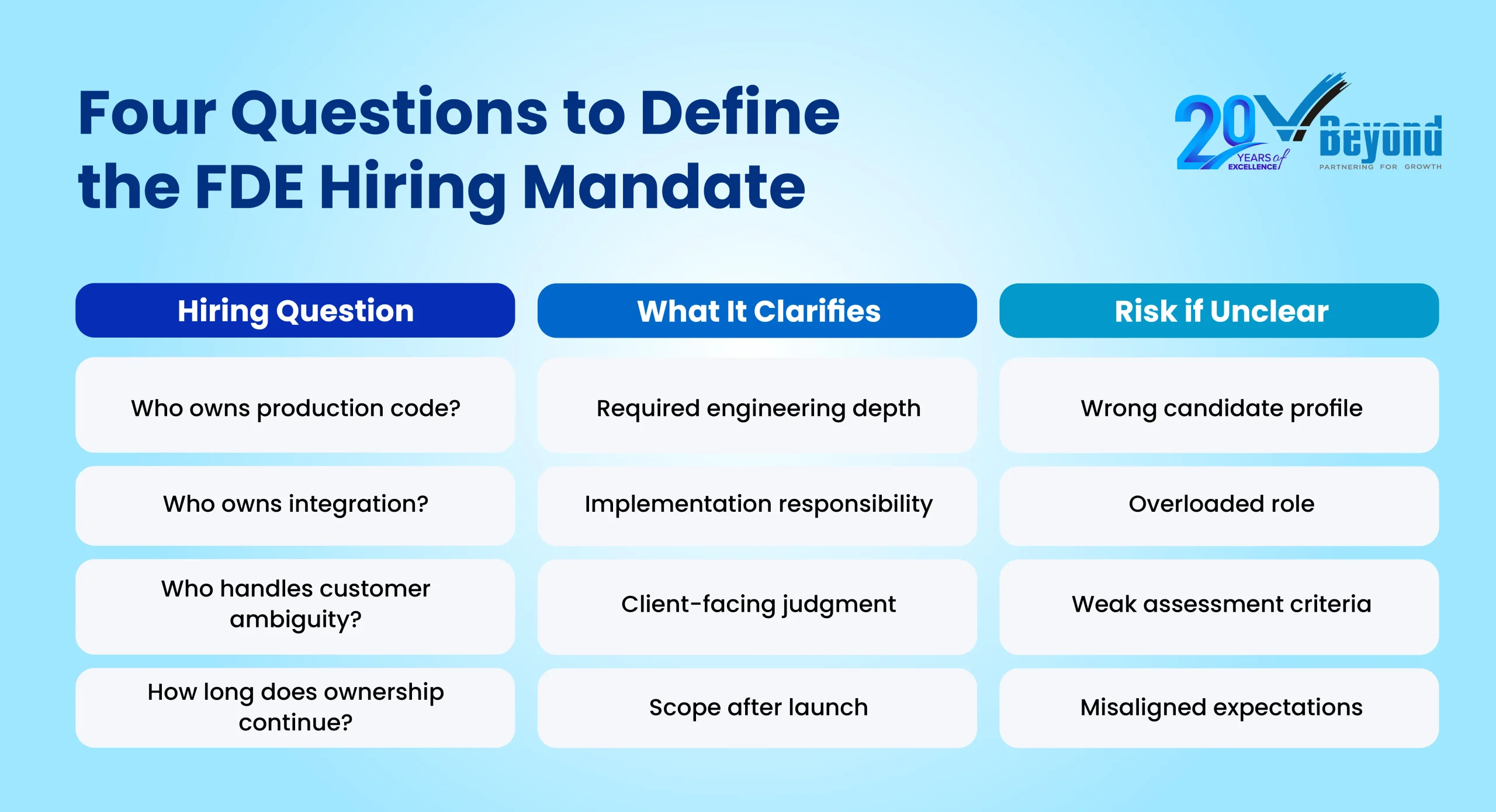
Before candidate outreach begins, leadership teams must resolve one central question: What work does the business actually need someone to own?
Job titles across enterprise technology overlap, but underlying day-to-day responsibilities differ significantly. Evaluating a forward-deployed engineer vs AI engineer vs solutions engineer clarifies these functional boundaries and prevents expensive hiring mistakes.
An applied AI engineer focuses internally on training models, adjusting algorithms, evaluating prompts, and building data pipelines inside the company’s proprietary environment. This specialist rarely meets external customers or manages bespoke enterprise integrations.
A solutions engineer operates primarily during the pre-sales cycle. This professional explains platform capabilities, constructs proof-of-concept demonstrations, and answers technical questionnaires. Once a contract closes, the solutions engineer transfers the client account to delivery teams.
An implementation engineer handles post-sales integration by configuring existing software packages, connecting standard interfaces, and establishing data connections. This specialist rarely modifies source code or builds custom infrastructure to resolve novel computational challenges.
A forward-deployed engineer assumes complete technical ownership inside customer systems. This professional writes production-grade code, builds custom integration layers, resolves pipeline failures, and remains accountable for system performance after launch.
Hiring managers divide job expectations into three distinct groups:
- Essential: Direct ownership of production code, complex systems integration, live debugging under operational constraints, and technical communication with external executives.
- Useful: Familiarity with specific industry workflows, regional compliance standards, or particular database types that an engineer picks up quickly through active project exposure.
- Unnecessary: Demands for advanced theoretical research degrees, academic publications, or extensive corporate management backgrounds that do not reflect daily operational requirements.
Not every technical project requires an FDE title. When an organization only seeks software demonstrations, a forward-deployed engineer vs solutions engineer assessment reveals that solutions engineering suffices. If the priority centers on internal model training, AI engineer hiring is the proper path. Defining the actual operational mandate prevents organizations from creating bloated job requirements that prolong the recruitment process.
Where Forward-Deployed Engineer Candidates Are Actually Likely to Come From
Sourcing strategies centered only on exact job titles can narrow the candidate pool in newer enterprise technology roles. Because responsibilities are often distributed across several technical job families, hiring organizations need to identify where to find forward-deployed engineer candidates by looking at functional capabilities as well as historical resume labels. Relevant candidates are often found in engineering backgrounds where software development overlaps with direct customer delivery.
Search for the Work, Not Only the FDE Title
Building a viable talent pipeline requires identifying where technical professionals already solve customer problems through direct programming. Recruiting teams track candidates across adjacent roles for forward-deployed engineer hiring. Effective sourcing focuses on tangible operating history: writing production-grade code, integrating software into complex enterprise data environments, diagnosing ambiguous technical requirements, making practical trade-offs, and maintaining technical accountability through live system launch rather than handing tasks off to secondary maintenance teams.
This combination of abilities appears across several distinct technical backgrounds:
- Software and product engineers who work in early-stage startups or customer-facing engineering teams where developers manage client integrations directly.
- Applied AI engineers who connect models directly to operational enterprise workflows and live databases.
- Solutions engineers and field engineers who retain active daily programming responsibilities alongside technical client consultations.
- Implementation specialists and technical consultants who write custom software rather than configuring pre-built packages.
- Infrastructure and site reliability engineers who spend substantial time embedded inside partner technical teams during platform launches.
Adjacent titles are useful search starting points, not proof of capability. Sourcing teams still need to examine the depth of each candidate’s experience. A solutions engineer with limited production responsibility may not meet the engineering requirements of the role. A back-end engineer with little customer-facing implementation experience may also lack evidence in an area central to the mandate.
Forward Deployed Engineer recruitment therefore depends on verified project experience rather than title matching alone. The strongest profiles show repeated evidence of technical execution, customer interaction, and responsibility through implementation.
What Should Hiring Teams Test in an FDE Candidate
Technical evaluation often separates programming, system design, and behavioral assessment into different interview stages. For FDE candidate assessment, that structure can leave gaps because the role can require technical execution, customer communication, and operational judgment within the same piece of work. When considering how to hire a forward-deployed engineer, the evaluation process needs to show how a candidate handles those demands together.
Production Engineering Judgment
Candidates need to demonstrate sound engineering decisions under realistic operating constraints. Rather than relying only on abstract algorithmic exercises, assessments can include systems integration scenarios involving APIs, debugging, reliability, security, and production constraints.
Evaluators can ask candidates to examine an existing architecture, identify likely failure points, and explain how particular design choices would affect reliability or maintainability. The objective is to establish whether the candidate can make practical engineering decisions and carry technical responsibility beyond an initial prototype.
Problem Solving Under Ambiguity
FDE work can begin with incomplete or changing requirements. When considering what to test in a forward-deployed engineer interview, hiring teams can introduce a business problem that does not arrive as a fully formed technical specification.
The discussion should show how the candidate identifies the main technical requirement, separates essential needs from optional requests, questions weak assumptions, and decides what can realistically be delivered. Core Forward Deployed Engineer skills include turning an unclear requirement into a workable technical plan without losing sight of system constraints.
Technical Ownership in a Customer Environment
The evaluation process also needs to establish how much technical responsibility the candidate has carried in customer-facing work. Relevant evidence includes direct collaboration with customer engineering teams, communication of technical constraints, integration responsibility, and continued involvement through implementation.
A realistic case can show how the candidate handles technical disagreement, explains trade-offs, and proposes an alternative when a requested approach creates engineering risk. The assessment should distinguish genuine delivery ownership from experience that has been primarily advisory or pre-sales.
The central assessment principle remains simple: test whether the candidate can move from an unclear customer problem to technical judgment, implementation, and production responsibility as one connected piece of work.
Define the Search Constraints Before FDE Outreach Begins
Before initiating outreach, hiring teams need to define the operating conditions attached to the role. Two organizations can use the same title for positions with different expectations. One may require deep production software development and regular customer interaction. Another may place greater weight on technical consultation, implementation coordination, or travel.
Leadership teams need clear answers when deciding how to write a forward-deployed engineer job requirement:
- What proportion of the role involves active software development versus customer-facing work?
- Does client implementation require regular travel or on-site presence?
- Does the engineer retain technical responsibility through production, or hand the system to another team after implementation?
- How much influence does the role have over internal product or model development?
- Which technical systems, data environments, or infrastructure will the hire need to work with?
- Is industry knowledge essential to the role, or can it be developed after hiring?
These conditions affect which candidates are realistic targets and how the role should be positioned in the market.
They also matter for forward-deployed engineer compensation benchmarking. A role that requires deep engineering work, substantial customer responsibility, frequent travel, and production ownership can compete for a different talent pool from one that sits closer to solutions engineering or technical consulting.
Once the mandate and working conditions are clear, the interview process should remain focused. Repeating the same technical or behavioral checks across several stages adds time without producing much new evidence.
(FDE hiring is part of the broader competition for AI and engineering talent. Read our blog: The AI Talent Hiring Arms Race: Integrating Advanced Tools in Your Recruitment Strategy, that provides more context on the pressures shaping AI recruitment and technical hiring.)
Conclusion
Forward-deployed engineer hiring depends on how clearly the role is defined. The title alone does not tell recruiters enough about engineering depth, customer responsibility, or ownership through implementation. Candidate evidence needs to show how the person has handled those demands in practice, and assessment should test the same conditions.
Clear ownership, relevant project history, and realistic working conditions make it easier to identify suitable candidates across adjacent technical backgrounds. The search stays focused on the work the role requires rather than on a narrow title match.
If your organization is hiring for a specialized technical role with complex skill requirements, connect with VBeyond Corporation to clarify role requirements, identify relevant candidates, and run a focused tech staffing search.
FAQs
1. What makes forward-deployed engineer hiring so difficult?
The role combines production engineering, implementation, customer interaction, and problem solving. Relevant experience is often spread across different job titles, making title-based sourcing and standard technical assessments less reliable.
2. Where should companies look for forward-deployed engineer candidates if the exact title is rare?
Relevant candidates may come from software engineering, applied AI, solutions engineering, implementation, technical consulting, customer engineering, or infrastructure roles where past work shows coding depth, integration responsibility, and direct customer involvement.
3. How is a forward-deployed engineer different from a solutions engineer or AI engineer
The distinction depends on the mandate. FDE roles often combine hands-on engineering with customer implementation, while solutions engineering may emphasize technical discovery and AI engineering may focus more heavily on building AI systems.
4. What should hiring teams test for in an FDE interview?
Assessment should examine production engineering judgment, problem solving under incomplete requirements, systems integration, technical trade-offs, customer communication, and evidence that the candidate has retained responsibility through implementation.
5. How can companies compete for FDE talent without matching top AI-company compensation?
Companies can compete through meaningful technical ownership, clear role scope, strong product influence, challenging implementation work, and a focused hiring process. Compensation still needs to remain credible for the specific candidate pool being targeted.