Four Key Takeaways
• A credible tech portfolio no longer carries the same hiring weight it once did, as AI makes professional outputs easier to produce.
• Five signals, including business value, human-AI transparency, workflow contribution, enterprise readiness, and adaptability, define what a credible tech portfolio in 2026 looks like.
• These signals are not new to hiring, but are likely to carry more decision-making weight as application volumes rise, and AI use becomes standard.
• Recruiters, HR leaders, and executives each bring different priorities to portfolio evaluation, and a structured approach to each signal may lead to faster, more reliable hiring decisions.
Why “Credible” Matters More Than “Impressive”
Hiring teams are not short of applications. They are short of confidence in what those applications actually show.
The tools that produce professional-looking portfolios are accessible to everyone. AI-assisted write-ups, auto-generated case studies, and polished presentation templates have made a strong-looking portfolio the floor, not the ceiling. McKinsey’s 2025 State of AI survey found that 88% of organizations now use AI in at least one business function, yet only 1% describe their rollout as fully mature.
Candidates are presenting AI-assisted work to organizations still figuring out how to evaluate it. That gap puts the burden of verification squarely on hiring teams.
The question hiring teams are increasingly asking is not “Does this look good?”. It is “What does this actually prove?”
Work itself has been changing. AI tools, cross-functional workflows, governance requirements, and human-agent collaboration are becoming standard parts of how technical work gets done. Deloitte’s 2026 Global Human Capital Trends research suggests that the workforce traits organizations are prioritizing are speed, orchestration, and adaptability, not technical output alone.
A credible tech portfolio in 2026 will need to reflect that operating reality, not just present a cleaned-up record of completed projects.
This blog examines what may separate a credible tech portfolio from one that merely looks the part. It covers five signals worth evaluating; how portfolio expectations could expand beyond 2026; and what recruiters, HR leaders, and executives might act on now to make sharper, faster hiring decisions.
Portfolio Credibility is Evolving, Not Being Replaced
The foundational elements of a strong portfolio have not changed. Clarity of work, proof of skill, and quality of output still matter. What appears to be shifting is the scope of what credibility needs to cover as work becomes more complex and AI-assisted.
Outcome-oriented portfolios, transparent AI use, and workflow thinking are not new concepts in hiring. What is changing is the weight they are likely to carry going forward. McKinsey’s research on people-agent-robot collaboration suggests that as AI takes on more execution, the ability to redesign workflows and exercise judgment may become the primary source of professional value. Portfolios that reflect these capabilities could prove more useful to hiring teams than those that simply document completed work.
Deloitte’s 2026 Global Human Capital Trends survey found that seven in ten business leaders say their primary competitive strategy over the next three years is to be fast and adaptable. The two most important drivers they identified are accelerating how people and resources are orchestrated, and increasing the workforce’s ability to adapt to change. As these priorities shape hiring decisions, portfolios that go beyond finished outputs may carry stronger signal.
Hire adaptable tech talent today with VBeyond Corporation.
The Five Signals that Define a Credible Tech Portfolio in 2026
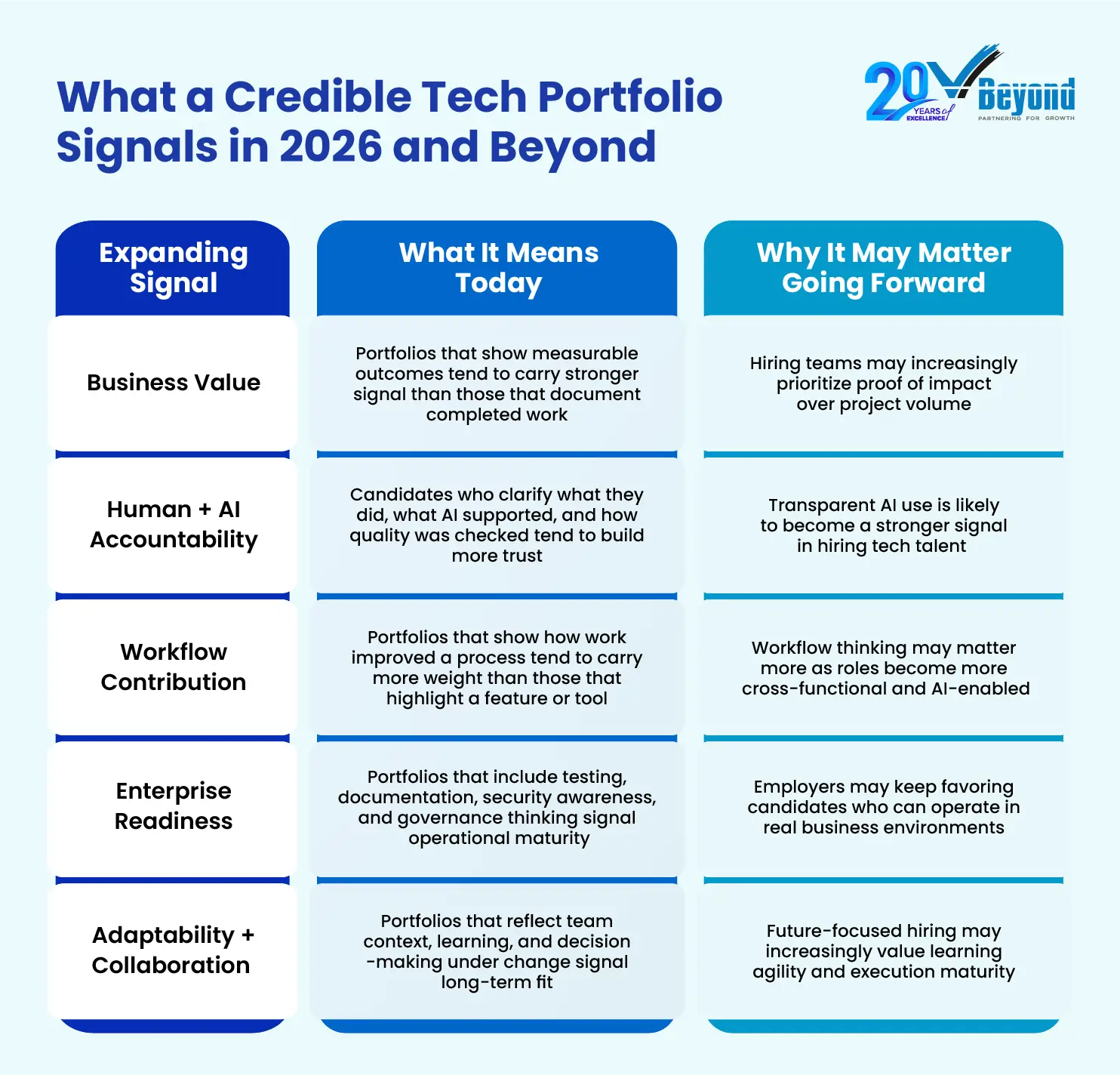
These signals are not new to hiring. Outcome evidence, collaboration, and professional maturity have always mattered. What is becoming clearer is that as AI raises application volumes and lowers the barrier to producing polished work, these signals are likely to carry more decision-making weight than before. The five signals below outline what a credible tech portfolio in 2026 may consistently need to demonstrate.
1. Business Value Signal: What Changed Because of the Work?
Outcome-oriented hiring is becoming a stronger filter. As project volume increases and AI makes execution faster, the ability to show what actually changed because of the work is what may separate a credible tech portfolio from a busy one.
The business value indicators that tend to carry weight in hiring include:
- Operational outcomes: Efficiency gained, cycle time improved, or defect rate lowered as a direct result of the work.
- Financial consequence: Cost avoided, revenue protected, or resource waste reduced through a specific intervention.
- Adoption and usage change: Whether a product, feature, or system was actually used differently after the work shipped.
- Risk reduction: Whether a process, system, or decision became more reliable, secure, or compliant because of the work.
- Proxy evidence: Where precise numbers are confidential, scale, process improvement, or a documented operational shift may still hold credibility.
Strong portfolios explain what the problem cost the organization before the work, what changed because of the intervention, and how that change was measured or observed. Activity is not evidence. A smaller project with a clear operational consequence is likely to be more credible than a larger project with no measurable impact.
2. Human–AI Transparency Signal: Who Did What, and How was Quality Controlled?
Transparency in AI use has been a growing expectation in professional work. In hiring tech talent going forward, it is likely to become a more direct signal of capability and judgment.
BCG’s research on AI transformation suggests that governance, guardrails, and workforce fluency are foundational requirements for scaling AI responsibly, and that standard appears to be extending to how individual candidates present their work.
The human-AI accountability markers most worth looking for in portfolios include:
- AI scope clarity: Which parts of the work AI supported and which parts the candidate owned and executed directly.
- Judgment boundaries: Where the candidate made decisions that AI could not, particularly around ambiguity, ethics, or stakeholder context.
- Quality verification: How outputs were reviewed for accuracy, bias, hallucination risk, or compliance before being acted on.
- Iteration and correction: What changed after testing, review, or feedback, and how the candidate responded to AI limitations.
- Governance awareness: Whether the candidate considered data privacy, access controls, or auditability as part of how AI was applied.
Strong portfolios explain what the AI contributed, what the candidate contributed, and what would have broken without human oversight. An AI portfolio that demonstrates human-AI collaboration with accountability is likely to signal far more capability than a polished output with no attribution.
3. Workflow Signal: Can this Person Improve How Work Actually Moves?
Workflow thinking has always distinguished strong technical professionals from those who only execute tasks. What appears to be amplifying its importance is scale. McKinsey’s 2025 State of AI research suggests that workflow redesign correlates more strongly with bottom-line impact than data quality, model performance, or headcount alone.
As AI becomes a more standard part of execution, the ability to improve how work moves may remain one of the harder things to replicate or automate.
Workflow contributions worth looking for in a strong portfolio include:
- Process improvement: Whether the candidate reduced handoffs, removed bottlenecks, or accelerated a recurring process that affected multiple teams.
- Decision clarity: Whether the work made a decision point faster, cleaner, or less dependent on manual intervention.
- Quality at scale: Whether testing, review, or validation improved across a workflow rather than just within one task.
- Cross-functional impact: Whether the change improved how downstream teams received, used, or built on the output.
- Reduced repetition: Whether the candidate identified and removed work that was being done manually and repeatedly without adding value.
Strong portfolios explain where the candidate found the friction, what was changed, who was affected, and what the process looked like after. A feature is not the full story. Hiring teams may increasingly want to know where that feature sits within a workflow, and what changed because of it.
4. Enterprise Trust Signal: Is This Work Ready For Real Operating Conditions?
Enterprise readiness has always been part of what separates a junior portfolio from a senior one. Testing, documentation, and security awareness are not new requirements. What appears to be raising their profile is the shift organizations are making from AI experimentation toward scaled, governed deployment.
BCG’s recent research suggests that strong governance and guardrails around AI build workforce-wide trust, and that intentional oversight through structured practices materially reduces risk as AI use scales.
A portfolio that signals enterprise readiness might show:
- Testing discipline: Whether the candidate built verification into the work as a structural part of delivery, not as an afterthought.
- Documentation quality: Whether the work was handed off in a state others could maintain, extend, or audit without reverse-engineering decisions.
- Security and access thinking: Whether data handling, permissions, and exposure risks were considered during design.
- Reliability and failure planning: Whether the candidate considered what happens when the system does not behave as expected, including rollback logic or escalation paths.
- Governance awareness: Whether the work accounted for compliance requirements, audit trails, or organizational risk standards relevant to the context.
Strong portfolios explain what could have gone wrong, what was put in place to prevent it, and how the work was designed to hold up under real operating pressure. Enterprise credibility is often found in what did not go wrong because the right checks were in place.
5. Adaptability and Collaboration Signal: Can This Person Grow with the Work?
Collaboration and learning agility have always been valued in technical hiring. What is making them more visible going forward is the pace at which roles are changing.
Deloitte’s Global Human Capital Trends research suggests that over 90% of executives now rate soft skills as a priority for their workforce, even in highly technical roles. As roles keep shifting, portfolios that show how a candidate grows with the work may carry increasing weight in hiring tech talent.
The soft skills that are worth assessing in tech roles include:
- Critical thinking and problem-solving: How the candidate framed ambiguous problems and chose between competing solutions.
- Communication and stakeholder clarity: Whether technical decisions were explained in terms non-technical partners could act on.
- Accountability: How the candidate owned outcomes, including failures and course corrections.
- Empathy and user-centred thinking: Whether product or system decisions reflected an understanding of who the work was built for.
- Adaptability and willingness to learn: How quickly the candidate adjusted when conditions, requirements, or tools changed.
Strong portfolios explain what the candidate owned, who else was involved, what constraints and trade-offs shaped key decisions, and what was learned along the way.
What Recruiters, HR Leaders, and Executives Should Look for Now
As hiring processes become more AI-assisted and application volumes keep rising, the ability to evaluate a credible tech portfolio with clarity and structure may become one of the more consequential skills a hiring team can develop. The five signals above are not abstract criteria. Below is how recruiters, HR leaders, and executives might each apply them in a real portfolio review session, along with a practical checklist to guide the conversation.
For recruiters: The portfolio can serve as a way to validate signal quality beyond résumé keywords and AI-polished applications. As AI handles more early-stage screening, the portfolio may become a more reliable test of whether a candidate’s claimed skills hold up under scrutiny. The focus should be on outcome evidence, not tool lists.
For HR leaders: Portfolios may work well as evidence in a skills-based assessment approach, particularly where formal credentials do not fully capture capability. With a growing number of employers prioritizing demonstrated skills over degrees in hiring tech talent, a structured portfolio review could give talent teams a more reliable basis for evaluating fit.
For executives and hiring managers: The portfolio can be a useful lens for judging whether a candidate can operate within modern work design, not just produce isolated deliverables. The question worth asking is not only “can this person do the job today?” but “how well will this person function as roles keep shifting?”
A practical review checklist:
- What did the candidate actually own, and what did AI support?
- What business problem was solved, and what outcome moved?
- How was quality checked and what constraints shaped the decisions?
- What does the work suggest about workflow and systems thinking?
- What does this tech portfolio suggest about future readiness?
Not every portfolio will answer all five questions cleanly, and that gap itself is informative. A candidate who can articulate partial answers with clarity and honesty often signals more professional maturity than one who presents polished responses without substance. The goal of portfolio evaluation is not to find perfection. It is to find signal worth trusting.
As AI becomes part of everyday work, hiring teams are reassessing what credible candidate proof looks like. (For a related perspective, read our blog The Rise of the “AI-Augmented Worker”: Future of Professional Hiring).
Conclusion: The Credible Portfolio as a Forward-fit Signal
A credible tech portfolio in 2026 is a signal of how someone thinks, delivers, collaborates, and uses AI with accountability.
The employers best positioned to be hiring tech talent may be those who use portfolios to assess not only present capability, but future fit. As proof of work continues to replace proof of credentials, hiring teams that evaluate portfolios with a structured lens are likely to make faster, more reliable decisions.
Portfolio credibility will likely keep expanding as work itself keeps changing. The best tech portfolio examples may come to answer two questions at once: What has this person done well? And how ready are they for where work is going next?
If portfolio credibility is becoming a sharper hiring filter, partner with VBeyond Corporation tech talent for high-impact roles across engineering, cloud, data, and cybersecurity.
FAQs
1. What should a tech portfolio include in 2026?
A tech portfolio in 2026 should go beyond a list of completed projects. It should show the business problem addressed, the candidate’s direct contribution, how AI was used and quality was controlled, and what measurably changed because of the work. Evidence of workflow thinking, enterprise readiness, and adaptability under changing conditions may carry increasing weight alongside technical outputs.
2. What are the best tech portfolio examples for developers?
The strongest tech portfolio examples are those that show clear outcome arcs: what the problem was, what the developer owned, and what shifted operationally or measurably after the work shipped. Portfolios that explain workflow improvements, document testing and governance decisions, and attribute AI use transparently tend to stand out more than those that simply showcase tools or technologies used.
3. Why are tech portfolio examples important for job applications?
As AI makes polished applications easier to produce, a well-structured tech portfolio may become one of the more reliable ways for hiring teams to verify what a candidate actually owns and delivers. It moves the evaluation beyond résumé keywords toward real evidence of capability, judgment, and professional maturity, particularly in roles where AI fluency and cross-functional execution are expected.
4. How do recruiters evaluate a developer portfolio?
Recruiters are increasingly looking for signal quality over project volume. A developer portfolio is most useful when it shows outcome evidence, clarifies the candidate’s direct ownership, explains how AI was used and checked, and reflects an understanding of how the work fits into a broader workflow or business context. Portfolios that answer these questions clearly tend to reduce hiring uncertainty faster.
5. What makes a developer portfolio credible in 2026?
Credibility in a developer portfolio comes from specificity, accountability, and operational consequence. A portfolio that shows what changed because of the work, how AI was used responsibly, what constraints shaped key decisions, and how the candidate grew through the work is likely to build more trust with hiring teams than one that relies on visual polish or project volume alone.